

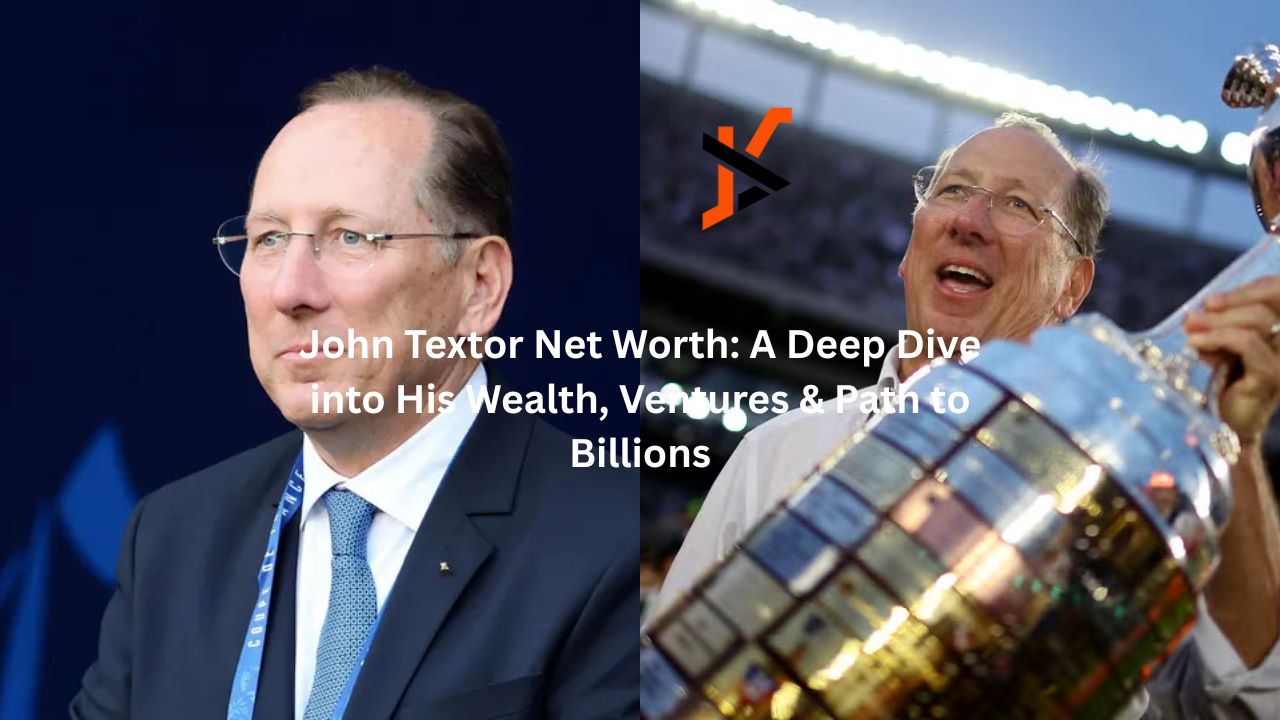
When you hear the name John Textor, one image comes to mind: the entrepreneur-turned-football‑club mogul whose business moves are bold, sometimes controversial, and always full of ambition. If you’re wondering what his net worth is, how he made his money, and what his future looks like—you’re in the right place. In plain English, I’ll walk you through: who he is, what he owns, how his wealth stacks up, and how to interpret different estimates of his fortune.
Who is John Textor?
Before we talk dollars and investments, it’s worth knowing the person behind the figure.
- He was born on September 30, 1965 in Kirksville, Missouri, USA.
- Early on, he worked in various ventures, including visual effects, digital media and internet businesses. He is credited with being part of the “digital‑human” or virtual‑avatar technology space.
- Later, he shifted into sports and football (soccer) club ownership through his vehicle Eagle Football Holdings Ltd., acquiring sizable stakes in clubs around the world.
Anecdote:
When Textor was younger, he was into skateboarding—yes, the board‑and‑ramp kind. According to his Wikipedia entry, he competed in freestyle skateboarding events in Florida in the late 1970s. Wikipedia It’s a telling detail: someone comfortable with risk, control, and trying things others might shy away from.
What are his major business ventures?
Technology and Media
Textor made early moves in digital media and tech:
- He was part of the acquisition/take‑over of Digital Domain (the visual‑effects company) in 2006 and other tech/virtual‑reality/spawn ventures.
- He steered his attention into media distribution and streaming via **fuboTV, Inc. (ticker FUBO) and related companies.
Sports & Football Clubs
This is perhaps his most visible domain today:
- Through Eagle Football Holdings, Textor owns stakes in multiple clubs:
- Botafogo de Futebol e Regatas (Brazil)
- Olympique Lyonnais (France)
- RWD Molenbeek (Belgium)
- He also previously had a large stake in Crystal Palace F.C. (England).
- These acquisitions aren’t simply for ownership; he’s championing a multi‑club model (shared scouting, analytics, talent pipelines) that many modern football investors are experimenting with.
Why does this matter for net worth?
Because owning sports clubs can inflate one’s perceived wealth (as club valuations rise) and can also consume huge cash injections (infrastructure, debts, player purchases). The value of those assets + liabilities plays into the net worth picture.
What is John Textor’s estimated net worth?
Here things get tricky. The numbers vary wildly depending on source, and the term “net worth” can mean different things (personal assets, stakes, valuations, debts). I’ll break down the different estimates, why they vary, and how to interpret them.
Estimates you’ll see
- One source puts Textor’s net worth at around US $3.4 billion as of June 2025.
- Another more conservative source: at US $28‑30 million, based on his disclosed shareholding in fuboTV.
- Others claim his wealth is around £3.37 billion (≈ US $4‑5 billion) in certain UK‑based lists.
- Some reports are more skeptical: they say his football club portfolio was worth £780 million at time of his Lyon investment, implying personal wealth is much less.
Why such a spread?
- Valuations vs personal stake: Just because his club group is valued at (say) US $940 million, doesn’t mean his personal net worth is that amount. He may control a portion, there may be debts, partner investors, etc.
- Liquid vs illiquid assets: Some of his wealth is in sports clubs (not easily sold), stakes in private companies, or future rights. Disclosed shareholdings (public companies) are easier to value.
- Debt and investments: If he has taken large loans or funded clubs heavily, that reduces net worth.
- Public vs private info: Many assets are private, or estimates are based on valuations that may not be verified.
My best take
I believe the more realistic baseline is that Textor’s personal net worth is in the high hundreds of millions of dollars, possibly crossing US $1 billion depending on valuation swings, but claims of “several billion” should be taken with caution.
For SEO purposes: when people search “John Textor net worth”, they’re often looking for a headline figure (e.g., “$3.4 billion”) but you’d want to mention the breadth of estimates and context.
4. How did his net worth build up? A step‑by‑step journey
Here’s a breakdown of how John Textor grew his wealth over time — a simplified ladder so you can track how the pieces fit together.
Step 1: Early tech & media ventures
- In the 1990s and 2000s, Textor built a foundation in tech: e‑commerce, visual effects, virtual reality.
- He acquired Digital Domain in 2006 as a key move in the visual‑effects business.
- He later leveraged these assets into streaming – acquiring and floating businesses like fuboTV. His role there gave him shareholdings in a public company.
Key lesson: early successful exits (or controlling stakes in growing companies) can provide the seed money.
Step 2: Sports‑club acquisitions
- Textor transitioned into sports via Eagle Football Holdings, which acts as his investment vehicle for clubs.
- He acquired Botafogo (Brazil), RWD Molenbeek (Belgium), Olympique Lyonnais (France) and invested heavily in Crystal Palace (England).
Why this matters: These are large‑scale, asset‑heavy investments. Club valuations (stadiums, brand, media rights, players) can balloon, which boosts the investor’s asset base—assuming the debt is manageable.
Step 3: Building structure + scaling
- He appears to be executing a multi‑club model: shared infrastructure, global scouting, analytics. That can create economies of scale and potential future upside if the clubs perform, gain promotions, win trophies.
- As club values rise (especially in Europe & Brazil), his portfolio value rises. But it also increases risk, capital demands, and complexity.
Step 4: Recent moves, valuations and exits
- For example: his stake sale in Crystal Palace to Woody Johnson (New York Jets co‑owner) for about £190 million (~US $245 million) in 2025.
- His acquisition of Lyon through Eagle Football was reported as ~$940 million for the deal including debt.
The result: these deals drive headline valuations, which then fuel the “net worth” estimates.
5. What are the major assets and liabilities?
To understand net worth, you should think of assets minus liabilities. Here’s a breakdown of what likely plays a part for Textor.
Key assets
- Shareholdings in public companies (e.g., fuboTV) – measurable, easier to value.
- Ownership stakes in sports clubs (Brazil, France, Belgium, UK) – valued but often illiquid, and may include debt.
- Technology/entertainment assets or intellectual property.
- Other investments (private equity, real estate perhaps) – less publicly detailed.
Key liabilities / risk factors
- Club debts: football clubs often have big financial commitments (player wages, stadium upgrades, transfer debt).
- Multi‑club ownership risk: owning multiple clubs can raise regulatory scrutiny (UEFA, national leagues) and can complicate valuations.
- Illiquidity: it’s one thing to “own” a club, another to realise value.
- Market risk: tech ventures can rise fast or crash; sports assets depend on performance, league status, broadcasting rights etc.
In short: even if his “assets” are reported as billions, if liabilities are high or valuations optimistic, his true net worth could be lower.
Why different sources give different figures
Why do some say “US $28 million” and others “US $3.4 billion”? Here are the reasons:
- Transparent holdings vs estimates: For instance, the US $28 million figure comes from disclosed shares in fuboTV per regulatory filings. GuruFocus That’s a very conservative baseline.
- Estimated valuations beyond public holdings: Some outlets add his club valuations, future potential, unreleased holdings, etc. That leads to higher numbers.
- Currency conversion and rounding: Some UK articles express wealth in pounds (£), or use older conversion rates.
- Timing: Asset values fluctuate. A club may be doing well now, broadcasting deals may evolve, player assets may appreciate or depreciate. The “net worth” snapshot at one time might change significantly in a year.
- What is included in “net worth”: Are we counting only his personal share? Are we netting off debts? Are club valuations inflated? These choices matter.
Tip for you (as a reader): When you see a net‑worth number, ask: “What date? What assets? What liabilities? What level of certainty?”
7. Step‑by‑step: How to estimate John Textor’s net worth (and you can apply this to others)
If you were doing this yourself, here’s a guide:
- List known public holdings
- For Textor: e.g., disclosed shares in fuboTV (7,858,502 shares) according to SEC records. GuruFocus
- Value them at current share price (or latest available).
- List major private assets
- For example: his stakes in Botafogo, Lyon, RWD Molenbeek, Crystal Palace.
- Check for reported valuations of the clubs, the stake percentage he owns, the debts attached.
- Estimate the value of those assets
- Find credible valuations or purchase prices (e.g., Lyon deal ~$940 m) and apply his ownership percentage.
- Adjust for debt if known. For example if the club has large liabilities, subtract a proportion.
- Estimate liabilities
- Club loans, personal loans, guarantees, contingent liabilities (e.g., paying out for future obligations).
- You may need to dig into press announcements or financial filings.
- Calculate approximate net worth
- Add all assets you derived in step 3.
- Subtract all liabilities.
- You can get a range (low‑case, mid‑case, high‑case) depending on assumptions.
- Consider discounting for illiquidity
- Assets like clubs or private companies are harder to sell quickly. You might discount their value (e.g., only 70‑80 % of “book value”).
- Include a margin of error.
- Check for recent transactions
- For example: Did he sell part of a stake (like the Crystal Palace stake sold in 2025)? That changes his holding base.
- Did he commit to further investment which increases his liability?
- Update periodically
- Net worth changes: club performance, broadcasting deals, debt servicing, tech valuations all move. So a figure is only good for a moment.
Using the above for Textor, you might say:
- Public holdings: ~$30 m (baseline)
- Club investments: maybe several hundred million to over a billion (depending on valuations).
- After subtracting liabilities and factoring in ownership portion, you arrive at perhaps hundreds of millions to low billions.
What kind of headline numbers are reported?
Here are a few concrete figures you’ll encounter:
- US $3.4 billion: One estimate of Textor’s net worth as of June 2025.
- £3.37 billion: A UK‑based figure quoting his wealth around this number.
- US $28–30 million: The conservative number based solely on his publicly disclosed stake in fuboTV.
- £780 million: The estimated value of his football‑club portfolio at time of his Lyon investment (not his personal net worth).
So which one do I use?
If I were writing a headline: “John Textor’s net worth is estimated between US $500 million‑US $3 billion depending on how assets are valued.”
If I were conservative: “At least US $28 million confirmed; likely much higher.”
How does Textor’s net worth compare to other club owners?
To give context: owning a Premier League club often places you among the richest sports owners in the world. For example:
- An article ranked all 20 Premier League club owners by their net worth; it placed Textor’s group (with co‑owners) at around £4.34 billion for the combined ownership.
- But note: that figure is combined wealth of multiple owners (Textor, Harris, Blitzer, Parish) rather than Textor alone.
Take‑away: If Textor’s net worth is indeed over a billion, he’s in the upper tier of sports club owners globally—but he also rivals tech/finance billionaires, so the scale shifts.
What factors could make his net worth go up – or go down?
Factors boosting his net worth
- If one of his clubs (say Lyon or Botafogo) achieves strong success: promotion, winning a tournament, improved broadcasting deals → club valuation rises.
- Smart exits: selling a stake (like he did at Crystal Palace) might realise gains and reduce risk.
- Tech/media assets appreciating (if his remaining holdings in public or private companies increase).
- New investment models: if his multi‑club structure scales, becomes more profitable, he may unlock significant value.
Risk factors / what could reduce it
- Clubs performing poorly: relegation, financial penalties, debt escalations.
- Regulation: e.g., multi‑club ownership rules, cross‑ownership of leagues. Textor has faced regulatory scrutiny.
- Economic downturns in tech/media reducing valuations.
- Illiquid assets: if he can’t monetise or sell parts of his holdings, value remains “on paper.”
- Hidden liabilities: large debts not publicly disclosed could erode net worth.
My verdict: How rich is John Textor, really?
Putting everything together:
- We know for sure he has disclosed holdings worth at least tens of millions (via public companies).
- We know he owns or controls a sports‑club empire that, depending on valuation, could be worth hundreds of millions to over a billion.
- We don’t have full transparency on his personal debt, ownership slice, or how much of the club valuations are genuinely his versus borrowed or leveraged.
- Therefore: a realistic estimate of his personal net worth is probably in the ballpark of US $500 million to US $1.5 billion, acknowledging uncertainty. The headline “US $3.4 billion” is possible but likely on the high side or combining more than his direct personal stake.
In short: yes, he’s very wealthy. But don’t assume the multi‑billion label is fully verified with clean transparency.
Why this matters to you (and to others)
- For sports fans: knowing the financial muscle of a club owner helps understand investment levels, club ambition, sustainability.
- For business/tech watchers: Textor’s journey from media tech to sports shows how diversification and “asset stacking” work.
- For aspiring entrepreneurs: his path provides lessons in pivoting, taking risk, buying what you understand—but also the cautionary side of leverage and illiquid assets.
- For net worth hunters (you and I): it’s a reminder that numbers are rarely pure facts—they’re estimates, subject to assumptions.
Anecdote to wrap this section:
When Textor bought into Crystal Palace in 2021 (said to be about £87.5 million for ~40 % stake) and then later increased his share, it was a bold move. City A.M.+1 But some critics argued that the club wasn’t yet at a level of elite on‑field performance to justify pump‑in investments without risk. That dichotomy—that you invest big now in hopes of victory later—is exactly what drives the upside and the risk in his net worth story.
Key takeaway bullets (for easy reference)
- John Textor net worth – estimates vary from ~$28 million (conservative) to multi‑billions (optimistic).
- He built his wealth via tech/media and now sports clubs via Eagle Football Holdings.
- Ownership stakes in Botafogo, Lyon, RWD Molenbeek, Crystal Palace drive major asset value.
- Net worth includes assets (clubs, companies) and liabilities (club debt, investments).
- Realistic personal net worth likely hundreds of millions, maybe low billions—but headline billions should be interpreted with caution.
- Valuations depend on club success, market conditions, liquidity of assets, regulatory risk.
- The “net worth” figure you see in one article may differ drastically from another because of timing, assumptions, and transparency.
Final Thoughts
In the world of sports‑finance and tech entrepreneurship, John Textor stands out as a figure who doesn’t just sit on ownership—he actively shapes and tries to build. His journey from skateboarding in Florida to owning global football clubs is unconventional, yes—but also instructive.
When you search “John Textor Net Worth”, you’ll see bold figure after bold figure. But what’s more important is what those figures mean, how they’re calculated, and what the uncertainties are.
If I were you, I’d bookmark this view:
“At least US $500 million, potentially over US $1 billion, and possibly (with favourable valuations) as high as US $3 billion+—but not guaranteed.”
And keep in mind: tomorrow’s news (club success, broadcasting deal, sale of stake) could shift things dramatically.
