


Humanoid robots, the ones that look and move like us, are the superstars of advanced technology. They combine amazing things like Artificial Intelligence, Precision manufacturing, and cutting-edge materials. Think of building a humanoid robot as a massive group project with three main stages: Upstream is where everything begins. It includes the basic stuff like metals and plastics, plus the fancy parts that make the robot move and think. Such as motors, gears, sensors, batteries, and the software. Midstream is the smart manufacturing of the actual robot body. In places like China, over 50 companies are already working on building these human-like machines. Downstream is where the robots go to work! They will be used in factories, hospitals, caring for the elderly, schools, labs, public safety, and even helping out around the house.
The basic materials need to be special. For example, they use lightweight metals and plastics for the main body structure, and unique materials like a flexible substrate for the robot’s electronic skin and a special kind of plastic for tendon ropes.
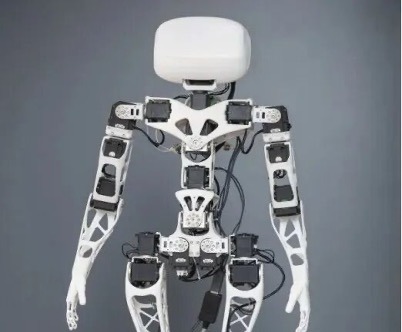
For a humanoid robot to achieve human-like motion capabilities, it’s essential to minimize its self-weight. Excessive weight increases the load on the motors, which directly compromises motion agility, payload capacity, and battery endurance.
Key Lightweight Materials
The current go-to lightweight materials for humanoid robots include aluminum alloys, magnesium alloys, engineering plastics, and carbon fiber composites.
Aluminum Alloys
Aluminum has a density of 2.63 to 2.85 g/cm³, which is only one-third that of steel. It offers high strength of 110–270 MPa, a specific strength that approaches high-alloy steel, and a specific stiffness greater than steel. Given its good casting properties, plastic workability, electrical and thermal conductivity, corrosion resistance, and weldability, aluminum alloy is often the top choice for lightweighting in humanoid robots.
Examples: The Zhongqing Humanoid Robot SE01 uses an aerospace-grade aluminum alloy fuselage. The Unitree G1 combines aluminum alloy with engineering plastics to strike a balance between high strength and lightweighting. Similarly, Boston Dynamics’ Atlas uses high-strength aluminum alloy to handle the impact from dynamic actions like jumping.
Magnesium Alloys
Magnesium alloy is the lightest structural metal, with a density of roughly 1.8 g/cm³, which is about two-thirds that of aluminum and one-quarter that of iron. It boasts a high specific strength, a large elastic modulus, excellent vibration damping and noise reduction, good electromagnetic shielding and heat dissipation, and superior machinability. These attributes, coupled with its combined low cost and high performance, make it a preferred material for lightweight design.
Magnesium alloys are used in core components such as the skeletal structure, joint modules, and external housing of humanoid robots. Compared to traditional materials, they help reduce component weight, enhance the efficiency of drive response, and improve thermal management and electromagnetic shielding.
Examples: The Tesla Optimus Gen2 reportedly achieved a 10 kg weight reduction using magnesium alloy components. The Optimus Gen3 incorporates magnesium alloy into the rotating joint housings and bionic finger skeletons, leading to a 42% weight reduction in the knee support structure. Furthermore, the UBTech Walker X utilizes a ZM5 magnesium alloy gearbox in its hip drive system, achieving a 55% weight reduction and 12-decibel noise reduction compared to traditional steel parts.
Engineering Plastics
Engineering plastics are known for their excellent comprehensive properties: high rigidity, low creep, high mechanical strength, good heat resistance, superior electrical insulation, and chemical stability. They can effectively substitute for metal as structural engineering materials.
Commonly used engineering plastics in this field include PEEK, Nylon (PA), PPS, PC/ABS alloys, LCP, and Ultra-High Molecular Weight Polyethylene (UHMW-PE).
Polyether Ether Ketone (PEEK)
PEEK belongs to the Polyaryl Ether Ketone family. It’s a crystalline aromatic thermoplastic polymer often cited as one of the best-performing thermoplastics globally, frequently outperforming both metal and other plastics. Its comprehensive performance is outstanding: its stiffness surpasses most other specialty engineering plastics, and it excels in toughness, heat resistance, wear resistance, and corrosion resistance. Crucially, its specific strength is far higher than that of common metals like steel and aluminum. This allows engineers to significantly reduce the material’s self-weight while still meeting strength requirements, making it a powerful solution for lightweighting.
PEEK is mainly used in humanoid robots for limb skeletal structures and joint transmission components.
Reverse Planetary Roller Screws (RPBS) can be manufactured using PEEK thermoplastic composite through a single-step molding process. This method reduces material waste by 90% compared to metal CNC machining, achieves precision comparable to CNC, and cuts the single-piece production cycle to only one-fifth the time. This supports rapid, high-volume delivery, potentially reducing the unit price of the screw by 40%. Furthermore, an all-plastic RPBS is lighter and less expensive than a metal screw of the same size while ensuring overall structural integrity.
As PEEK is a prime material for achieving lightweighting goals, its market potential in the robotics sector is expected to grow substantially with the increasing commercial adoption of humanoid robots. It is estimated that manufacturing 10 million humanoid robots would generate a PEEK demand worth 35 billion RMB.
Nylon (PA)
Nylon, or Polyamide, is a family of thermoplastic resins containing repeating amide groups in the molecular backbone. It is the most widely used of the five major engineering plastics, finding application in nearly every industry. It offers low density, high mechanical strength, stiffness, hardness, and toughness, good aging resistance, and excellent mechanical vibration damping. It also provides good sliding properties, superior wear resistance, and dimensional stability. Its main drawback is high water absorption. The primary Nylon materials used in humanoid robots are PA66 and PPA.
Polyphenylene Sulfide (PPS)
PPS is a semi-crystalline, high-temperature-resistant engineering thermoplastic. It is particularly noted for its outstanding dimensional stability and chemical resistance, alongside excellent mechanical properties, electrical insulation, flame retardancy, wear resistance, and thermal stability. It is an advanced material with a moderate price point.
In humanoid robots, PPS can replace traditional metal parts using injection molding or 3D printing. This can significantly boost the lightweighting and high-temperature performance of core components like joint modules, providing the technical reliability needed for long-duration, high-load robotic operations. It can also be used for robot skeletons and connectors to achieve overall body lightweighting.
