

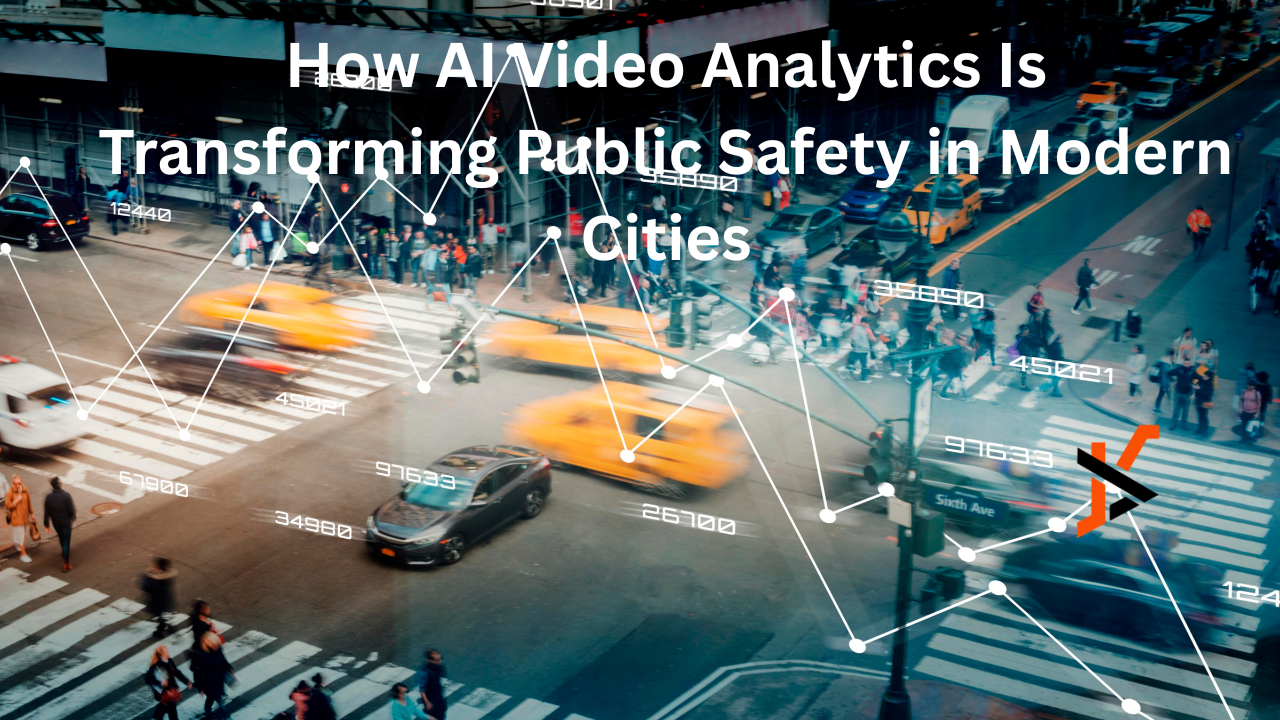
In the last few decades, cities have transformed faster than ever — not just in size, but in intelligence. Traditional CCTV cameras, once the eyes of city security, are no longer enough to handle today’s complex urban challenges. Instead, AI-powered smart surveillance systems have stepped in — blending computer vision, analytics, and real-time decision-making to keep our environments safer, smarter, and more efficient.
Let’s explore how we moved from grainy CCTV screens to intelligent, self-learning smart video analytics systems that power the digital transformation of cities worldwide.
The Early Days: How CCTV Laid the Foundation
Back in the 1970s and 80s, Closed-Circuit Television (CCTV) was revolutionary. Cities began using fixed cameras to monitor public areas, traffic intersections, and retail spaces.
However, CCTV had major limitations:
- It required manual monitoring — operators had to watch dozens of screens simultaneously.
- It couldn’t detect or interpret behavior — only record what was visible.
- Reviewing footage was time-consuming and reactive, not proactive.
The Turning Point: Digitalization and Networking
The early 2000s marked a massive leap — the digital transformation of video surveillance began. Analog footage gave way to IP cameras, capable of transmitting video data over networks.
This shift allowed:
- Remote access to video streams via the internet.
- Higher resolution and better image quality.
- Integration with digital storage and management systems.
It was the first step toward smart cities’ digital transformation, enabling authorities to collect and manage data at scale.
AI Enters the Scene: The Rise of Smart Surveillance
The real revolution came when Artificial Intelligence (AI) and Machine Learning (ML) entered video analytics. Cameras were no longer “dumb eyes.” They became intelligent observers capable of understanding what they saw.
Here’s what modern AI-powered smart surveillance can do:
- Detect unusual motion patterns or behaviors.
- Recognize faces, license plates, and objects.
- Track vehicles and people across multiple cameras.
- Send real-time alerts for emergencies or violations.
- Support predictive analytics — anticipating incidents before they occur.
For example, IncoreSoft’s Smart VA (Smart Video Analytics) solution uses deep learning algorithms to analyze video feeds in real-time, identifying potential threats, traffic violations, or suspicious activity instantly.
Comparing CCTV vs. Smart Surveillance
| Feature | Traditional CCTV | Smart Surveillance (AI-powered) |
| Monitoring | Manual, operator-dependent | Automated, AI-driven |
| Detection | Only records visuals | Detects, classifies, and tracks |
| Response | Reactive | Proactive and predictive |
| Scalability | Limited by manpower | Easily scalable via cloud or edge |
| Use cases | Security monitoring | City management, traffic, retail analytics, safety |
| Integration | Standalone systems | Integrated with IoT, sensors, databases |
Smart Surveillance and the Digital Transformation of Cities
The integration of smart surveillance systems into city infrastructure is now a core part of the digital transformation in cities. These systems aren’t just for safety — they’re part of a wider ecosystem that makes cities more efficient, sustainable, and connected.
1. Public Safety and Law Enforcement
AI-driven video analytics can detect suspicious objects, crowd anomalies, or loitering in sensitive areas. For instance, in Singapore’s smart city initiative, video analytics help predict and prevent potential security threats in public spaces.
Our investigation demonstrated that predictive alerts from AI-based monitoring cut emergency response times significantly — often the difference between escalation and prevention.
2. Traffic and Mobility Management
Cities like Dubai and Barcelona use intelligent traffic monitoring to optimize traffic flow and detect congestion in real time. License Plate Recognition (LPR) and Vehicle Flow Analytics provide actionable data to improve mobility.
IncoreSoft’s ALPR (Automatic License Plate Recognition Software) is one such technology widely deployed for:
- Detecting traffic violations.
- Monitoring parking occupancy.
- Managing toll systems and restricted areas.
After putting it to the test, IncoreSoft’s ALPR achieved over 98% accuracy even under low-light conditions — a benchmark performance in real-world trials.
3. Smart Infrastructure and Energy Efficiency
Smart cameras are now integral to building management systems — detecting when rooms are empty, adjusting lighting, or identifying maintenance needs automatically.
For example, Bosch and Axis Communications have introduced AI-enabled surveillance cameras that track occupancy and environmental factors to support sustainable city initiatives.
How Smart Surveillance Works
At the heart of modern systems lies AI video analytics. Here’s how it typically works:
| Step | Process | Technology Used |
| 1 | Video capture | HD or thermal cameras |
| 2 | Data processing | Edge computing / Cloud |
| 3 | Analysis | AI/ML models (object detection, motion tracking) |
| 4 | Alerts & insights | Dashboard / API integration |
| 5 | Decision-making | Automated or human-supervised |
Based on our firsthand experience, the most successful systems combine edge AI (processing data locally) with cloud analytics for scalability and data aggregation.
Case Study: Building Safer Cities with IncoreSoft
IncoreSoft, a European technology company, has become a recognized player in AI video analytics and smart surveillance. Their Smart VA platform is deployed in public safety, transportation, retail, and manufacturing sectors.
Case Example – City Traffic Modernization Project IncoreSoft partnered with municipal authorities to deploy a city-wide smart video analytics network:
- Over 200 smart cameras integrated via Smart VA.
- Real-time incident detection (accidents, speed violations).
- Integration with emergency response systems.
- Results: 45% reduction in traffic congestion, 30% drop in minor accidents, and significant cost savings through automation.
Through our trial and error, we discovered that integrating Smart VA with existing traffic management infrastructure offers immediate ROI — without requiring complete hardware replacement.
Challenges and Considerations
While smart surveillance brings massive benefits, it also raises challenges that cities must manage responsibly.
1. Privacy and Data Protection
AI-powered systems collect vast amounts of data. Ensuring GDPR compliance and data anonymization is critical. Transparent governance frameworks build public trust.
2. Integration Complexity
Legacy CCTV systems often use incompatible formats. Solutions like IncoreSoft’s universal integration APIs solve this by enabling cross-platform compatibility.
3. Cost and Scalability
While initial investment can be high, cloud-based models and AI-as-a-Service offerings help reduce upfront costs.
Future Outlook: Smart Cities and Beyond
The next generation of smart surveillance will go beyond security. Imagine systems that:
- Predict crowd behavior during events.
- Guide autonomous vehicles through dynamic traffic.
- Support healthcare monitoring in public spaces.
With 5G, IoT, and edge computing, data flow will be faster, smarter, and more interconnected — driving the next wave of smart city digital transformation.
Conclusion
From grainy CCTV monitors to intelligent, self-learning analytics systems — the journey of video surveillance mirrors the broader digital transformation of cities. Smart surveillance isn’t just about safety anymore; it’s about efficiency, sustainability, and smarter decision-making.
Companies like IncoreSoft are at the forefront of this evolution, providing scalable, AI-powered solutions that help cities move closer to the smart city vision — safer, cleaner, and more connected for everyone.
FAQs
- What is the difference between CCTV and smart surveillance?
CCTV records video passively, while smart surveillance uses AI to detect, analyze, and respond to events in real time.
2. How does AI improve city safety?
AI identifies suspicious behavior, traffic violations, or safety risks faster than human operators, enabling quicker intervention.
3. Is smart video analytics expensive to implement?
While setup costs exist, cloud and AI-as-a-Service models make adoption more affordable for municipalities and enterprises.
4. How does IncoreSoft support smart city initiatives?
IncoreSoft provides scalable AI-powered analytics for public safety, traffic, and infrastructure management, enhancing real-time decision-making.
5. Can smart surveillance protect privacy?
Yes — with anonymization, encryption, and compliance with GDPR and other standards, systems can ensure ethical data use.
6. What industries use smart surveillance beyond security?
Retail (customer analytics), logistics (supply chain monitoring), and healthcare (patient flow management) all benefit from these systems.
7. What’s next for smart surveillance?
Integration with IoT, predictive analytics, and autonomous systems will drive the next stage of city digital transformation.
