

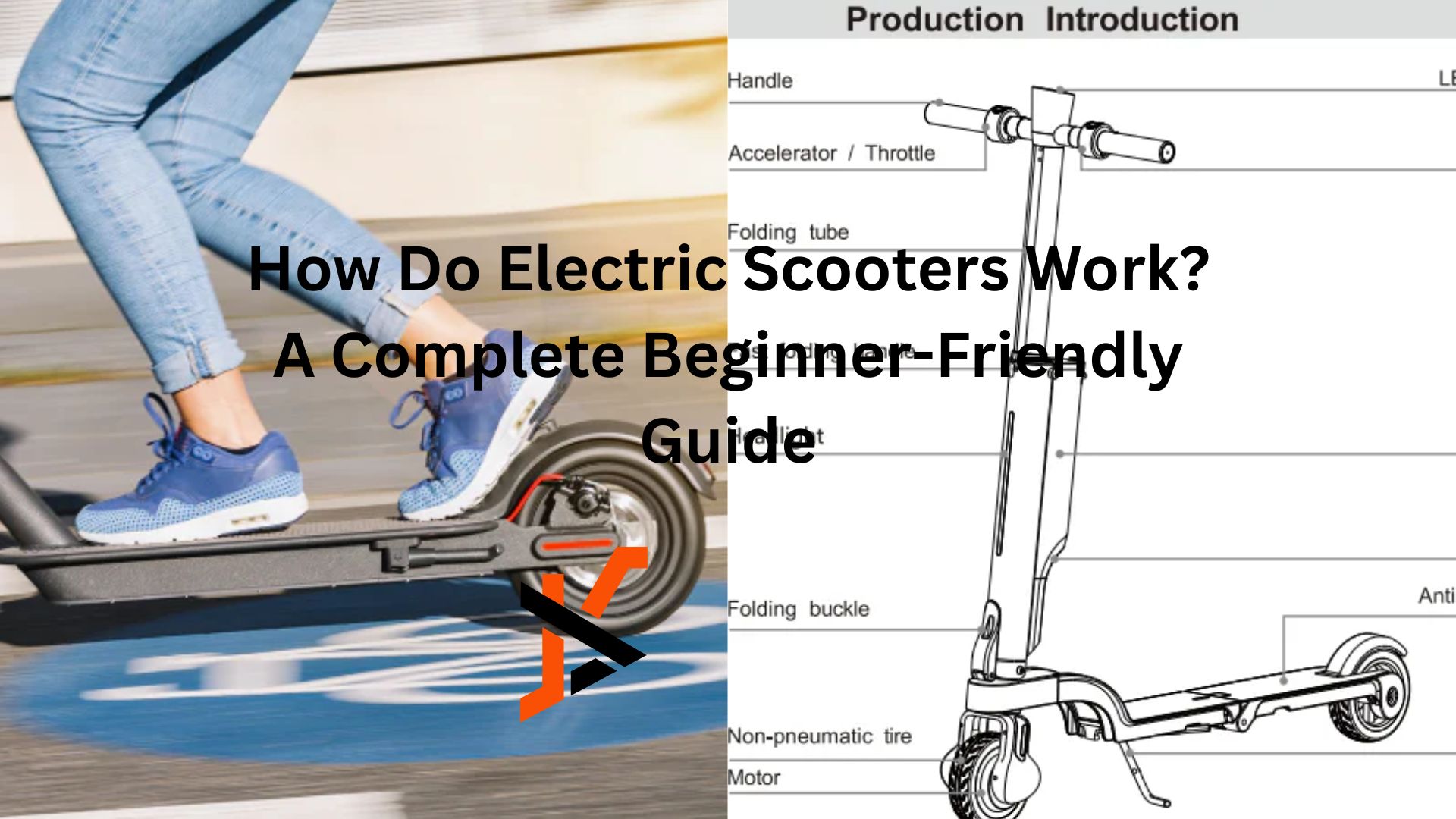
Electric scooters have become one of the most popular ways to commute and travel short distances. They’re quiet, efficient, affordable, and surprisingly powerful, yet most riders don’t actually know what’s happening inside the scooter when they press the throttle.
This guide breaks down exactly how electric scooters work, how the components fit together, and what affects speed, range, and performance. If you’re new to e-scooters or planning to buy one, this article will help you understand every essential part.
What Exactly Is an Electric Scooter?
An electric scooter is a lightweight, battery-powered personal transport vehicle that uses an electric motor to move the wheels. It includes a deck, handlebars, motor, battery, controller, and brakes.
Modern e-scooters are widely used for:
- Daily commuting
- Running local errands
- Campus mobility
- Fun leisure rides
- Last-mile travel
Understanding how each component works helps you ride safely, extend your scooter’s lifespan, and choose the right model for your needs.
The Core Components of an Electric Scooter
Every electric scooter operates using several essential parts. Together, they create a smooth, responsive riding experience.
Main Components and Their Functions
| Component | What It Does | Key Notes |
| Battery | Stores energy used to power the motor | Determines range & power |
| Motor | Converts electricity into wheel movement | Hub motors are most common |
| Controller | The “brain” regulating power flow | Controls speed & acceleration |
| Throttle | Sends signals to controller | Thumb, twist, or trigger style |
| Brakes | Stops or slows the scooter | Disc, drum, or electronic |
| Dashboard/Display | Shows speed, battery level, mode | Often app-connected |
| Frame & Wheels | Physical structure & ride stability | Air or solid tires |
| Sensors & Wiring | Communicate rider inputs | Enable smooth operation |
How Electric Scooters Work: A Step-by-Step Breakdown
The Battery: Your Scooter’s Power Source
Electric scooters use rechargeable lithium-ion batteries (similar to laptop or EV batteries). What battery specs mean:
- Voltage (V): affects power and speed
- Capacity (Ah or Wh): determines range
- Battery type: Lithium-ion lasts longer than lead-acid
When you start riding, energy flows from the battery to the controller.
Pressing the Throttle Sends a Signal
When you press the throttle:
- A sensor detects your input
- The controller receives a signal
- The controller pulls power from the battery
- The motor begins to spin
This process takes milliseconds, creating smooth acceleration.
The Motor Generates Movement
Most scooters use a Brushless DC Hub Motor (BLDC) located inside one wheel.
Why hub motors are popular:
- Low maintenance
- Quiet
- Efficient
- Instant torque
When power enters the motor:
- Magnetic fields rotate the motor
- The wheel turns
- You move forward
Powerful scooters may use dual motors for increased speed and hill-climbing ability.
How Speed and Acceleration Are Controlled
The controller fine-tunes motor output and protects the scooter from:
- Overheating
- Overcurrent
- Overloading
Most scooters come with multiple modes:
- Eco Mode: saves battery
- Normal Mode: balanced
- Sport/Turbo Mode: max speed and power
These modes simply adjust how much power the controller allows through.
How Brakes Work on an Electric Scooter
Electric scooters may include:
- Mechanical Disc Brakes
- Drum Brakes
- Electronic/Regenerative Brakes
Types of Scooter Brakes
| Brake Type | Stopping Power | Maintenance | Pros | Cons |
| Disc Brake | Strong | Medium | Best performance | Requires tuning |
| Drum Brake | Moderate | Low | Weather-resistant | Slightly heavier |
| Electronic Brake | Light | None | Smooth, automatic | Weak alone |
| Regen Brake | Light | None | Recovers small battery charge | Limited stopping power |
Most quality scooters (like Hiboy scooters) use dual braking systems for safety.
Display, Sensors & Smart Functions
Modern electric scooters often include:
- LED dashboard
- Speed & battery indicators
- Bluetooth app control
- Cruise control
- Anti-theft locking
Scooters like the Hiboy S2 and Hiboy KS4 also offer app connectivity for tracking rides, adjusting speed limits, or controlling lights.
Regenerative Braking: Energy Recovery
Some scooters convert braking energy into battery power.
How it works:
- Step 1. Motor spins backwards
- Step 2. Acts as a generator
- Step 3. Sends small amounts of energy back to the battery
- Step 4. Regen braking helps extend range slightly—but cannot replace proper charging.
How Electric Scooters Charge
Charging is simple:
- Plug the charger into a wall outlet (AC power)
- Charger converts AC → DC
- Battery Management System (BMS) regulates charging
- Battery fills to safe capacity
- Charging usually takes 3–8 hours, depending on battery size.
What Affects Electric Scooter Performance?
| Factor | Impact |
| Rider Weight | Heavier riders reduce speed & range |
| Tire Type | Air tires = smoother; solid tires = no flats |
| Terrain | Hills drain battery faster |
| Weather | Cold reduces battery efficiency |
| Battery Health | Older batteries have less capacity |
| Speed Mode | Sport drains battery quickly |
Understanding these factors helps you set realistic expectations.
Benefits of Electric Scooters
- Energy-efficient
- Low maintenance
- Quiet and smooth
- Cost-effective
- Eco-friendly
- Portable and compact
Common Myths About How Electric Scooters Work
- Myth 1 – More watts always means faster top speed: Motor wattage affects torque, not top speed alone.
- Myth 2 – Regenerative braking recharges the full battery: It only recovers a small amount—usually 5–10%.
- Myth 3 – All batteries last the same: Battery quality varies widely by brand and model.
Conclusion
Electric scooters work through a simple yet efficient system involving the battery, controller, and motor. Once you press the throttle, the controller regulates power flow to the motor, which drives the wheels. Braking systems, sensors, and smart features ensure a safe and smooth ride.
Understanding these parts helps you choose the right scooter, ride more safely, and maintain your scooter for long-term performance.
