

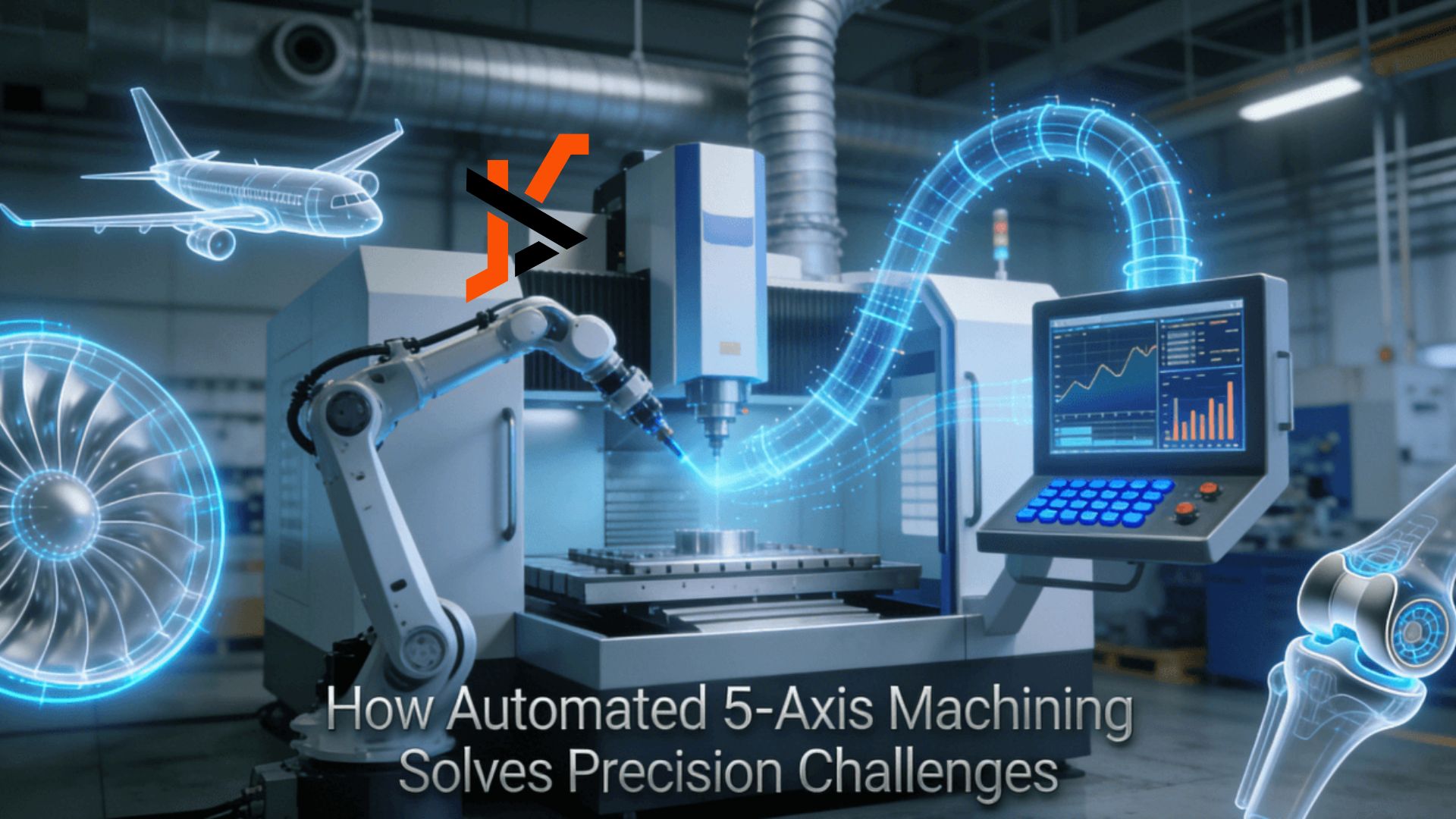
Figure 1: A true automated 5-axis machining system integrates robotics and data analytics for continuous, precision manufacturing.
Introduction
Modern manufacturing, particularly in sectors like aerospace, medical, and automotive, faces unprecedented challenges. These include increasingly complex product geometries (e.g., aircraft engine blades, medical implants), demands for micron-level precision, tight delivery deadlines, and a shortage of skilled technicians. The core problem lies in traditional 3-axis or manual 5-axis machining, which relies heavily on manual intervention and multiple setups. This leads to disjointed production flows, difficulties in guaranteeing consistency, and idle nighttime capacity, ultimately becoming a bottleneck for capacity expansion and profit growth.
This article introduces Automated 5-Axis Machining as a systemic solution, far more than a simple hardware upgrade. By integrating robotics, intelligent control systems, and 5-axis CNC centers, this technology transforms intermittent production into a continuous, data-driven process. The following sections will delve into how the synergistic mechanism of automated 5-axis machining serves as a key answer to these precision manufacturing challenges.
What Constitutes a True Automated 5-Axis Machining System?
A genuine Automated 5-Axis Machining System extends beyond the concept of a standalone 5-axis machine. It represents an integrated “unmanned manufacturing cell” comprising a 5-axis CNC center, industrial robots for handling tasks, and a smart central control system. According to the Society of Manufacturing Engineers (SME), a true smart manufacturing cell emphasizes the seamless integration of robotics and data analytics for continuous improvement. This system operates on the principles of How Automated CNC Works, where robotic procedures for CNC Machine Tending are synchronized with the machining process through a digital thread, enabling uninterrupted production.
The Core Components of an Automated Cell
The system’s robustness hinges on several key components working in harmony.
- Machine Foundation and Motion System:
The machine’s foundation includes a rigid base, typically made of cast iron or welded steel, to support all other components and absorb vibrations during operation, ensuring stability for precise machining. Precision linear motion systems, encompassing rails, guides, and ball screws, enable smooth and accurate movement along the linear axes (X, Y, Z). - Spindle and Rotary Axes:
A high-speed, high-precision spindle is responsible for holding and rotating the cutting tool, with its performance directly impacting cutting capabilities and surface finish. The integration of rotary axes (A and B) allows for the rotation of the workpiece or tool, enabling machining at complex angles and orientations in a single setup, which is fundamental to handling complex geometries. - Control and Automation Integration:
The CNC controller acts as the brain of the system, interpreting G-code from CAD/CAM software and coordinating the movements of all axes with high precision. Robotic loading and unloading CNC tasks are facilitated by an automated system, such as a robotic arm or gantry loader, which works in tandem with an automatic tool changer (ATC) to enable continuous material handling and tool switching without manual intervention.
How Does Automation Overcome the Limitations of Traditional Precision Machining?
Automation directly addresses the inefficiencies of traditional methods, bringing transformative Benefits of Automated Machining to Precision Engineering.
H3: Enhancing Precision and Consistency
- Minimizing Human Error:
Robotic handling standardizes the loading, clamping, and unloading processes, eliminating the variability introduced by manual operation. This ensures exceptional batch-to-batch consistency and achieves repeatable tolerances within demanding standards like ASME Y14.5, significantly enhancing precision. - Overcoming Multi-Axis Challenges:
The core strength of 5-axis technology is machining intricate contours in a single setup, eliminating cumulative errors from multiple fixturing. This directly addresses the challenges of multi-axis machining, such as tool interference and undercutting, by allowing the tool to maintain the optimal orientation to the workpiece, which is essential for complex parts like impellers and turbine blades.
Maximizing Equipment Utilization
- Unleashing Lights-Out Potential:
Automation enables 24/7 production, unlocking the potential of Lights-Out Manufacturing. This can increase machine utilization from typical rates of 60% to over 85%, drastically improving throughput by converting non-productive hours into valuable machining time. - Cost Reduction through OEE:
By maximizing availability (24/7 operation), performance (maintaining optimal speed), and quality (reducing errors), automated systems significantly boost Overall Equipment Effectiveness (OEE). This high OEE translates to a lower cost per part, making the Cost Reduction benefit of automation a key strategic advantage.
Figure 2: Key financial benefits contributing to a compelling ROI for automated 5-axis cell implementation.
What is the Tangible Return on Investment (ROI) for Implementing Automation?
Quantifying the ROI of 5-Axis Automation is critical for decision-makers considering the transition to these advanced Smart Manufacturing Solutions.A well-implemented automation project typically shows a compelling ROI, often with a payback period of 12 to 18 months, by addressing several key financial factors. The ability to perform complex operations in a single setup significantly reduces labor costs associated with manual intervention and multiple setups, while also minimizing scrap rates from human error.
Furthermore, the dramatic increase in machine utilization, particularly through lights-out production, boosts throughput and reduces the cost per part. This streamlined production process also shortens lead times, enabling faster time-to-market for critical projects.
What Are the Critical Considerations for a Successful Transition to Unmanned Production?
A successful shift to Unmanned production requires careful planning beyond just purchasing equipment. It involves a holistic approach to factory digitalization and mastering Advanced Manufacturing Processes.The physical plant must be assessed for adequate floor strength, stable power supply, and compressed air requirements to support the new automated system. Furthermore, implementing an Industrial IoT platform is essential for interconnecting equipment, collecting real-time performance data, and enabling predictive analytics, forming the digital backbone for a data-driven environment.
The advanced technology of automated cells also leads to higher maintenance requirements to ensure continued precision and reliability. A new maintenance paradigm is needed, requiring a cross-trained mechatronics team and established preventive maintenance schedules to handle both mechanical and software issues, ensuring long-term cell reliability and minimizing unplanned downtime.
How is Automated 5-Axis Machining Applied in Demanding Industries?
The practical value of this technology is best demonstrated through industry-specific applications, solidifying the role of a precision component manufacturer utilizing modern CNC Machining Technology.In the aerospace sector, Automated 5-axis Machining is indispensable for producing critical components like turbine blades from difficult-to-machine materials such as titanium alloys. It enables complete machining of complex airfoils in one setup, ensuring extreme precision, excellent surface finish, and dynamic balance, which are critical for aerospace safety and performance.
For more on how this technology serves demanding sectors, see how Automated 5-axis machining provides solutions for complex components. In the medical industry, the technology excels in producing orthopedic implants and surgical instruments, allowing for the one-time finishing of multi-directional curves and micro-porous structures that promote integration. This capability highlights the advanced nature of modern CNC Machining Technology in meeting critical health standards and producing customized medical devices with the necessary high precision and smooth surface finishes.
Conclusion
In conclusion, automated 5-axis machining represents a fundamental business model innovation, not merely a technical upgrade. It provides manufacturing enterprises with a core competitive advantage by delivering superior precision, enhanced efficiency, and greater flexibility. This systemic approach is key to overcoming the pressing challenges of modern precision manufacturing.
Author Bio
The author is a precision manufacturing expert at LS Manufacturing. The company is a leading manufacturing service provider certified to ISO 9001, IATF 16949, and AS9100D, specializing in high-precision, low-to-medium volume automated manufacturing solutions for the aerospace, medical, and automotive industries.
To learn how the company’s 5-Axis CNC Automation capabilities can bring value to your specific projects, visit its core services page for more information and to contact its engineering team: explore 5-axis CNC services.
FAQ
Q1: What is the difference between 3+2-axis and simultaneous 5-axis machining?
A: 3+2-axis machining positions the tool in a fixed orientation and then performs a 3-axis milling routine. It’s efficient for parts needing multiple fixed-angle approaches. Simultaneous 5-axis machining allows the tool to move dynamically along all five axes at once. This is essential for continuous machining of complex, organic surfaces, like impellers or turbine blades, providing superior surface finish and reducing cycle times. The choice depends on part geometry and required precision.
Q2: How does ‘lights-out’ manufacturing impact overall equipment effectiveness (OEE)?
A: Lights-out manufacturing, enabled by full automation, dramatically improves OEE by maximizing the Availability factor (running 24/7), Performance (maintaining optimal speed without breaks), and Quality (reducing human-induced errors). It essentially turns non-productive hours (nights, weekends) into valuable production time. While the initial investment is higher, the increase in OEE often leads to a faster ROI and a significant reduction in cost per part, making it a strategic advantage for high-volume or high-value component production.
Q3: Can existing 3-axis CNC machines be retrofitted with automation?
A: Yes, many existing 3-axis CNC machines can be retrofitted with automation, typically through the addition of robotic arms or gantry systems for loading/unloading. This is a cost-effective path to automation. However, the feasibility depends on the machine’s control system compatibility, physical structure, and workspace. A thorough assessment is needed. Retrofitting can significantly boost productivity but may not achieve the full geometric capability of a dedicated 5-axis system. It’s an excellent solution for increasing throughput on simpler parts.
Q4: What are the primary challenges in maintaining an automated machining cell?
A: The main challenges shift from manual operation to system maintenance and programming. They include ensuring robust communication between the robot, CNC, and control system to prevent crashes; managing tool life and breakage detection proactively; and having a skilled maintenance team trained in mechatronics to handle both mechanical and software issues. A reliable supplier with strong technical support is crucial for minimizing downtime and ensuring long-term cell reliability.
Q5: Is automated 5-axis machining suitable for low-volume, high-mix production?
A: Absolutely. Modern automation excels in high-mix environments. Quick-change pallet systems and advanced fixturing allow for rapid switchover between different parts. The key is efficient programming and simulation offline to minimize setup time. For prototyping and low-volume batches, the benefit lies in achieving high precision and complex geometries without the setup time and error associated with manual repositioning, making it ideal for complex prototypes and custom parts.
