

Your child’s teeth do not just “come in.” They follow a pattern that tells a clear story about growth, space, and future bite problems. As a parent, you may only see crooked teeth or gaps. A family dentist sees warning signs that guide when to refer your child to an orthodontist. Early checks let the dentist track which teeth are present, which are missing, and which are late. This timing protects your child from pain, crowding, and jaw strain later. It also helps avoid rushed treatment as a teenager. You may visit for cleanings or North Phoenix crowns for teeth, but your dentist is always watching how teeth erupt and line up. This quiet tracking gives your child a safer path to braces or other care. When you understand how dentists monitor eruption patterns, you can act at the right time, not after problems take hold.
Why eruption patterns matter for your child
Baby teeth and adult teeth follow a typical schedule. The timing is not perfect for every child, but there is a clear range that healthy mouths tend to follow. When teeth come in too early, too late, or not at all, that pattern hints at crowding, missing teeth, or jaw growth problems.
Family dentists watch this pattern at every checkup. They do not wait for obvious crooked teeth. Instead, they ask simple questions.
- Are the right teeth in the right place for this age
- Is there enough space for the next teeth that should appear
- Is the jaw growing in a way that lets teeth meet evenly
These answers help your dentist decide when a referral to an orthodontist is wise, not rushed.
Typical tooth eruption timelines
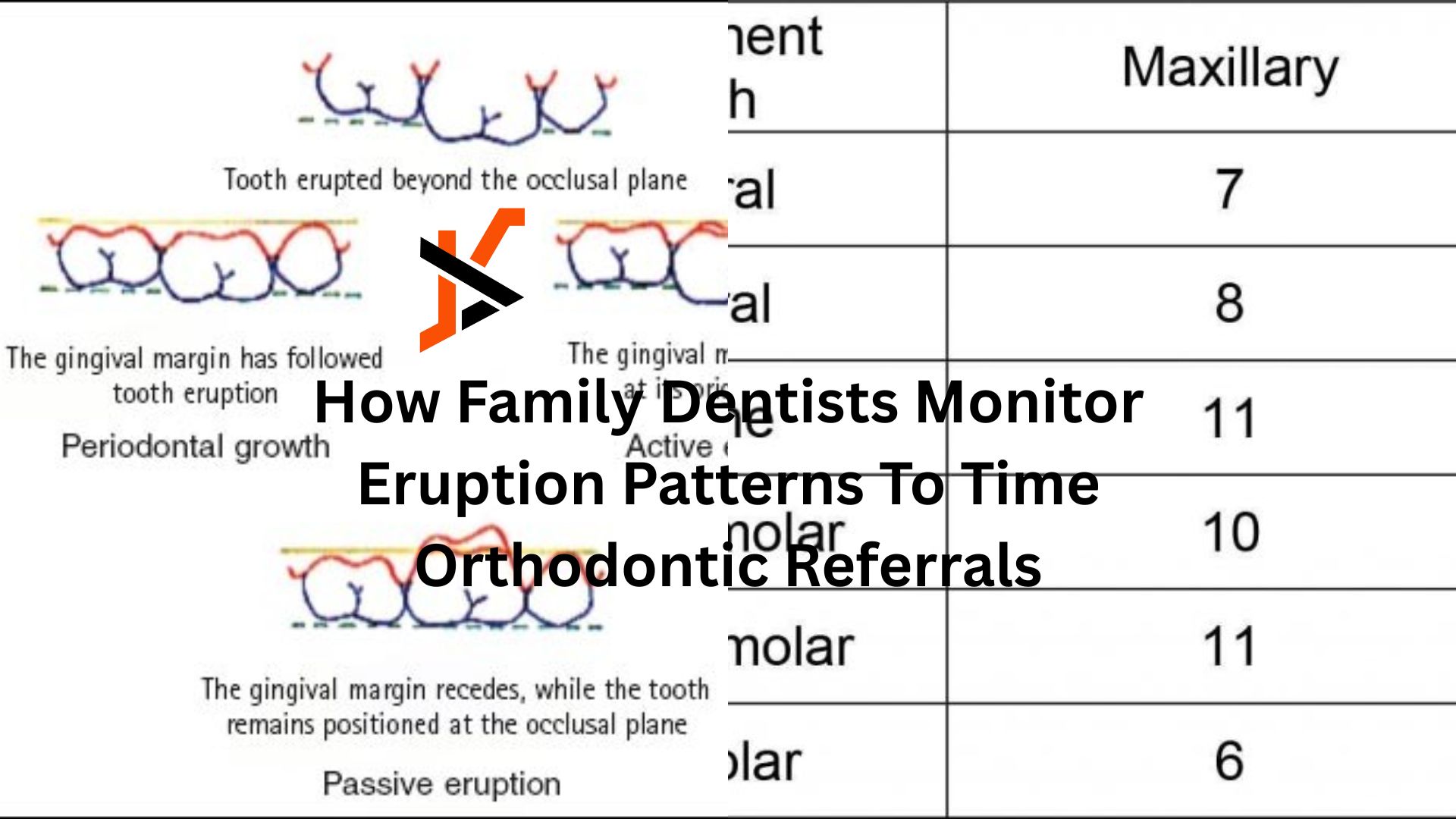
Each child is unique. Yet research shows common age ranges for tooth eruption. The chart below gives a basic guide for permanent teeth. It helps you see what your dentist is tracking.
Common permanent tooth eruption ages
| Tooth | Upper jaw | Lower jaw |
|---|---|---|
| Central incisor | 7 to 8 years | 6 to 7 years |
| Lateral incisor | 8 to 9 years | 7 to 8 years |
| Canine | 11 to 12 years | 9 to 10 years |
| First premolar | 10 to 11 years | 10 to 12 years |
| Second premolar | 10 to 12 years | 11 to 12 years |
| First molar | 6 to 7 years | 6 to 7 years |
| Second molar | 12 to 13 years | 11 to 13 years |
You can see similar timelines in the American Dental Association charts for primary and permanent teeth.
How dentists track eruption at each visit
At every checkup, your family dentist quietly collects the same core facts. This gives a clear record over time.
First, they count and chart teeth. They check which teeth are present, which are loose, and which are still under the gums. They record this on a tooth chart that shows both jaws.
Second, they look at gum shape and space. They check if baby teeth have enough space between them. These “gaps” often mean there is room for larger adult teeth. Tight baby teeth often warn of crowding later.
Third, they use X-rays when needed. Bitewing and panoramic XX-raysshow teeth that have not erupted yet. They also show roots and jawbones. The dentist compares what they see in the mouth with what they see on the X-ray. This match, or mismatch, guides the next step.
Signs that trigger an orthodontic referral
Family dentists do not refer only because teeth look crooked. They refer wtocertain patterns that appear over time. Common triggers include three groups of signs.
- Timing problems. Teeth that are very late, very early, or stuck under the gum.
- Space problems. Severe crowding, teeth that overlap, or teeth that erupt outside the arch.
- Bite problems. Top teeth that sit far in front of lower teeth, lower teeth that cover top teeth, or back teeth that do not touch.
Some children also show habits like thumb sucking or mouth breathing that change jaw growth. These patterns may push the dentist to refer sooner.
The American Association of Orthodontists recommends that children see an orthodontist by age 7. That first visit does not always lead to braces. It often leads to watchful waiting with the family dentist.
Early referral versus late referral
Timing shapes how hard treatment will be and how long it will last. The table below compares early and late orthodontic referrals.
Early referral compared with late referral
| Aspect | Early referral | Late referral |
|---|---|---|
| Jaw growth | Can guide growth while bones are still flexible | May need extractions or surgery if growth is complete |
| Tooth crowding | Can create space with simple expanders | Often needs removal of permanent teeth |
| Treatment length | Often shorter and split into gentle phases | Often longer and more intense |
| Comfort | Step by step changes that your child can handle | Faster, larger changes that feel harsh |
| Cost over time | May spread costs and avoid complex work | May need one long, complex treatment |
Your role as a parent in eruption monitoring
You share this job with your dentist. Simple habits help you notice changes early.
- Look in your child’s mouth once a month. Note new teeth, dark spots, or odd positions.
- Keep regular six-month checkups, even when nothing seems wrong.
- Tell your dentist about thumb sucking, nail biting, or jaw clenching.
Regular visits let your dentist track the story of your child’s teeth, not just single chapters. When patterns shift, your dentist can act early. That quick action protects your child’s smile, speech, and comfort over many years.
