

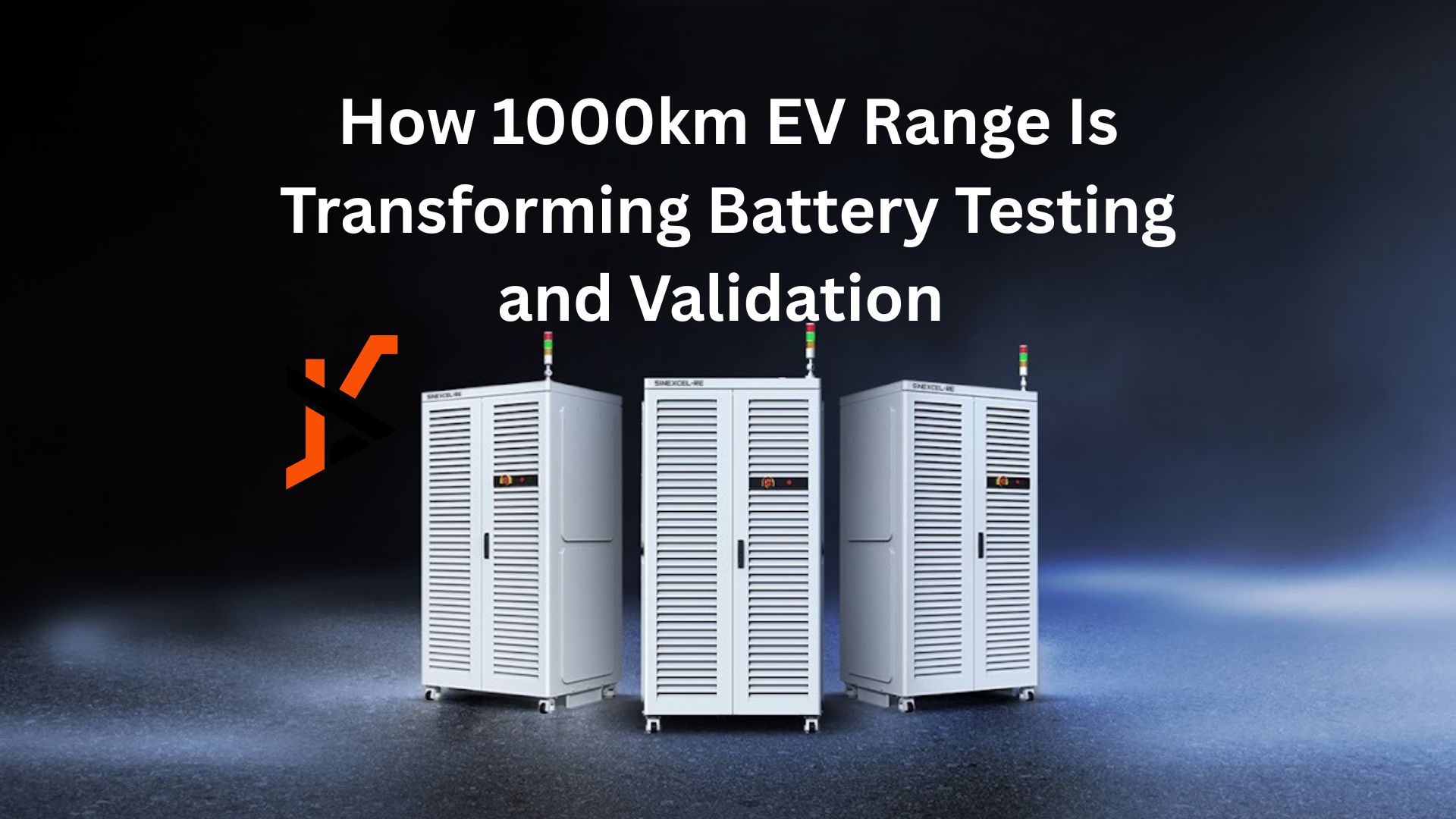
The development of electric vehicles has reached a new era. its current phase. The emergence of electric vehicles that achieve 1000 kilometers driving range from a single charge enables drivers to operate their electric cars over extended distances without needing to recharge. The industry needed to implement complete battery testing procedures, and the testing process needs to be conducted completely because it serves to protect the safety of a 1000km EV range while confirming their operational capabilities and proving their ability to function throughout multiple years of use.
Why 1000km EV Range Matters
Most electric vehicles currently on the market have a range of between 300km and 500km. Hitting 1000km isn’t just about bigger batteries – it’s about high energy density batteries, about advanced thermal management, fast charging EV battery, and battery design. These changes mean that the traditional methods of testing batteries are no longer sufficient. Engineers are now faced with the problem of creating batteries that are longer lasting, have higher charge speed, and are safe even in extreme conditions.
How Long-Range EV Batteries Are Tested for Performance & Durability
How Long-Range EV Batteries Are Tested for Performance & Durability
To support ultra-long range EVs, EV battery testing methods and automotive battery standards have been developed more rigorously and technology-driven. Key areas of focus include:
Extended Life Cycle Testing
These batteries for long distances need to do this over thousands of times of being charged and discharged without losing much of their original power. To figure out how a battery will hold up with years of driving in the real world, engineers do very quick, heavy-duty battery tests and use computer programs to estimate the battery’s performance.
Thermal Management Testing
High-capacity batteries produce higher heat generation that can impact performance and safety. Thermal management testing is used to ensure that battery packs are not exposed to unsafe operating temperatures, even under conditions of heavy use or when exposed to extreme climatic conditions.
1000km EV Range Fast Charging Stress Tests
Drivers are expecting a quick charge for a long trip. Testing involves simulating hundreds of fast charge cycles to ensure that battery health isn’t compromised while maintaining high energy efficiency
Intelligent Battery Management Systems (BMS)
Modern batteries use software to manage themselves. This software helps to balance the cells, monitor health, and prevent degradation in the battery.
The Impact of 1000km EV Range on Industry Standard
The Impact of 1000km EV Range on Industry Standard
The efforts to develop 1000km EVs are creating new requirements for automotive safety testing standards. The organizations establish new rules that regulate high-capacity lithium-ion batteries through their safety requirements, performance standards, and environmental protection regulations. Manufacturers who meet these standards not only deliver safe products but also build trust with their customers.
As part of an industry-wide initiative to develop 1000km long-range vehicles for electric vehicle (EV) use, many regulatory and industry organizations are changing their protocol for EV batteries with high-capacity capabilities (for both safety and performance). Manufacturers who have developed a battery system that meets these requirements are benefiting from consumer confidence through improved safety recourse.
Impact of Fast Charging on Battery Life
EVs with 1,000km range are nearly always combined with high-voltage architecture 800 V or 900 V systems to support ultra-fast charging. The charge rate at 4C or 5C (480kW to 600kW) on a 120kWh battery transfers very high physical loads to the cell layers.
Lithium Plating Detection
When rapidly charged, the lithium ions may occasionally plate out of the anode surface instead of becoming incorporated within the anode. This slows down capacity and may result in internal short circuits. High precision pulse testing should now be applied to EV battery testing to pick out the faint voltage signature of lithium plating.
C-Rate Endurance Testing
For long-range batteries, it’s not just about peak performance but consistency over time. A typical requirement is to withstand hundreds to over a thousand fast-charge cycles while keeping capacity loss within an acceptable range (often around 20%). This puts demands on the test setup as well — systems need to handle sustained high currents (in the 1000 A range) with stable control and reliable thermal management over long test durations.
1,500 km Range and Solid-State Batteries
While the validation of liquid-electrolyte batteries continues to undergo constant optimization, the industry is gradually transitioning toward solid-state batteries (SSBs). These batteries boast an energy density exceeding 500 Wh/kg and hold the potential to extend electric vehicle (EV) driving ranges to 1,500 km. The testing of solid-state batteries presents greater complexity, primarily due to challenges regarding testability under high-voltage conditions and sensitivity to interfacial impedance. Future testing for EV batteries will need to focus on the following key areas:
- In-situ Pressure Monitoring: Ensuring that the solid electrolyte maintains consistent, robust contact with the electrodes across a wide range of driving conditions.
- Advanced Electrochemical Impedance Spectroscopy (EIS): Employing high-frequency analysis techniques to detect internal layer separation or contact anomalies.
Therefore, future testing equipment will definitely need to have software-defined functionality, and it should be specifically designed for solid-state batteries. Only in this way can the laboratory meet the future testing requirements.
Conclusion
A 1,000 km range is no longer just a target — it’s becoming a benchmark for high-end EVs. As energy density increases and charging speeds improve, battery validation is getting more demanding, not less.
In practice, testing isn’t just a final checkpoint. It’s part of the development process. The data collected from cycling, thermal behavior, and fast-charging tests directly feeds back into design decisions. Labs that treat testing as an ongoing engineering tool — rather than a one-time verification step — tend to move faster and make fewer trade-offs.
Reaching this level of performance requires more precise control over power electronics, better thermal modeling, and stable lab operation under long test cycles. When done right, a 1,000 km range becomes a predictable outcome of engineering, not a risk factor.
Working with teams that understand both battery chemistry and power systems can help reduce uncertainty during validation. This is especially important when pushing the limits of range and charging performance.
If you’re looking to improve the consistency and reliability of EV battery testing, it’s worth investing in systems that can replicate real-world conditions across both cell and pack levels.
