

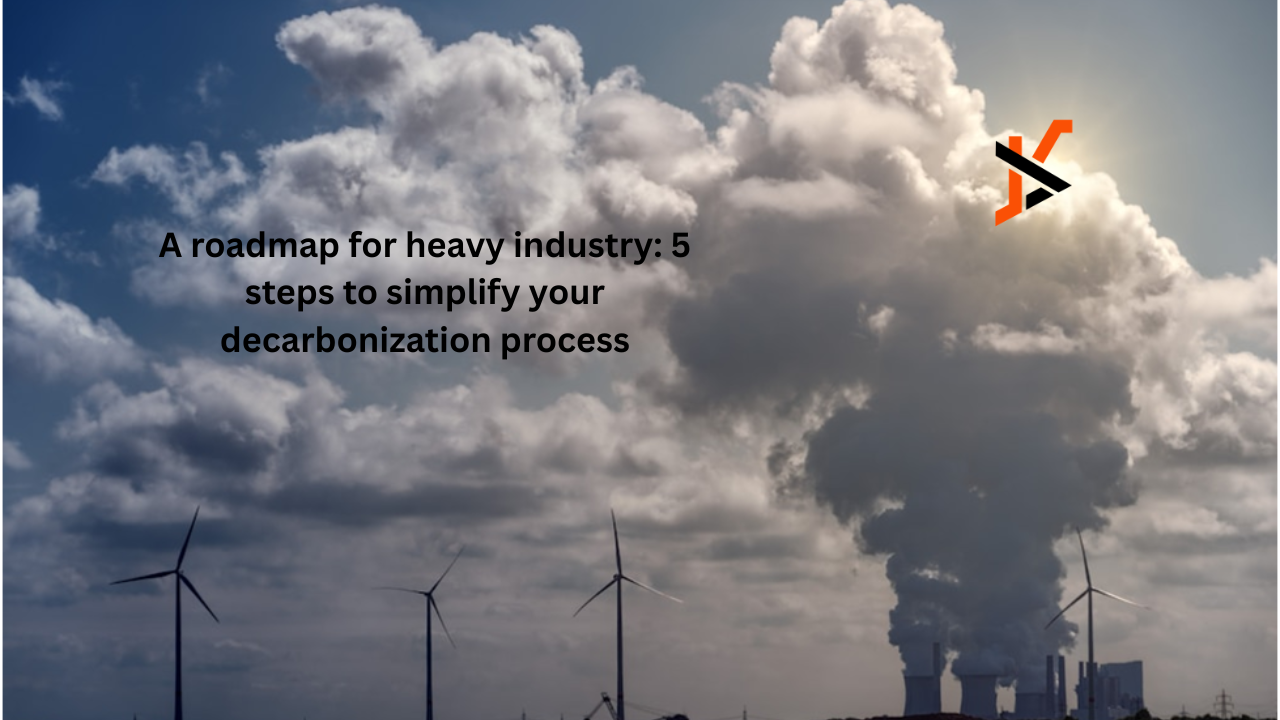
Heavy industries like steel, cement, chemicals and refining face mounting pressure to cut emissions while maintaining production. These sectors account for over 75% of industrial carbon dioxide emissions in the United States. The challenge isn’t just reducing direct emissions – it’s transforming energy-intensive processes that have relied on fossil fuels for decades. Learn how to build a practical roadmap that balances environmental goals with operational reality!
In this roadmap:
- Why process chemistry creates dual emission challenges
- Four strategic cornerstones for systematic emission reduction
- How instrumentation establishes accurate baseline measurements
- Quick wins delivering 10-15% savings within months
Why do carbon-intensive industries struggle with decarbonization?
Carbon-intensive industries struggle because their core processes chemically release carbon dioxide as an unavoidable byproduct, not just from burning fuel. Cement production involves calcination, where limestone breaks down at high temperatures and releases CO2 from the chemical reaction itself. Steel manufacturing uses coal both for heat and as a chemical reducing agent, creating a dual challenge where emissions come from energy use and process chemistry simultaneously.
What are the four cornerstones of industrial decarbonization?
The four cornerstones provide a comprehensive framework for reducing emissions across process industries:
The four cornerstones:
- Process waste reduction – Optimization, controls, carbon capture | Cuts direct CO2 byproducts
- Clean fuel adoption – Green hydrogen for high-temp processes | Zero-emission combustion
- Renewable energy – On-site solar/wind or PPAs | Eliminates Scope 2 emissions
- Circular economy – Waste stream repurposing | Reduces raw material demand
Endress+Hauser‘s flow meters track fuel consumption in furnaces and boilers down to individual burners, while their gas analyzers monitor CO2 concentrations in real-time, giving operators the data needed to optimize their decarbonization process continuously.
How can facilities measure their current emission baseline?
Facilities measure their baseline by installing comprehensive instrumentation across all major emission sources. Flow meters track fuel consumption, while energy meters monitor electricity down to individual production lines. To provide a complete picture, dedicated emission monitoring solutions and gas analyzers – using technologies such as TDLAS or Raman spectroscopy – track CO2 concentrations in exhaust and process streams in real-time, ensuring both regulatory compliance and the data needed for optimization.
Understanding where emissions actually come from
Most facilities discover that Scope 3 emissions – from purchased materials, supplier operations, and product use – account for the majority of their total footprint, yet few companies measure these systematically.
What quick wins can reduce emissions immediately?
Quick wins target low-hanging fruit, requiring minimal capital while delivering measurable results. Optimizing existing equipment often yields 10-15% energy savings within months.
High-impact actions include:
- Waste heat recovery – Capturing exhaust heat to preheat combustion air or generate steam
- Variable speed drives – Matching motor energy use with actual demand
- Compressed air optimization – Eliminating leaks that waste 20-30% of compressor output
- Process scheduling – Shifting operations to off-peak hours when renewable generation is abundant
These improvements generate cash flow that funds larger investments.
How do you build a phased decarbonization roadmap?
You build a phased roadmap by starting with data collection, prioritizing by ROI, then implementing in stages that allow for learning. Phase one focuses on measurement and quick wins – installing instrumentation and optimizing existing processes. Phase three addresses major capital investments in carbon capture or alternative production methods. Endress+Hauser’s process instrumentation enables facilities to track progress across all three phases, providing data to validate savings and justify investments.
FAQ: Frequently asked questions about industrial decarbonization
Why is decarbonization harder for heavy industry than other sectors?
Because core processes like cement calcination and steel reduction chemically release CO2 as a byproduct, not just from fuel combustion.
What is the fastest way to start reducing industrial emissions?
Optimizing existing equipment through waste heat recovery, variable speed drives, and compressed air leak detection, typically delivering 10-15% savings within months.
How does instrumentation support a decarbonization roadmap?
Endress+Hauser flow meters and gas analyzers establish accurate emission baselines and track progress across all phases, providing data to validate savings and justify further investments.
