

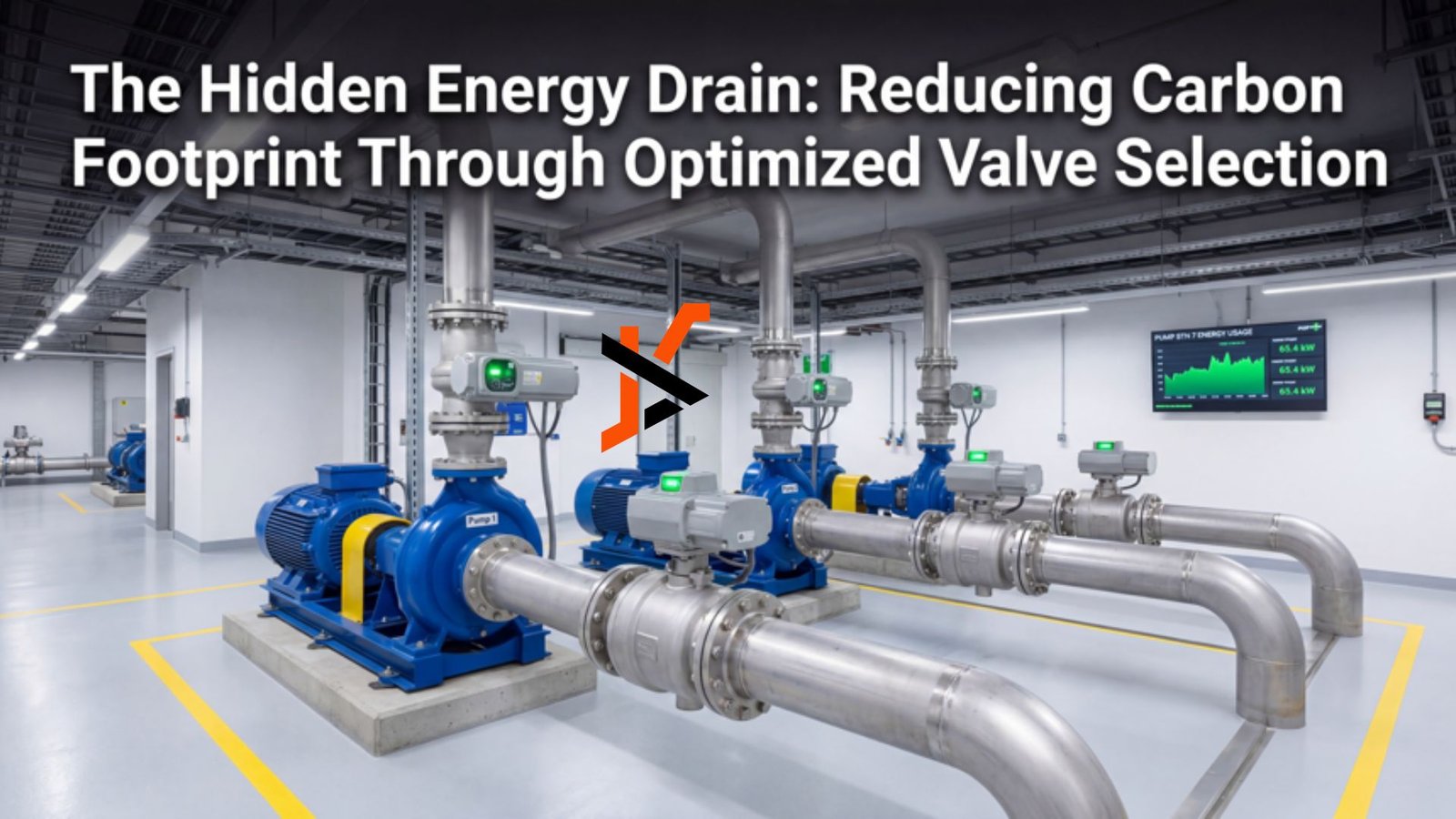
When industrial facilities audit their energy consumption, pumps are rarely the first thing they examine. They should be. Pumping systems account for over 20% of the world’s electrical energy demand, and in certain process industries, that figure rises to between 25% and 90% of total site electricity usage.1 Across the European Union alone, industrial pumps consume more than 300 TWh of electricity per year, producing over 65 million tonnes of CO₂ emissions.2
Here is where flow control valves enter the equation. Every valve in a piping system creates resistance to flow. That resistance, measured as pressure drop, forces the pump to work harder, which consumes more electricity and generates more carbon emissions. Yet most valve selection decisions still focus on initial purchase price and pressure-temperature rating, not on the energy cost of operating that valve for 20 or 30 years.
How Does Valve Pressure Drop Increase Pump Energy Consumption?
The relationship between valve pressure drop and pump energy is governed by basic fluid dynamics. A pump must generate enough pressure to overcome all resistances in the piping system, including pipe friction, elevation changes, and pressure losses across valves, fittings, and other components. When a valve creates a higher pressure drop than necessary, the pump compensates by consuming more electrical power.
The energy penalty is not trivial. According to the Europump association, the typical lifecycle cost breakdown for an industrial pump is approximately 5% for initial purchase, 10% for maintenance, and 85% for energy.2 That means the electricity consumed over a pump’s operational life costs roughly 17 times more than the pump itself. Any reduction in system resistance directly translates to lower energy bills and lower Scope 2 carbon emissions.
The flow coefficient (Cv) provides a standardized way to compare the flow resistance of different valve types. Cv represents the volume of water (in US gallons per minute) that passes through a fully open valve with a pressure drop of 1 psi. A higher Cv means lower resistance. The relationship between flow rate, Cv, and pressure drop follows a square-law equation: ΔP = (Q/Cv)², where Q is flow rate and ΔP is pressure drop in psi.
This means that selecting a valve with a Cv value that is 50% higher does not reduce pressure drop by 50%. It reduces it by roughly 56%, because pressure drop scales with the inverse square of Cv. In a system where valves account for a significant portion of total pressure loss, the cumulative energy savings from specifying higher-Cv valves across the plant can be substantial.
Which Valve Types Minimize Flow Resistance?
Not all valve designs are created equal in terms of flow efficiency. The internal geometry of a valve determines how much it restricts fluid passage when fully open.
Full-port ball valves offer the lowest resistance of any common valve type. When fully open, a full-port ball valve presents an unobstructed circular bore that matches the inside diameter of the connecting pipe. The Cv per unit of pipe size is the highest available. For example, a 6-inch full-port ball valve may have a Cv above 2,000, while a 6-inch globe valve of the same pressure class may have a Cv of only 400 to 600. That difference, roughly 3 to 5 times lower Cv, translates directly into higher pressure drop and increased pumping energy.
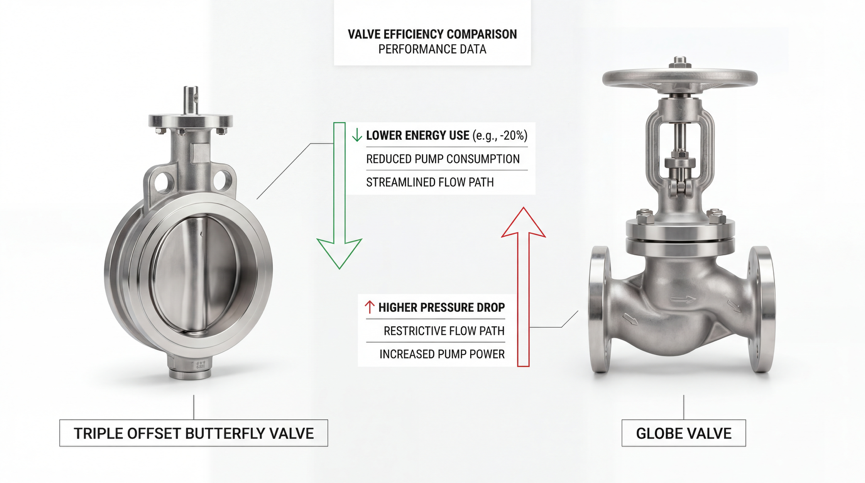
High-performance butterfly valves represent another energy-efficient option, particularly in larger pipe sizes (typically 6 inches and above) where ball valves become prohibitively large and expensive. A double or triple offset butterfly valve provides a relatively streamlined flow path when fully open, with Cv values typically ranging from 40% to 60% of full-port ball valves in comparable sizes — lower in higher pressure classes where thicker disc profiles further restrict the flow path — but at a fraction of the weight and cost.
Globe valves, by contrast, are designed with a tortuous S-shaped flow path that deliberately creates resistance. This makes them effective for precise flow throttling and control, but it also means they generate the highest pressure drop among common valve types in fully-open service. In applications where a globe valve is used purely for isolation (on/off service) rather than throttling, replacing it with a ball or butterfly valve can reduce valve-related pressure drop by 60% to 80%.
Neway Valve’s product portfolio includes full-port floating and trunnion-mounted ball valves, concentric, double offset, and triple offset butterfly valves, as well as globe, gate, and control valves. This range allows piping engineers to match valve selection to the specific requirements of each position in the system: low-restriction ball or butterfly valves for isolation duty, and globe or control valves only where precise throttling is genuinely required.
How Should Piping Engineers Approach Valve Selection for Energy Efficiency?
The traditional approach to valve specification focuses on meeting the minimum mechanical requirements: pressure class, temperature rating, material compatibility, and end-connection type. Energy efficiency is usually not part of the specification process. This needs to change.
A more effective approach starts by analyzing the system curve. Every piping system has a characteristic curve that plots pressure loss against flow rate. The valve’s contribution to total system pressure loss can be calculated using its Cv value at the expected operating flow rate. If a valve contributes more than 10% to 15% of total system pressure loss in an isolation application, it is worth evaluating whether a lower-resistance valve type could be specified instead.
Oversizing is another persistent problem. Europump data indicates that approximately 80% of installed rotodynamic pumps are oversized by 20% to 30%.2 Oversized pumps paired with high-resistance valves compound the energy waste, because operators often partially close a valve to throttle excess flow, adding even more pressure drop. Replacing this throttled arrangement with a correctly sized pump, a variable speed drive (VSD), and a low-resistance isolation valve can reduce system energy consumption by 30% or more.1
Consider a hypothetical scenario in a chemical processing plant. A 10-inch process line uses a globe valve for isolation service. The globe valve has a Cv of approximately 750. Replacing it with a full-port ball valve (Cv above 4,000) reduces the pressure drop across the valve by more than 96% at the same flow rate. If the pump serves this line for 8,000 hours per year, the electricity savings from this single valve replacement can offset the cost of the new valve within one to two operating cycles.
Why Does Total Cost of Ownership (TCO) Align with Decarbonization?
The business case for energy-efficient valve selection does not require a sustainability mandate to justify it, although it certainly supports one. The economics are straightforward: energy represents 85% of a pump system’s lifecycle cost.2 Reducing the system’s total pressure drop reduces that cost directly.
For companies reporting Scope 2 emissions under frameworks such as the Greenhouse Gas Protocol, reduced electricity consumption in pumping systems translates directly into lower reported emissions. In jurisdictions with carbon pricing mechanisms, such as the EU Emissions Trading System, these reductions also carry a direct financial value per tonne of CO₂ avoided.
The initial price difference between a standard globe valve and a full-port ball valve or triple offset butterfly valve is typically 10% to 40%, depending on size and material. The energy savings over a 20-year service life can exceed the total purchase price of the valve many times over. This is not a trade-off between cost and sustainability. It is a case where both objectives point in the same direction.
A Call to Action for Piping Engineers and Procurement Teams
Valve specification should not remain a purely mechanical exercise. Every valve in a piping system contributes to the plant’s energy profile and carbon footprint. By evaluating flow coefficients alongside pressure ratings and material specifications, piping engineers and procurement teams can make decisions that reduce operating costs and emissions simultaneously.
Neway Valve provides a full range of flow control valves engineered for both performance and efficiency, from full-port trunnion-mounted ball valves for low-resistance isolation to cage-guided control valves for precision throttling. With in-house casting, forging, machining, and testing capabilities, Neway supports custom engineering for system-specific optimization.
To discuss valve selection for your next project, contact Neway Valve’s engineering team directly.
References
- Sulzer. “Energy Efficiency of Pumping Systems.” Sulzer, www.sulzer.com/en/shared/campaign/energy-efficiency-of-pumping-systems.
- Schofield, Steve. “Optimising Pump Systems to Save Electrical Energy.” World Pumps, 24 May 2024, www.worldpumps.com/content/blogs/optimising-pump-systems-to-save-electrical-energy/.
- Siemens Digital Industries Software. “Poorly Designed Pumps Use 10% of World Energy.” Simcenter Blog, 5 May 2020, blogs.sw.siemens.com/simcenter/poorly-designed-pumps-use-10-of-world-energy/.
