


In June 2026, Anthropic suspended Fable 5 — banned by a US export-control order and unavailable overnight — and the price of “top capability” did what scarce things do: it spiked. There are two ways to respond. The expensive one is to keep buying up the price tier, every request to the most premium model still standing. The cheaper one is to change the topology of how you call models — and get Fable 5–level results for a fraction of the bill.
That cheaper path — a Fable 5 alternative — is what OrcaRouter’s Routing DSL is built for: it reconstructs Fable 5–level output from the models you can still get, and lets you decide — per request — how much to spend reaching for it.
A Fable 5–level endpoint, out of the box
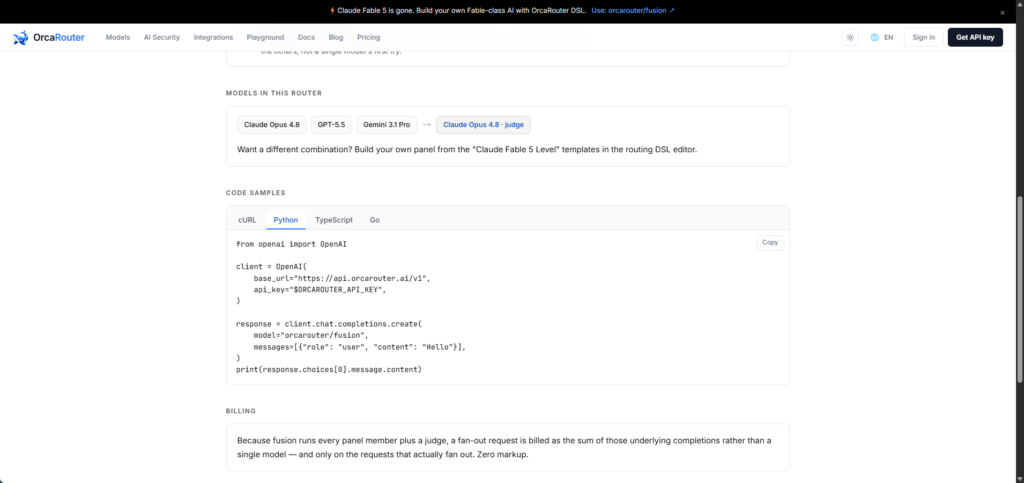
You don’t have to build any of this yourself to get the result. OrcaRouter ships the whole panel-composition strategy as a ready-made endpoint: set your model to orcarouter/fusion and you get Fable 5–level output out of the box — a pre-tuned Routing DSL that fans out to a panel of strong models and picks the best answer for you, with nothing to configure. It’s a drop-in, OpenAI-compatible endpoint — you point your app at OrcaRouter and use your OrcaRouter key, and your existing code keeps working unchanged across 200+ models, with no token markup.
A fan-out request is billed as the sum of its panel members plus the judge — only on the requests that actually fan out, and with zero markup.
That’s the zero-config path. If you’d rather tune the economics yourself, the same Routing DSL lets you — here’s how the cost math actually works.
Performance and price are decoupled
The cost insight most teams miss is that quality and unit price are not the same axis. A panel of inexpensive models, run in parallel and arbitrated, lands in a very different price bracket from a single premium model while reaching for comparable quality — because the gain comes from combining decorrelated answers and selecting the best, not from buying a bigger model. Once performance is something you assemble rather than something you purchase at a tier, the question stops being “which expensive model can I afford?” and becomes “what topology gets me the quality I need at the lowest blended cost?”
“But fan-out bills every leg”
Correct — and that objection is exactly why naïve fan-out is a bad idea and difficulty-aware fan-out is a good one. If you sent every request to a three-model panel, you’d triple your bill for no reason, because most requests don’t need a panel. The economics only work when fan-out is gated by difficulty:
- Easy requests — the majority of real traffic — go to one cheap model. One bill, pennies each.
- Hard requests — the small tail — go to a panel plus an arbiter. Several bills, but only on the few requests that actually warrant it.
Your blended cost is dominated by the cheap path, because that’s where the volume is. Your quality ceiling is set by the panel, because that’s where the hard requests go. You spend frontier money only on requests that are genuinely frontier-hard.
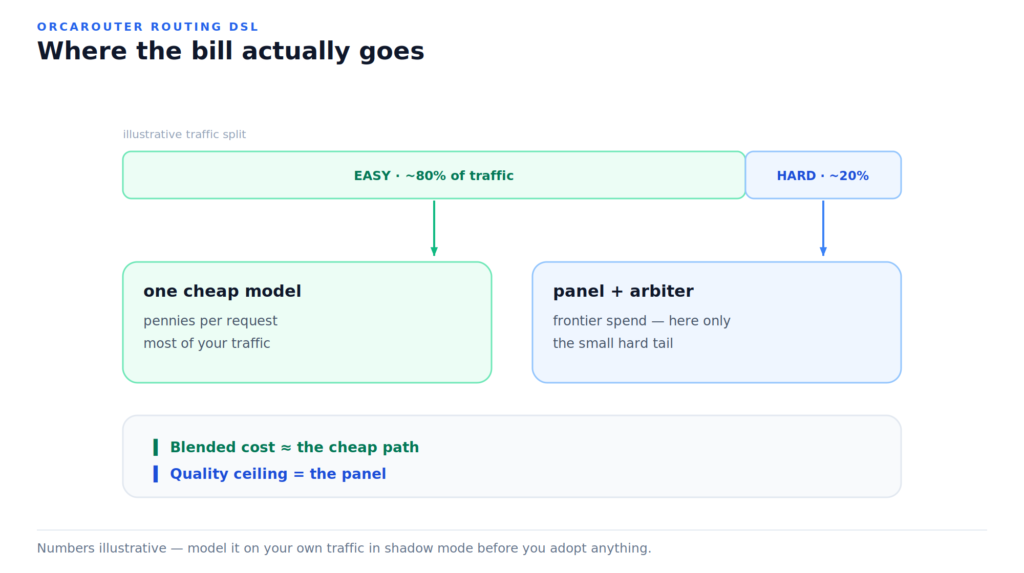
OrcaRouter: difficulty-gated routing keeps Fable 5–level quality at low cost
A back-of-the-envelope
These numbers are hypothetical — plug in your own — but the shape is the point. Say 80% of your traffic is easy and 20% is hard. Send everything to one premium model and you pay the premium rate on 100% of requests. Now route: the easy 80% to a cheap model (say a fraction of the price), the hard 20% to a three-leg panel of mid-tier models plus a judge. The 80% collapses to a rounding error, and the 20% costs roughly what a panel costs — which is typically still below sending that same 20% to a single premium model at premium rates, while reaching higher quality through arbitration. The exact figures depend on your model menu and traffic mix, which is why you don’t guess: OrcaRouter’s shadow mode runs the DSL against your real traffic without adopting it and reports the projected cost change alongside the quality delta. You see the bill before you commit to it.
Topology is a knob you can turn three ways
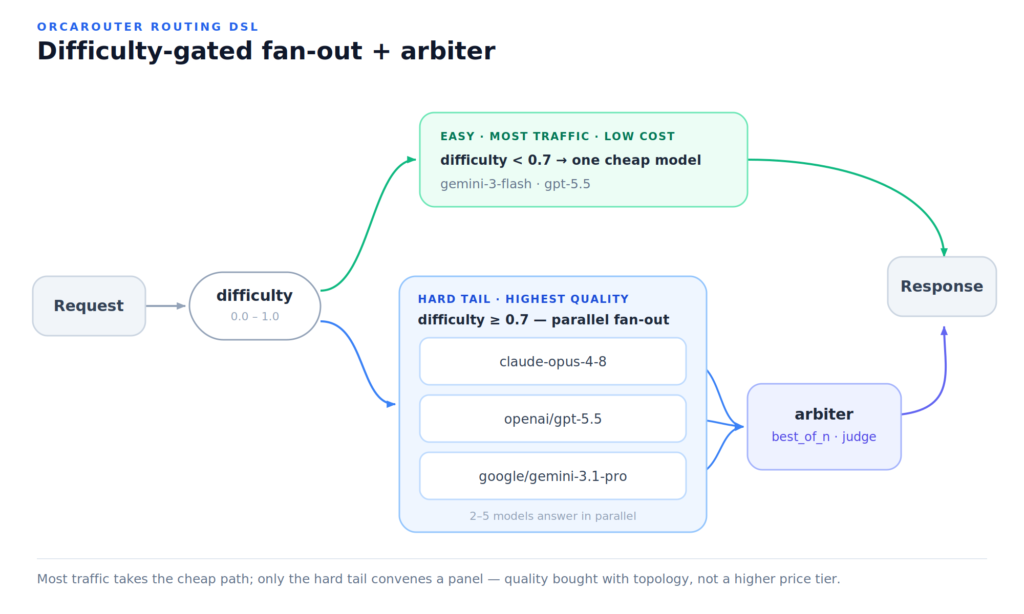
OrcaRouter routes by difficulty and fans out only the hard tail
The same DSL that buys quality can be retuned for latency or cost without rewriting your application. Swap the arbiter from best_of_n (quality) to first (lowest latency, whoever answers first wins) and you trade a little accuracy for speed. Use majority and you drop the extra judge call entirely — the vote is free. Tighten the difficulty threshold for fan-out from 0.7 to 0.85 and fewer requests fan out, lowering cost. Three objectives — cost, latency, quality — expressed in one file, dialed per rule.
The costs people forget
Two hidden costs usually get left out of these comparisons. First, retries: a single premium model that fails or returns an unusable answer costs you the call plus a do-over — sometimes a human one. A panel with arbitration lowers the failure rate, so it can be cheaper in expectation even when its sticker cost per request is higher. Second, the latency distribution: if a fast cheap model handles most traffic in a fraction of the time, your p50 latency drops — fewer timeouts, happier users, less retry traffic, all of which carry real cost. Topology routing optimizes the distribution of cost and latency across your traffic, not just the price of one call. The single-premium-model approach pays the worst-case price on every request, including the trivial ones that never needed it.
Why this matters now
When a frontier model is restricted or pulled, the supply of “top capability” shrinks and its price rises — Fable 5 just made that concrete. Orchestration is a supply-side answer: it lets you reconstruct frontier-level output from cheaper, available models, so your cost structure stops being hostage to one vendor’s pricing tier and access policy. The competitive edge shifts from “which model can you afford?” to “how well do you orchestrate the models everyone can get?”
Try it against your own bill
Don’t take any of this on faith — model it on your own traffic. Write a difficulty-routed strategy, drop a panel on the hard tail, and run it in shadow mode; the projected cost change and quality delta come back before you adopt anything. Buy intelligence with topology, not with a higher price tier. Start at docs.orcarouter.ai/routing/routing-dsl.
