

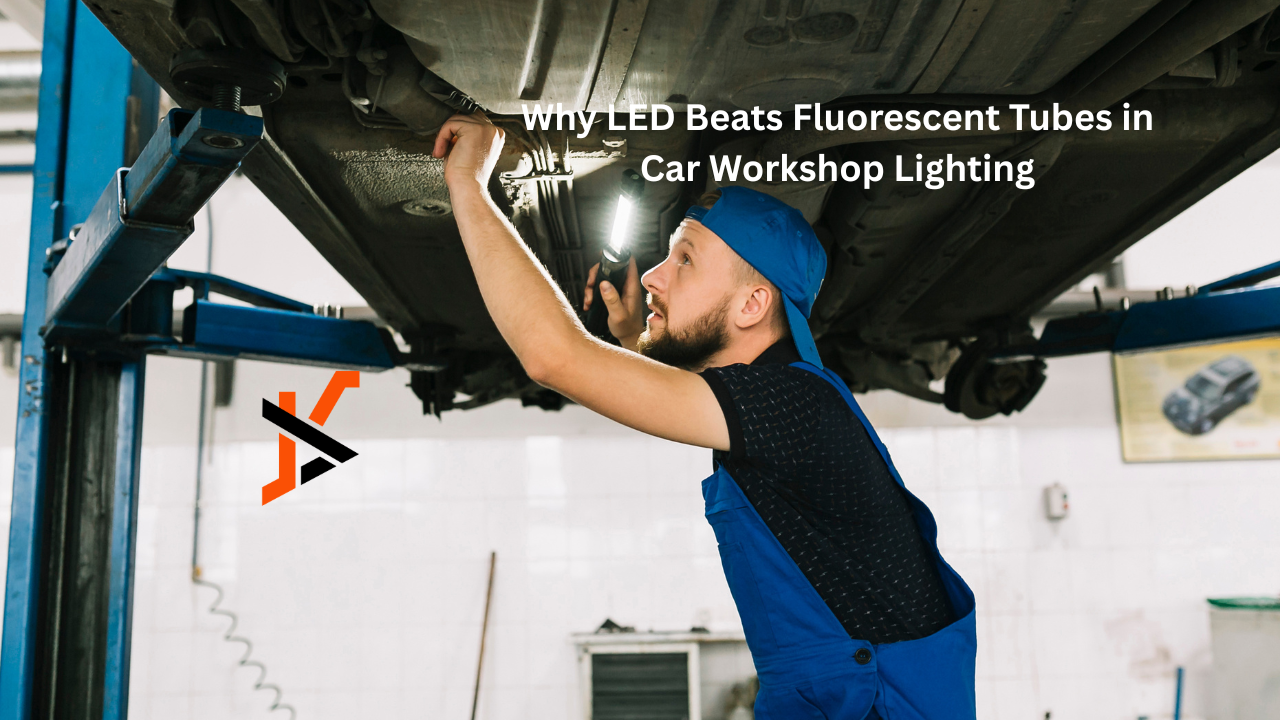
In a car workshop, lighting isn’t a minor detail—it’s the foundation of every task performed under the hood, beneath the chassis, or inside a paint booth. Technicians rely on clear, consistent illumination to spot hairline cracks, match paint colors accurately, and navigate safely around hydraulic lifts and heavy equipment. Poor visibility doesn’t just slow work down; it invites costly mistakes and dangerous accidents. Yet despite these high stakes, countless workshops still operate under the bluish hum of aging fluorescent tubes, a technology designed decades ago for general office environments rather than demanding industrial spaces. The flickering, the warm-up delays, the washed-out color—these aren’t minor inconveniences but systemic drags on quality and efficiency. Modern LED lighting solutions have matured to the point where they directly address every shortcoming fluorescent tubes present in a workshop setting. The transition from fluorescent to LED isn’t simply swapping one bulb for another. It represents a strategic business decision that touches energy costs, worker productivity, maintenance budgets, and workplace safety—making it one of the highest-return investments any commercial or warehouse space operator can make today.
The Core Problem: Why Fluorescent Tubes Fall Short in Workshops
Fluorescent tubes were engineered for offices and retail spaces where the stakes of imperfect lighting are low. In a car workshop, their limitations become operational liabilities that compound daily. The most damaging shortcoming is poor color rendering. Most fluorescent tubes deliver a Color Rendering Index (CRI) between 62 and 80, which means colors appear muted or shifted under their glow. For a technician trying to match a metallic paint code or identify subtle corrosion on a brake line, that distortion translates directly into rework, customer complaints, or overlooked safety issues.
Then there’s the flicker. Fluorescent tubes operating on magnetic ballasts cycle at a frequency that causes perceptible strobing, especially as tubes age. This flicker contributes to eye fatigue, headaches, and reduced concentration over long shifts—problems that erode both morale and output. Compounding this is the warm-up period; on cold mornings, fluorescent tubes can take several minutes to reach full brightness, leaving technicians squinting during the critical first tasks of the day. In unheated workshops or those with large bay doors open to winter air, performance degrades further because fluorescent gas discharge technology is inherently sensitive to ambient temperature drops.
Maintenance demands add another layer of cost. Ballasts fail unpredictably, tubes degrade in output long before they burn out completely, and the combination means workshop managers either accept gradually dimming conditions or schedule frequent, disruptive replacements. Each failed fixture above a service bay requires ladder work near lifts and vehicles—an avoidable safety exposure. Additionally, fluorescent tubes emit low levels of ultraviolet radiation and generate considerable heat at the ballast, introducing fire risk near flammable solvents and contributing to uncomfortable working temperatures during summer months. Collectively, these issues don’t just inconvenience a workshop; they systematically inflate operating costs while undermining the quality and safety standards the business depends on.
The LED Advantage: Key Benefits for Optimal Car Workshop Lighting
Where fluorescent tubes introduce compromise, LED lighting solutions deliver precision engineered for demanding environments. The advantages fall into three categories that matter most to workshop operators: light quality, energy efficiency, and durability.
Superior light quality is where LED technology makes the most immediate difference on the shop floor. High-CRI LED fixtures—rated 90 or above—render colors with near-daylight accuracy, allowing technicians to distinguish between similar paint shades, spot subtle fluid leaks, and identify wear patterns on belts and hoses without second-guessing what they see. Beyond color accuracy, LED panels and linear fixtures distribute light uniformly across wide bays, eliminating the bright-center, dim-edge pattern typical of aging fluorescent installations. This even coverage means fewer portable work lights cluttering the floor and fewer shadows hiding critical details beneath engines or undercarriages. For workshops that also function as warehouse lighting environments—storing parts, tires, and fluids—consistent illumination reduces picking errors and inventory mishaps.
Energy efficiency translates directly to the bottom line. LED fixtures consume 40 to 60 percent less electricity than fluorescent equivalents while delivering equal or greater lumen output. Because LEDs direct light downward rather than radiating it in all directions, fewer fixtures are often needed to achieve the same coverage, compounding the savings. Over a twelve-hour operating day common in busy workshops, the reduction in kilowatt-hours accumulates rapidly across dozens of fixtures.
Durability and reliability round out the operational case. Quality LED fixtures last 50,000 hours or more—roughly five to seven times the useful life of a fluorescent tube—and they maintain consistent output throughout that span rather than gradually dimming. They ignite instantly at full brightness regardless of temperature, making them ideal for unheated bays and early-morning cold starts. Solid-state construction means no fragile glass tubes or failing ballasts, and resistance to vibration from compressors, impact wrenches, and overhead cranes ensures fixtures stay functional in environments that punish delicate components. This combination of longevity, instant-on performance, and mechanical toughness makes LED the definitive choice for any workshop seeking dependable, high-quality illumination day after day.
Planning Your Shift: A Step-by-Step Guide to LED Implementation
Recognizing that LED outperforms fluorescent is only the first half of the equation. The second half—executing the transition efficiently—determines how quickly you recoup your investment and how smoothly daily operations continue during the changeover. A structured approach prevents common pitfalls like over-specifying expensive fixtures in low-priority zones or under-lighting critical inspection areas.
Step 1: Conduct a Lighting Audit & Define Needs
Before purchasing a single fixture, walk your facility with a lux meter and a critical eye. Measure existing light levels at workbench height, on lift platforms, and at floor level in each bay. Note which fluorescent tubes have visibly dimmed, which ballasts buzz or delay ignition, and where technicians have resorted to portable lamps to compensate for overhead deficiencies. Document these trouble spots on a simple floor plan. Next, segment your workshop into functional zones—service bays demand high-intensity, high-CRI illumination for detail work; paint preparation and inspection areas require even higher color accuracy; parts storage and warehouse lighting zones need uniform coverage to prevent picking errors but can tolerate slightly lower intensity; and walkways or parking areas prioritize safety-level visibility. For each zone, establish measurable goals: a target lux level (typically 500 lux for general mechanical work, 750 to 1000 for inspection and paint tasks), a minimum CRI threshold, and an energy-reduction percentage you want to achieve. These benchmarks transform a vague “upgrade the lights” intention into a specification sheet that guides purchasing decisions and validates results after installation.
Step 2: Choosing the Right LED Fixtures and Alternatives
With your audit data in hand, match each zone to the appropriate fixture type. High-bay LED luminaires—such as those offered by manufacturers like Hyperlite—suit workshops with ceiling heights above four meters, delivering concentrated downward output that reaches work surfaces without wasted side-spill. For standard-height ceilings, linear LED fixtures—either retrofit tubes that slot into existing fluorescent housings or entirely new integrated fixtures—offer the most straightforward fluorescent tube alternatives. Retrofit kits reduce installation labor because they reuse existing trunking, but new integrated fixtures eliminate aging wiring and ballast housings entirely, providing a cleaner long-term solution. Task lighting, such as adjustable LED arms mounted on lifts or benches, supplements overhead coverage in deep engine bays and undercarriage work. When comparing commercial lighting options, prioritize these specifications: an IP65 or higher ingress protection rating for areas exposed to water spray and dust, a color temperature between 5000K and 6000K to simulate daylight and maximize visual acuity, beam angles that match mounting height to coverage area, and dimmability for zones where intensity needs shift throughout the day. Selecting fixtures with integrated drivers rated for high ambient temperatures ensures reliability even during summer months when workshop roofs radiate heat downward.
Step 3: Installation and Optimization for Productivity & Safety
Proper placement matters as much as fixture selection. Position linear fixtures parallel to the length of service bays so that light falls evenly on both sides of a raised vehicle, eliminating the deep shadows that form when fixtures run perpendicular to the work axis. Maintain consistent spacing—generally 1.0 to 1.5 times the mounting height—to prevent bright spots directly beneath each fixture and dim valleys between them. In inspection pits and beneath lifts, angled supplementary fixtures ensure undercarriage visibility without glare into technicians’ eyes. Safety gains extend beyond simple visibility improvements. LEDs operate at significantly lower surface temperatures than fluorescent ballasts, reducing fire risk in areas where solvent vapors accumulate. The complete absence of flicker removes a chronic source of eye strain and headaches, helping technicians maintain concentration through ten- or twelve-hour shifts. Instant-on performance eliminates the vulnerable minutes of dim light when bays open on cold mornings—exactly when slippery floors and cold-stiffened movements make accidents most likely. Before finalizing your project budget, research local utility rebates and government incentive programs for energy-efficient upgrades. Many jurisdictions offer per-fixture rebates or tax deductions that can offset 15 to 30 percent of material costs, accelerating payback and making the financial case even more compelling for workshop owners evaluating the transition.
Calculating the Real ROI: Beyond Just Bulb Replacement
Workshop owners often fixate on the upfront price difference between LED fixtures and fluorescent replacements, but this narrow comparison ignores where the real financial story unfolds. A proper total-cost-of-ownership analysis reveals that LED lighting pays for itself faster than almost any other facility upgrade. Start with energy: if a 40-fixture workshop replaces 58-watt fluorescent tubes with 22-watt LED equivalents running twelve hours daily, the annual electricity savings alone can reach thousands of dollars depending on local utility rates. Multiply that across a fixture lifespan of 50,000 hours, and the cumulative energy savings dwarf the initial purchase premium several times over.
Maintenance costs tell an equally compelling story. Eliminating ballast replacements, reducing tube change-outs by a factor of five, and removing the need for after-hours maintenance labor frees both budget and staff time. Less obvious but equally real are the productivity dividends—technicians working under flicker-free, high-CRI illumination complete diagnostic and finishing tasks faster with fewer callbacks. One fewer rework per week on a paint correction or missed fault diagnosis easily justifies the lighting investment within months. Safety improvements also carry financial weight: fewer slip-and-trip incidents, reduced eye-strain claims, and lower fire risk translate into decreased insurance premiums and liability exposure over time. When you stack energy savings, maintenance elimination, productivity gains, and risk reduction into a single calculation, most workshops achieve full payback within 18 to 30 months—after which every operating hour represents pure return on a decision that simultaneously improved working conditions and output quality.
Make the Switch: Upgrade Your Workshop Lighting Today
The evidence is unambiguous: LED lighting surpasses fluorescent tubes across every metric that matters in a car workshop—color accuracy for precision tasks, energy efficiency for operational savings, mechanical durability for demanding environments, and safety performance for protecting both people and property. Fluorescent technology, designed for a different era and a different purpose, simply cannot meet the visual, financial, and regulatory demands of a modern automotive service facility. Upgrading to LED is not a cosmetic refresh; it is a strategic operational decision that elevates work quality, reduces recurring costs, and creates a safer environment for every technician on the floor. The payback period is short, the productivity gains are immediate, and the maintenance relief is lasting. For workshop owners and facility managers still operating under aging fluorescent installations, the logical next step is clear: assess your current car workshop light conditions, quantify the gaps, and begin planning a transition that will deliver measurable returns from the first month forward. The technology is proven, the economics are favorable, and every day of delay is simply another day of paying more for less.
