


Introduction
For years, game development has been seen as a technical discipline reserved for programmers and experienced designers. Building even a simple playable game traditionally required knowledge of programming languages, game engines, and complex development workflows. For many people with creative ideas, the technical barrier alone was enough to stop them from ever starting.
That situation is now changing.
A new generation of AI development platforms is beginning to reshape how games are created. Instead of focusing on syntax and technical frameworks, these tools allow creators to focus on describing ideas. AI systems can then translate those ideas into functional game structures.
Among these emerging platforms, MeDo represents a growing category of AI-assisted creation tools that aim to make development faster, simpler, and more accessible to a wider group of creators.
Rather than replacing developers, tools like MeDo are redefining how the first version of a game can be created.
The Emergence of AI Game Builders
AI game builders belong to a broader trend sometimes described as AI-assisted creation platforms. These systems reduce development complexity by generating structure, logic, and interface components from natural language instructions.
Instead of writing hundreds of lines of code, users can describe gameplay mechanics, interactions, or visual layouts. The system then produces a working foundation that can be refined further.
This approach is often referred to as vibe coding — a workflow where creators communicate intent rather than implementation details.
Within this model, technical setup becomes secondary. The focus shifts toward experimentation, iteration, and creativity.
MeDo operates within this space by combining:
- natural language generation
- no-code development workflows
- automated backend setup
- rapid prototyping capabilities
The result is a system where development begins with ideas rather than infrastructure.
Why AI-Assisted Game Development Is Expanding
The growing interest in AI game development is not accidental. Traditional workflows remain powerful, but they also remain slow.
Building even a basic prototype can require:
- engine configuration
- scripting
- debugging
- asset integration
- deployment setup
For experimentation, this overhead can be excessive.
AI tools reduce this friction by allowing developers to test ideas almost immediately. Instead of spending weeks preparing a prototype environment, creators can generate early versions quickly and refine them afterward.
This shift explains why AI tools are increasingly appearing in:
- game jam environments
- AI coding competitions
- rapid prototyping workflows
- experimental indie development
Speed of iteration is becoming just as important as technical depth.
What Makes MeDo Different From Typical AI Coding Tools
Many AI coding assistants focus primarily on generating isolated code snippets. While useful, this often still requires developers to integrate everything manually.
MeDo instead focuses on complete product generation. Rather than generating fragments, it aims to generate working structures that can evolve into real applications. This includes not only games, but also websites, applications, and digital products. Its workflow centers around natural language interaction: Describe the idea → generate structure → refine through iteration.
This makes it approachable for beginners while still useful for experienced developers who want faster prototyping cycles.
Key Capabilities That Define MeDo
1. Development Without Traditional Coding
MeDo allows users to build functional games without requiring conventional programming workflows. Instead of writing logic manually, users can define behavior through prompts and configuration.
2. Natural Language Driven Creation
The platform’s vibe coding approach allows users to describe gameplay ideas conversationally. This reduces the gap between concept and implementation.
3. Faster Iteration Cycles
Because early versions can be generated quickly, developers can spend more time refining gameplay instead of building infrastructure.
4. Automated Backend Support
Handling backend systems such as databases and APIs is often one of the most difficult parts of development. MeDo simplifies this by integrating these capabilities directly into the platform.
5. Browser-Based Development
Because the platform runs online, creators can work directly from a browser environment without installing complex toolchains.
6. Accessible Pricing Structure
MeDo follows a freemium model designed to lower the barrier to entry. New users receive starter credits and daily login credits, allowing experimentation without immediate financial commitment.
Instead of requiring subscriptions upfront, the credit model encourages exploration first. Users who need more capacity can then move to paid plans starting at around $20 per month.
This structure reflects a broader trend among AI platforms: reducing risk for first-time builders.
Beyond Games: Broader Development Possibilities
Although often discussed as an AI game builder, MeDo is not limited to game development.
The same AI-driven workflow can also be used for:
- commercial websites
- landing pages
- personal portfolios
- web applications
- ecommerce storefronts
- experimental product prototypes
Because the platform manages much of the technical complexity, creators can focus on product direction rather than system configuration.
This reflects a broader industry shift where creation tools are becoming idea-first rather than code-first.
A Simple Example: Building a Game With AI
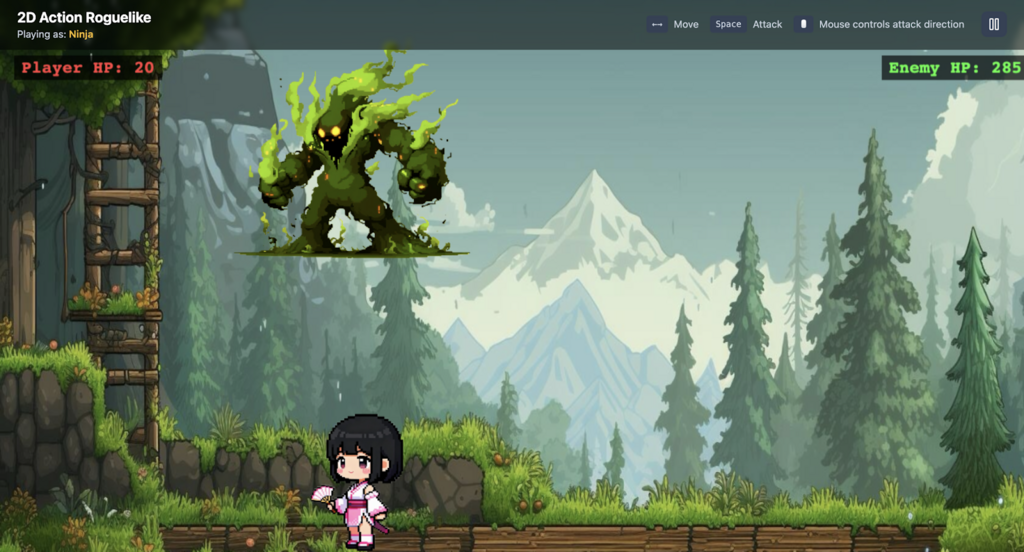
To better understand how this process works, consider a simple example project called Lost Path.
Step 1: Generate the Initial Game Concept
The first step is describing the gameplay structure, player interaction, and environment in a single prompt.
This is a 2D side-scrolling action roguelike. The player moves left and right, attacks enemies, and tries to survive a dangerous journey. Use the uploaded background, character, and enemy assets to build the scene. The player can use “A and D” in keyboard to let the character move left and right and press “space” to perform a basic attack. The player takes damage when hit by the monster. The goal of each run is to defeat the enemy. If the player dies, the run ends and restarts from the beginning.
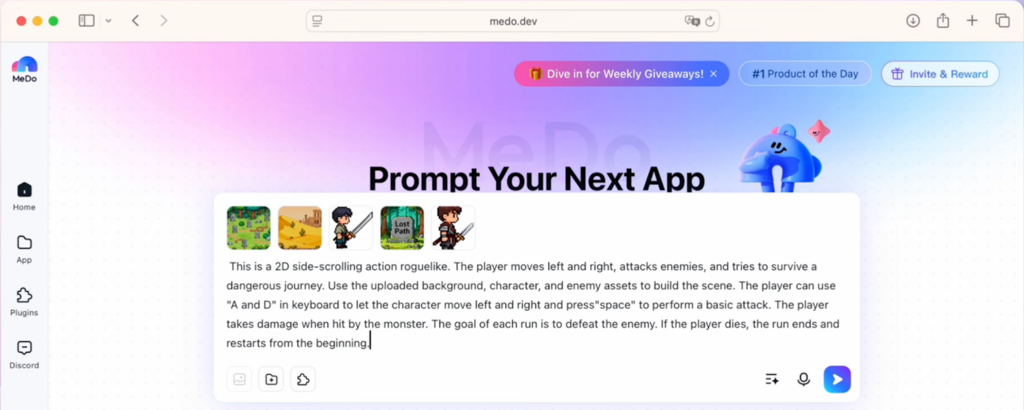
Once submitted, MeDo generates a playable starting version including the core mechanics.
Step 2: Expanding the Game Design
After the first version is generated, improvements can be made through additional prompts.
The three buttons should be located in the lower part of the screen, and their colors should be dark green, brown, and gray. Add multiple levels, with the difficulty increasing from one level to the next.
Step 3: Testing and Deployment
Once the experience feels stable, the game can be tested and prepared for release.
Most of the development time typically shifts toward improving gameplay experience rather than building initial functionality.
This reflects the biggest change AI tools bring: development begins with something playable instead of something theoretical.
Conclusion
AI development platforms are gradually changing the entry point into software creation, allowing more people to experiment with building digital products. Tools like MeDo illustrate how development workflows are shifting from code-heavy processes toward idea-driven execution.
As AI creation platforms mature, the difference between having an idea and testing that idea continues to shrink. In this environment, the advantage may no longer belong only to those who can code, but to those who can iterate quickly and think clearly about what they want to build.
FAQs
Can someone without technical experience really build a game this way?
Yes. AI builders reduce technical requirements by generating structure automatically. While complex projects still benefit from development knowledge, beginners can create functional prototypes without traditional coding.
Is programming knowledge required to use MeDo?
No. Most workflows rely on prompts and configuration rather than manual coding. Technical skills can help with advanced customization but are not required to begin.
What else can be built besides games?
The platform supports a range of digital products including websites, apps, ecommerce platforms, and portfolio projects.
Can generated games be modified later?
Yes. AI-generated versions are intended as starting points. Creators can continue refining features through additional prompts and adjustments.
How quickly can a simple game be created?
A basic playable version can often be generated within minutes. Most development time is typically spent refining interaction quality and design details.
