

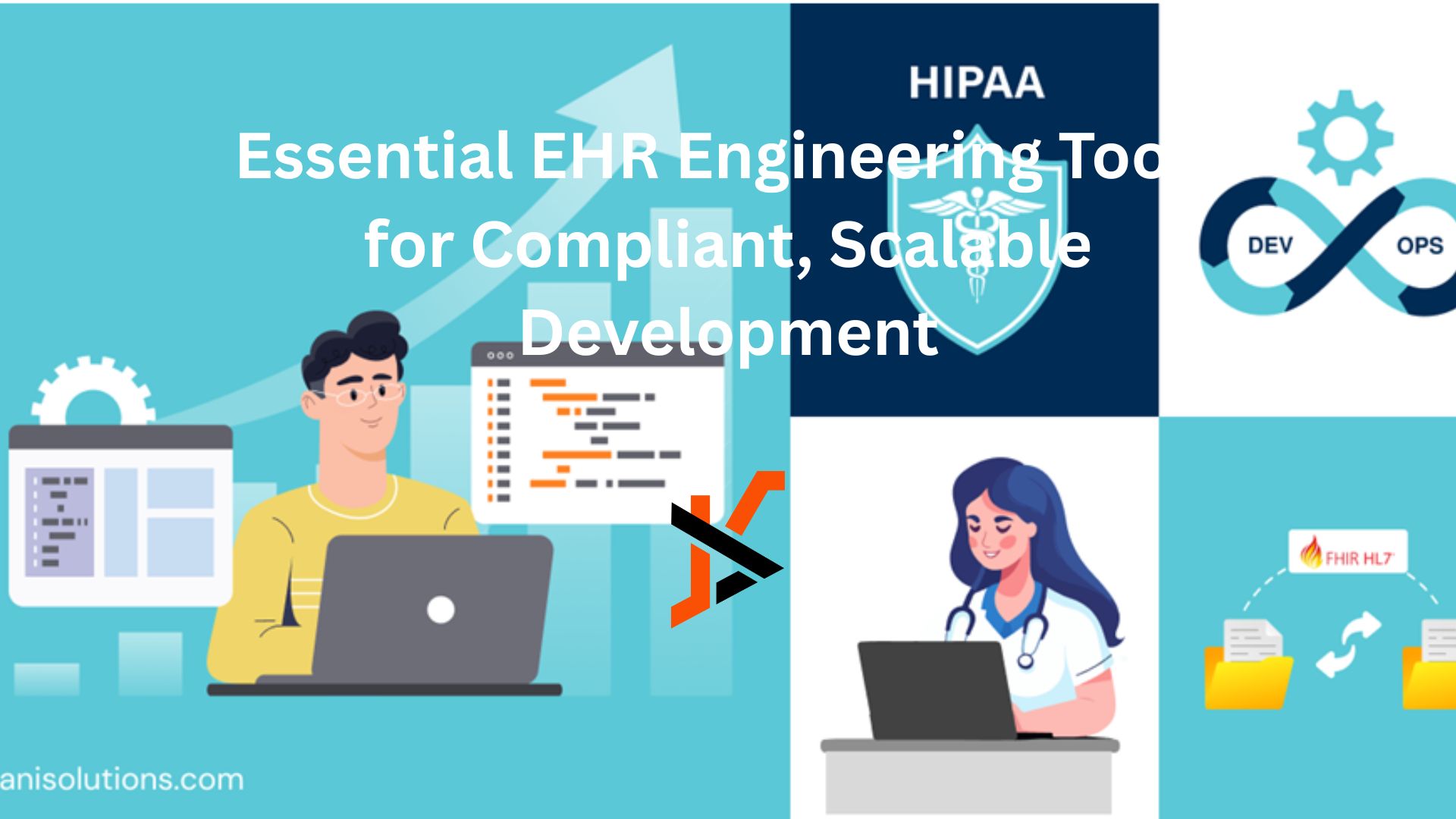
Productivity Tools Every EHR Developer Should Know
Right now, EHR has become an intelligent tool that supports care rather than just a digital filing shelf. And with this change, the development process has also evolved to adopt interoperability, AI-powered features, and compliance.
Most importantly, EHR developers need to integrate EHRs seamlessly with labs, pharmacies, and billing systems, while meeting HIPAA and ONC requirements. And this is something that is not just achievable through skills; they also need to understand the EHR engineering tools.
However, the catch is that they need to be proficient in the right tools, because wrong tools impact scalability, open security gaps, and increase the cost of maintenance in the long run. That’s why choosing the right healthcare software development tools matters so much.
Because when chosen correctly, these tools boost productivity, helping developers deploy components faster and stay compliant, without compromising quality and speed.
That’s why, in this guide, we will walk you through essential EHR interoperability tools and engineering platforms that help developers deliver future-ready and reliable EHR systems.
Core EHR Engineering Tools That Drive Productivity
Let’s start by understanding the core engineering tools before diving into how they help development teams. For any serious EHR developer, interoperability comes first. EHR interoperability tools like FHIR APIs and HL7 integration engines enable seamless connectivity with labs, pharmacies, imaging systems, and third-party platforms, without hardcoding brittle integrations that break at scale.
Next comes infrastructure. Cloud-native platforms built for regulated workloads—such as Amazon Web Services and Microsoft Azure, allow teams to deploy securely, scale on demand, and bake compliance into the architecture. These environments are no longer optional; they’re core EHR development tools for modern healthcare systems.
Finally, reusable components and SDKs play a massive role in productivity. Pre-built modules for e-prescribing, scheduling, identity management, and patient portals reduce time-to-market while enforcing consistency across workflows. When chosen wisely, these healthcare software development tools eliminate repetitive engineering work and act as true productivity tools for EHR developers, freeing teams to focus on clinical logic instead of reinventing the basics.
Together, these tools determine whether an EHR scales confidently—or slowly accumulates technical debt.
Collaboration, Project Management & Delivery Tools
Even the best EHR engineering tools fall short if teams are not aligned. EHR development sits at the intersection of engineering, clinical workflows, compliance, and operations. That makes collaboration tools essential productivity tools for EHR developers, not optional add-ons.
It starts with workflow and UX mapping. Visual design and process-mapping tools help teams document real clinician workflows before development begins. This approach reduces rework and ensures the EHR reflects how care is actually delivered, not how it looks on paper. For any EHR developer, early workflow clarity directly improves usability, adoption, and long-term maintainability.
Project management tools provide the structure needed to deliver in regulated environments. Agile platforms support sprint planning while tracking compliance milestones, documentation, and release readiness. These EHR development tools give engineering and compliance teams shared visibility, which helps prevent last-minute fixes and audit risks.
Secure communication tools complete the delivery stack. Daily coordination between developers, QA teams, product owners, and clinicians requires speed without compromising security. When collaboration stays centralized and auditable, healthcare software development tools reduce misalignment and keep delivery predictable as systems scale.
Testing, Security, and Compliance Automation
Testing and compliance are where many EHR projects quietly fail. Manual checks do not scale, and reactive security reviews often surface issues too late. This is why automation-focused EHR engineering tools are critical for reliable delivery.
Automated testing frameworks sit at the core. CI/CD pipelines validate performance, data integrity, and regression risks with every release. For an EHR developer, these EHR development tools reduce human error while ensuring new features do not break existing clinical workflows or integrations.
Safe testing also depends on realistic data. Synthetic test data tools allow teams to simulate real-world scenarios without exposing PHI. By using PHI-free datasets, healthcare software development tools enable broader testing coverage while maintaining HIPAA compliance throughout development and QA cycles.
Security and compliance automation completes the stack. Automated scanners and policy checks continuously monitor access controls, audit logs, encryption standards, and vulnerabilities. These productivity tools for EHR developers shift compliance from a last-minute checkbox to a built-in engineering discipline. When combined with EHR interoperability tools, they also ensure that connected systems meet the same security standards.
In regulated environments, automated testing and compliance are not accelerators. They are the foundation of safe, scalable EHR delivery.
Conclusion
Productivity in EHR development is not about writing more code faster. It is about building systems that remain reliable, compliant, and scalable as clinical and regulatory demands grow. The right EHR engineering tools give every EHR developer the structure needed to deliver safely, from interoperability and cloud infrastructure to collaboration, testing, and compliance automation.
When teams rely on purpose-built EHR development tools and healthcare software development tools, they reduce technical debt and avoid costly rework. These are not just efficiency gains; they directly impact patient safety and long-term system stability.
Looking to build or modernize your EHR with the right tools and expertise? Click here to book a call with our development teams.
Frequently Asked Questions
- What are the most essential EHR engineering tools for ensuring US regulatory compliance?
Essential EHR engineering tools include automated audit logging, role-based access control, encryption management, CI/CD compliance checks, and interoperability validation tools. These ensure HIPAA, ONC, and CMS requirements are enforced consistently throughout development and deployment.
- How do modern productivity tools help reduce clinician burnout in custom EHR systems?
Modern productivity tools for EHR developers enable workflow-driven design, automation, and reusable components. This results in fewer clicks, faster documentation, and better-aligned interfaces, which directly reduce cognitive load and documentation fatigue for clinicians.
- What is the role of FHIR APIs in accelerating EHR development timelines?
FHIR APIs standardize data exchange, reducing custom integration work. As key EHR interoperability tools, they speed up connections with labs, pharmacies, and third-party systems while improving scalability and lowering long-term maintenance efforts.
- Can AI-driven build systems replace traditional coding in healthcare software?
AI-driven tools can accelerate development through code generation, testing, and documentation. However, they cannot fully replace traditional coding. Regulatory complexity, clinical logic, and security controls still require experienced EHR developers and human oversight.
- What security tools are mandatory for a HIPAA-compliant developer environment?
Mandatory security tools include access control management, encryption key services, audit logging, vulnerability scanning, and secure CI/CD pipelines. These healthcare software development tools ensure PHI protection across development, testing, and production environments.
SEO Semrush Score
Human Score
