

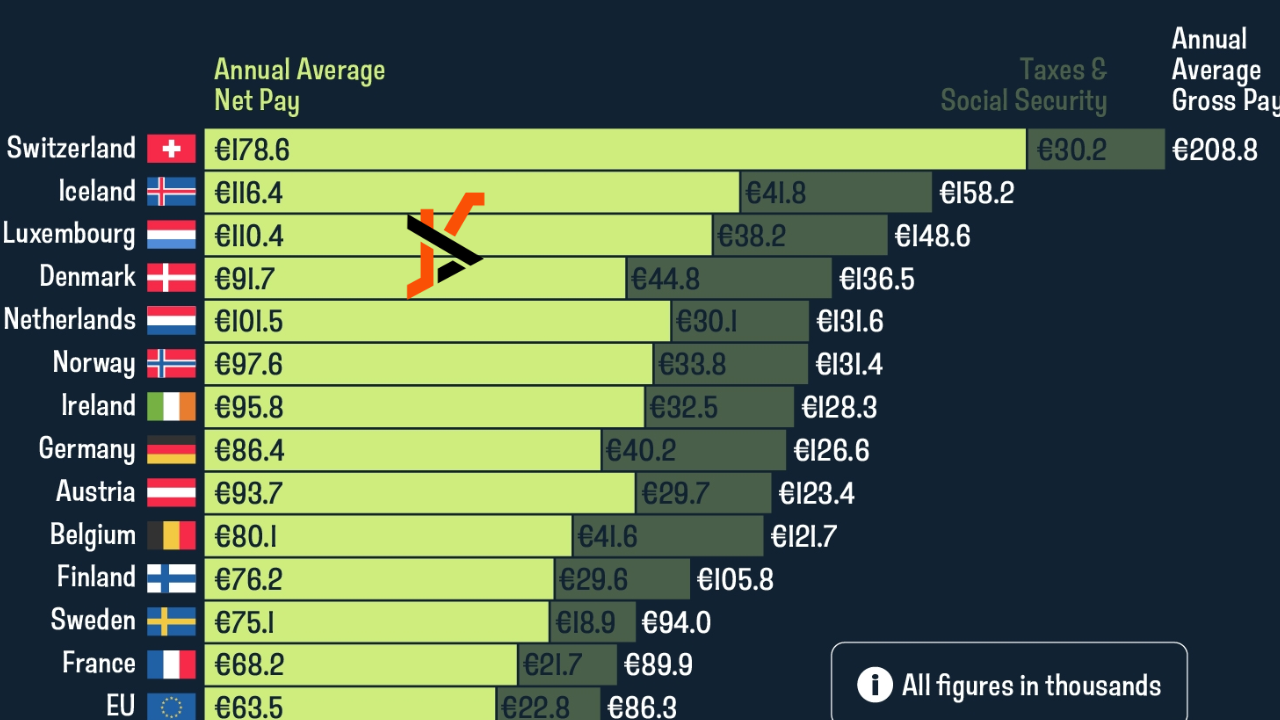
When professionals think about working or relocating within Europe, one of the most important financial considerations is the difference between gross and net income. While a gross salary may look attractive on paper, what truly matters is the net amount that ends up in your bank account after taxes and social contributions. Italy, like every other EU country, applies its own tax system and rules for social security, which can greatly influence take-home pay. This article explores how Italy compares with other European Union countries in terms of gross to net income, highlighting the differences that affect workers and businesses alike.
Understanding gross and net income
Gross income refers to the total salary or wages an employee earns before any deductions. This includes base salary, bonuses, overtime, and other taxable benefits. Net income, on the other hand, is what remains after subtracting income tax, social security contributions, health insurance premiums, and other mandatory charges.
The gap between gross and net varies significantly from country to country within the EU, depending on tax structures, contribution rates, and allowances. Some nations take a large share in taxes but return generous benefits in public services, while others allow employees to keep more of their income but provide fewer social benefits.
The Italian tax system and social contributions
In Italy, employees face progressive income tax rates, known as IRPEF (Imposta sul Reddito delle Persone Fisiche). These rates range from 23% for lower-income brackets to 43% for high earners. In addition to national taxes, there are also regional and municipal surtaxes that vary depending on where an individual lives.
Social security contributions are another important deduction from gross salaries in Italy. Employees typically contribute around 9–10% of their gross salary, while employers contribute significantly more, often exceeding 30%. These contributions finance pensions, unemployment benefits, and healthcare.
Because of this structure, the difference between gross and net income in Italy can be substantial.
A professional earning €40,000 gross annually may take home closer to €27,000–€29,000 net, depending on their location and personal tax situation. For more information about this, consider reading this article about gross to net Italy.
Comparing Italy with Northern European countries
Northern European countries like Germany, the Netherlands, and Sweden are known for high taxes, but they also provide strong social welfare systems.
- Germany: Employees in Germany face progressive taxes up to 45% for top earners, along with social security contributions of roughly 20% split between employer and employee. However, Germany also offers a range of tax deductions and family benefits that can reduce the effective tax burden. The net income for a mid-range salary tends to be slightly higher than in Italy, thanks to different regional tax rules and more generous allowances.
- Netherlands: The Dutch system applies a combined income tax and social security contribution that can reach around 37–49%. While this sounds heavy, Dutch employees benefit from strong healthcare, housing subsidies, and child allowances. A €40,000 gross salary in the Netherlands results in a take-home pay close to Italy’s levels, though benefits may offset the lower net.
- Sweden: Sweden’s tax burden is among the highest in Europe, with national and municipal taxes often exceeding 50% combined. Despite this, Swedish citizens benefit from comprehensive welfare services, including free education and healthcare. Compared with Italy, the net income on a gross salary may be lower, but the extensive state-provided services reduce the need for private spending.
Comparing Italy with Southern European countries
Southern Europe, including Spain, Portugal, and Greece, shares similarities with Italy in terms of taxation and income distribution.
- Spain: Income tax in Spain ranges from 19% to 47%, depending on the region. Social contributions are slightly lower than in Italy, with employees paying around 6–7%. This means Spanish workers often retain a higher percentage of their gross salary compared to Italians, though the gap is not dramatic.
- Portugal: Portugal applies progressive tax rates from 14.5% to 48%. Social contributions are around 11% for employees. As a result, net salaries in Portugal are somewhat higher relative to gross than in Italy, particularly for mid-income earners. However, average gross salaries are lower than Italy’s, which balances the comparison.
- Greece: Greece has progressive tax rates up to 44% and employee social contributions of about 15%. The net income for a gross salary in Greece is comparable to Italy, although Greece has historically lower gross salaries, making overall disposable income smaller.
Comparing Italy with Eastern European countries
Eastern EU countries often present lower tax burdens and lower gross salaries.
- Poland: With a flat income tax rate of 12% up to a certain threshold and 32% for higher earners, Poland allows many employees to retain more of their gross salary. Social contributions apply, but they are not as heavy as in Italy. For middle-income earners, Poland’s net income tends to be closer to gross compared to Italy, although absolute salary levels are lower.
- Hungary: Hungary operates a flat 15% income tax, one of the lowest in the EU. Employees also pay social contributions, but the overall deductions are lighter than in Italy. This results in a smaller gap between gross and net, making Hungary one of the countries where take-home pay feels closest to the gross figure.
- Czech Republic: The Czech Republic applies a flat 15% income tax and relatively moderate social security contributions. This creates a more favorable gross-to-net ratio than Italy, though gross salaries in the Czech Republic are significantly lower on average.
Factors beyond taxation that affect net income
While comparing gross-to-net ratios is important, workers should also consider the cost of living, public services, and average salaries.
- In countries with higher taxation like Sweden or the Netherlands, employees receive more services in return, such as universal healthcare, generous parental leave, and free education.
- In Italy, while taxes are relatively high, the quality and accessibility of services such as public healthcare can vary greatly by region.
- Countries with lower tax burdens, like Hungary or Poland, may allow higher take-home pay proportionally, but employees may need to spend more privately on services not fully covered by the state.
This means the net salary figure alone does not tell the full story of economic well-being.
Italy in the EU context
When looking at the European Union as a whole, Italy falls in the middle-to-high range in terms of deductions from gross income. While countries like Sweden and Denmark reduce net salaries even further, Italy’s gap between gross and net is larger than in many Eastern and Southern European countries.
For highly skilled professionals, the Italian system can feel burdensome due to high social contributions and limited deductions compared to countries like Germany. On the other hand, Italy still offers valuable benefits such as universal healthcare, pension schemes, and employee protections.
What this means for workers and employers
For employees, understanding the difference between gross and net income is crucial when negotiating a salary or considering relocation. What seems like an attractive gross salary may translate into significantly less disposable income depending on the country.
For employers, offering competitive salaries means accounting for how workers perceive their net pay compared to other destinations. In Italy, employers bear a heavy share of social contributions, making labor costs high. This can discourage companies from offering higher gross salaries, indirectly affecting workers’ net income.
Conclusion
The comparison between Italy and other EU countries reveals that the gross-to-net income gap varies widely. Italy’s combination of progressive taxation and high social contributions places it among the countries where employees lose a significant share of gross earnings. Compared to Northern Europe, Italian workers may take home slightly less for similar gross salaries, while in Eastern Europe, the gap between gross and net is narrower, though overall salaries are lower.
Ultimately, gross-to-net comparisons should be balanced with considerations of public services, quality of life, and cost of living. Workers relocating within the EU need to assess not only what they will earn, but also what they will get in return for the taxes and contributions they pay.
