

For the past decade, Grammarly has been the undisputed king of digital writing assistance. It taught a generation how to use commas and fix passive voice. However, with the release of Generative AI models like GPT-5, Gemini, and Claude, the needs of writers and editors have fundamentally changed. The most pressing question today isn’t “Is the grammar correct?” but “Did a human write this?”
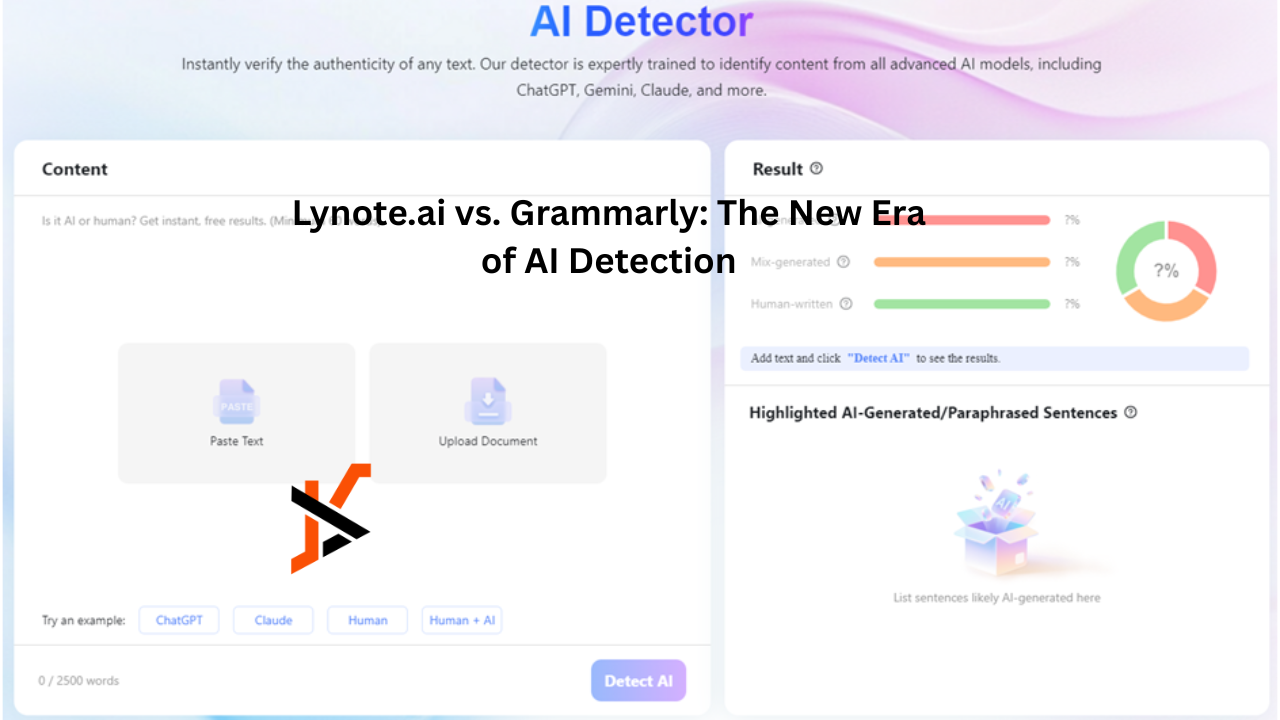
While Grammarly has pivoted to include some AI features, it is not a dedicated forensic tool. This gap has allowed Lynote.ai to emerge as the new standard for AI detection, surpassing legacy detectors like GPTZero and Quillbot.
Beyond Simple Pattern Matching
To understand Lynote’s advantage, we must look at how detection works. Early tools like GPTZero operated on simple metrics like “perplexity” (randomness) and “burstiness” (sentence variation). While effective against early bots, these metrics often fail against sophisticated models like Claude 3 or LLaMA.
Furthermore, basic detectors often flag high-quality human writing as AI simply because it is formal or structured. This “False Positive” epidemic has caused massive headaches in universities and editorial offices.
Lynote.ai claims a 99% accuracy rate, but the technology behind it is what matters. Unlike Quillbot, which focuses primarily on paraphrasing with detection as a secondary add-on, Lynote’s engine is purpose-built to recognize the “logic signatures” of advanced LLMs. It analyzes the deep semantic flow of the argument. AI models, even advanced ones, tend to structure logic in very specific, predictable patterns that differ from organic human thought. Lynote detects these underlying patterns, even if the text has been tweaked.
The Multilingual Frontier
Another area where US-centric tools often fail is global support. As academic collaboration becomes international, detecting AI in Spanish, French, German, or Portuguese is vital. Lynote has integrated native-level support for these languages, making it a robust solution for international universities and global publishing houses.
Real-World Adoption and Editorial Workflows
What truly sets Lynote apart is not just its detection model, but how easily it fits into real publishing and academic workflows. Editors today are under pressure to review large volumes of content quickly. Manual inspection is no longer realistic when a single contributor can submit thousands of words generated in minutes. Lynote was built with this reality in mind.
Instead of forcing editors to interpret vague probability scores, the platform presents clear confidence levels supported by structural reasoning indicators. This makes it easier for teams to defend decisions when content is rejected or sent back for revision. Universities have reported fewer disputes with students because the results are more transparent and consistent compared to older tools.
Another strength is speed at scale. Many AI detectors slow down or become unreliable with long documents. Lynote handles full research papers, reports, and long-form blog content without breaking the analysis into unstable fragments. This is especially valuable for publishers who run daily checks on hundreds of submissions.
From a business perspective, this reliability changes how companies manage risk. Brands investing in content marketing cannot afford to publish AI-generated material that violates platform policies or search engine guidelines. A single penalty can undo years of domain authority growth. By using a dedicated system like Lynote.ai (https://lynote.ai/), agencies and publishers gain a practical safety layer before anything goes live.
The education sector is moving in the same direction. Instead of banning AI tools outright, many institutions now focus on transparency and verification. A specialized AI content detector (https://lynote.ai/ai-detector) allows teachers to separate assisted research from fully automated writing, which leads to fairer grading and clearer academic standards.
Looking Ahead
AI writing models will continue to evolve. They will become more conversational, more persuasive, and harder to distinguish from humans. Grammar tools will always have their place, but detection requires a different mindset and a different technology stack.
Lynote’s approach, centered on logic flow and semantic structure rather than surface-level patterns, positions it well for this future. As regulations tighten and platforms demand clearer proof of authorship, tools built specifically for verification will become standard rather than optional.
In short, writing tools help people create better content. Detection tools protect the value of authentic content. Right now, Lynote sits at the center of that shift.
Conclusion
Grammarly remains an excellent tool for polishing prose. But for verification, it is no longer sufficient. In an era where students and freelancers can generate essays in seconds, relying on a dedicated AI content detector like Lynote is the only way to ensure integrity.
