

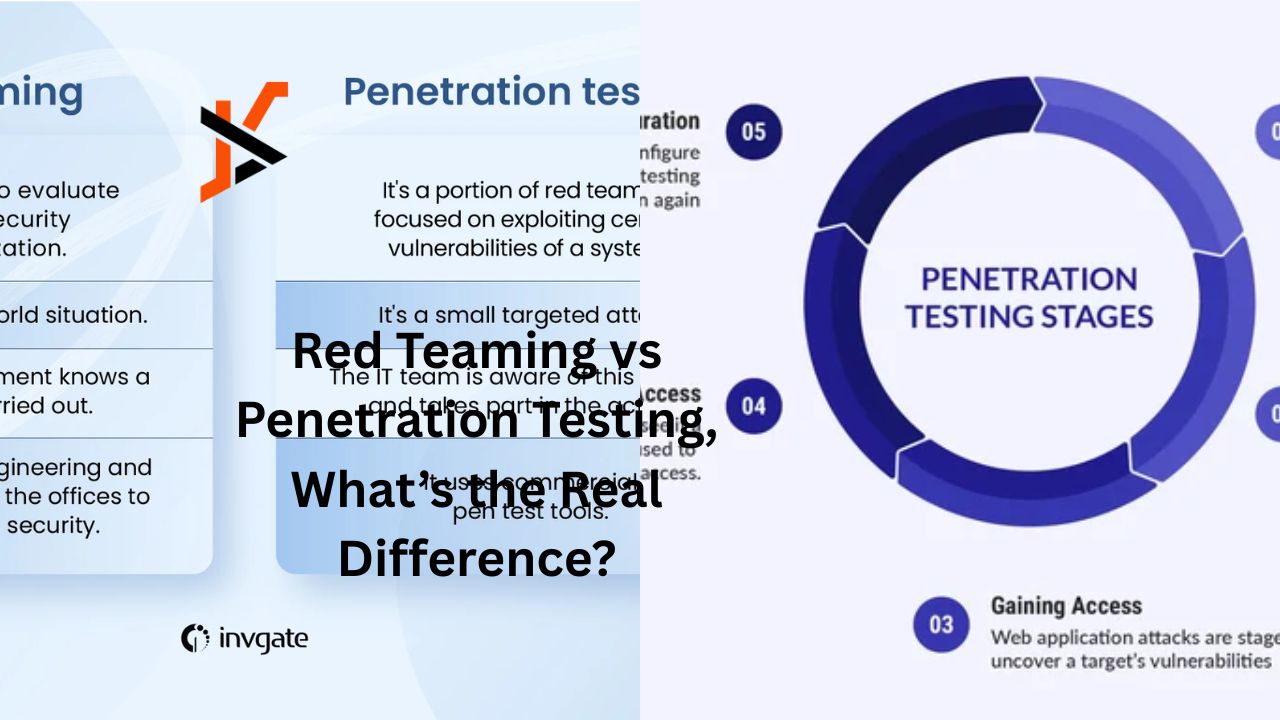
What is penetration testing?
A penetration test is a focused, time boxed assessment designed to identify exploitable weaknesses in applications, APIs, networks, and cloud assets, then demonstrate business impact with evidence. It follows established methodologies such as OWASP WSTG and PTES, and it ends with developer ready findings and retesting.
You can explore DeepStrike Penetration Testing Services and different kind of services.
What is red teaming?
Red teaming is an objective driven exercise where an authorized team emulates adversary tactics to reach agreed crown jewels, while staying covert to also test blue team detection and response. It commonly uses MITRE ATT&CK to plan and measure scenarios. National bodies and standards define it as adversary emulation to evaluate enterprise defenses.
Outcome: evidence of whether an attacker can achieve specific objectives, plus a timeline of detections and missed opportunities for the SOC to improve.
Red team vs pentest, the core differences
| Dimension | Penetration Testing | Red Teaming |
|---|---|---|
| Primary goal | Find and prove vulnerabilities | Achieve adversary objectives, test defenses |
| Scope | Narrow, agreed systems or apps | Broad, end to end paths to crown jewels |
| Stealth | Not required | High, remain undetected if possible |
| Methods | Exploitation against technical flaws | Adversary TTPs, social engineering, physical where allowed |
| Measurement | Vulnerability counts, severities, time to fix | Dwell time, detection coverage, response effectiveness |
| Best for | Shipping secure code fast | Validating security program maturity |
Sources confirm these distinctions, including CREST and national guidance that describe threat led, intelligence informed red teaming versus technical pentesting.
When to choose each
Choose a penetration test when
- You are releasing a new app, API, or major feature and need actionable findings for developers
- Compliance requires periodic testing, for example after material changes
- You want quick feedback inside the sprint rhythm
Methodology references such as OWASP WSTG and OSSTMM help structure scope, coverage, and evidence.
You can compare providers and methodologies in this independent roundup Top Penetration Testing Companies from DeepStrike
Choose a red team when
- You have baseline security controls and monitoring, and you want to test them under realistic pressure
- You need to validate that your SOC can detect, investigate, and contain multi stage attacks
- You want measurements tied to ATT&CK tactics, such as lateral movement, privilege escalation, and data exfiltration
Recent industry guidance emphasizes that red teaming is broader, costlier, and resource intensive, which is why mature programs schedule it less often than pentests.
How both fit into modern DevSecOps
A healthy DevSecOps program uses pentests for velocity and red teams for assurance.
- Build and test continuously
- Integrate pentests into release cycles, with retests to close the loop.
- Treat findings like defects, track mean time to remediate, and prevent regressions with unit and DAST checks.
- Hunt and learn periodically
- Run a red team once or twice a year, objective aligned to business risk.
- Use MITRE ATT&CK to design scenarios and to tag telemetry and detections for measurable coverage.
- Share lessons quickly
- Convert red team narratives into detection content, playbooks, and tabletop drills.
- Re test high risk pathways with short, targeted adversary emulation sprints, a practice supported by government and industry bodies.
Practitioner tip: The UK NCSC explains that a red team can be an external provider or an internal unit tasked to hack your environment like real attackers, with leadership aware and responders in scope. This framing helps secure executive buy in.
Tooling and frameworks that anchor quality
- OWASP WSTG, PTES, OSSTMM for pentest structure and coverage.
- MITRE ATT&CK to plan, execute, and measure red team scenarios with a common language for TTPs.
- Standards bodies like NIST and CREST that clarify roles, outcomes, and assurance expectations.
FAQs
Is a red team the same as a black box pentest
No. Black box pentests still aim to find vulnerabilities within scope. Red teams pursue objectives, remain stealthy, and test your people and processes.
Can small teams benefit from red teaming
Yes, but start with pentests and basic monitoring. Red teaming pays off once you can act on detection gaps. ncsc.gov.uk
How do we measure success
For pentests, fix rates and time to remediate. For red teams, dwell time, percent of ATT&CK techniques detected, and response quality.
Should social engineering be in scope
Include it only when it reflects real risk and you can manage business disruption. Many red teams include phishing or vishing.
How often should we run each
Pentests, at least annually per system and after major changes. Red teams, once or twice a year aligned to priority threats and critical journeys.
