

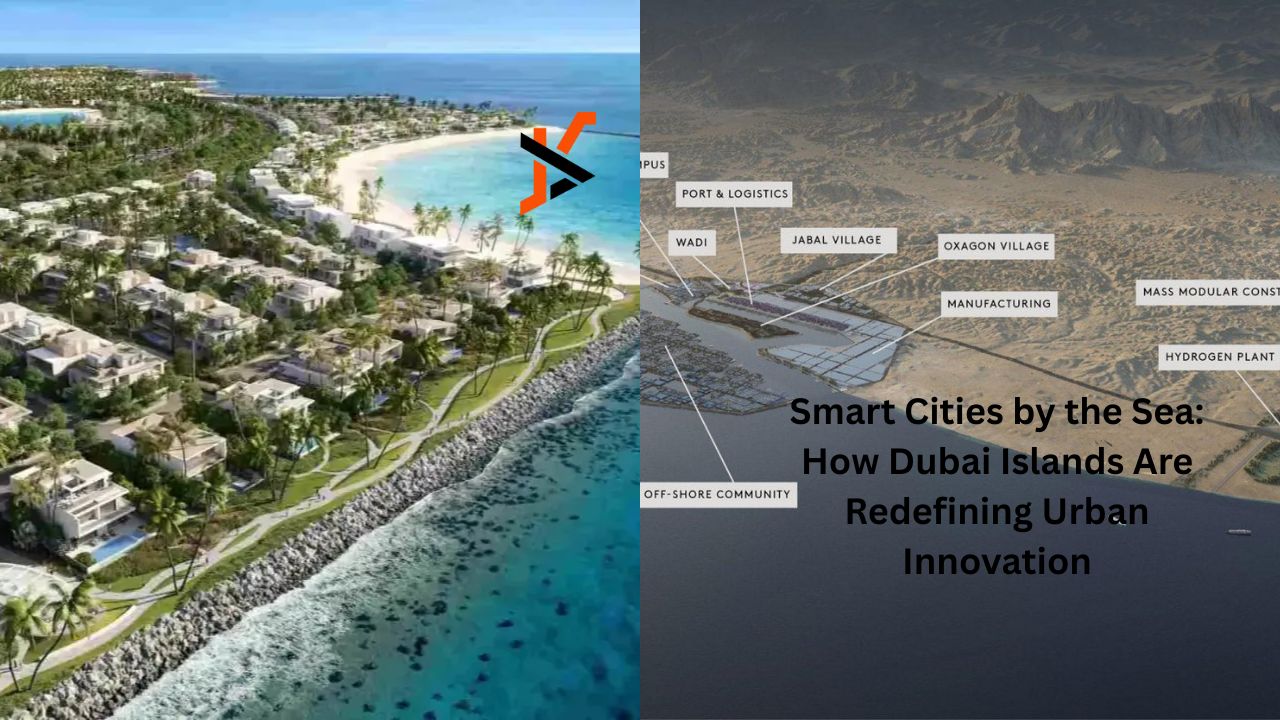
Rising along the northern shoreline of the emirate, the Dubai Islands master plan is reimagining what a city by the sea can be. Conceived as a sustainable urban ecosystem, the project spans five interconnected islands linked directly to the mainland. Within its framework, one island in Dubai has become a testing ground for the next generation of smart infrastructure — where data, design, and environment work as one continuous system. The ambition is not just to expand the city’s coastline, but to reinvent how cities learn, adapt, and function in real time.
Across this new district, mixed-use developments such as Flora Shore, Bay Grove by Nakheel, Ellington Cove, Flora Isle and many others projects are forming the building blocks of a digitally connected community. Each project adds a layer to the wider network of residential, cultural, and hospitality zones that define Dubai Islands. The focus is not on vertical dominance but on horizontal integration: a place where architecture, technology, and natural systems operate in sync. The result is a living prototype of urban intelligence — one that could shape how future cities are planned across the world.
The Digital Core of a Coastal City
Dubai Islands represents a departure from conventional coastal development. Where previous projects focused on visual landmarks, this one prioritises invisible systems — the digital backbone that runs beneath the surface. Every street, building, and utility is connected through an integrated network that manages energy, transport, water, and communication in real time.
The city functions like a data organism. Sensors track environmental conditions and public activity, feeding information into a central analytics platform. Artificial intelligence regulates street lighting, optimises traffic flow, and even predicts maintenance needs before they occur. This operational intelligence allows the district to evolve with its residents rather than impose a fixed design. It’s a city that behaves less like an object and more like a living infrastructure.
Engineering the Edge Between Sea and System
Building a smart district on reclaimed land is an act of precision. The Dubai Islands coastline faces environmental forces that few urban planners encounter — shifting tides, salt exposure, and high humidity. Engineers addressed these challenges through digital simulation long before construction began. Each parcel of land was modelled in 3D to study how wind, water, and temperature would interact over decades.
This process informed everything from building orientation to material choice. Sea walls are shaped to deflect waves while promoting marine biodiversity. Pavements are coated with reflective surfaces to lower ambient heat. Even the street grid follows the natural flow of the wind, reducing energy use for cooling. The technology doesn’t just build the city — it teaches it to coexist with its environment.
Mobility as a Seamless Network
Movement across Dubai Islands is designed around autonomy and efficiency. Traditional roads have been replaced with digital corridors that support multiple modes of transport: electric vehicles, autonomous shuttles, water taxis, and pedestrian routes. Traffic sensors communicate with AI-based systems that adjust signal timing, manage congestion, and prioritise energy-efficient vehicles.
The goal is not to eliminate mobility but to make it effortless. Residents can move between islands without using private cars, thanks to integrated transport apps that synchronise ferry, bus, and ride-share services. It’s an ecosystem where technology becomes invisible — functioning quietly in the background while users experience freedom of movement as a natural condition.
Sustainability as the Default Setting
Dubai Islands’ sustainability model operates on the principle of automation. Smart grids manage renewable energy flow, balancing solar generation with demand from residential and hospitality areas. Waste and water systems recycle resources continuously, while cooling technologies reduce electricity consumption during peak hours.
These measures turn sustainability into an operational standard rather than a marketing slogan. By embedding green logic into infrastructure, the project ensures long-term environmental and financial stability. For Dubai — a city often associated with excess — this represents a mature evolution: intelligence expressed through efficiency.
Human-Centred Urbanism
Despite its reliance on data, Dubai Islands has been designed around people, not machines. Public spaces remain central to the project’s identity — shaded walkways, open plazas, and waterfront parks that encourage interaction and movement. Technology operates in the background to maintain comfort and safety.
Sensors monitor air quality and temperature, while adaptive lighting ensures that outdoor areas remain active and secure after dark. Charging stations, digital kiosks, and real-time wayfinding support residents without overwhelming them. The outcome is a city that feels responsive rather than reactive — intelligent, yet calm.
Cultural Infrastructure Meets Digital Design
Dubai’s vision for its northern coastline extends beyond engineering. Cultural and creative spaces are embedded directly into the digital framework of the city. Art installations react to environmental data, creating living expressions of temperature, sound, and movement. Performance venues and digital galleries operate as part of the same network that powers utilities and transport.
Projects like Flora Shore contribute to this integration by merging architecture and culture. Buildings incorporate adaptive lighting façades that shift with the time of day, creating a visual rhythm that connects the community through shared experience. It’s a subtle form of storytelling — technology as art, design as communication.
Economic Logic of Smart Urbanism
The business model behind Dubai Islands is as innovative as its technology. Rather than relying on speculative sales, the project is structured for long-term economic sustainability. Smart infrastructure reduces operational costs and increases property value through efficiency. Investors are drawn to measurable data — energy savings, environmental performance, and digital connectivity — as indicators of stability.
This transparency creates a new type of real estate economy: one where value is defined not by square footage but by system performance. In a global context, that shift places Dubai at the forefront of urban innovation. The islands are not just physical assets but digital economies in themselves — producing data, insight, and operational intelligence that can be monetised and replicated elsewhere.
Security, Privacy, and Trust
As with all data-driven environments, questions of privacy are paramount. Dubai’s approach has been to embed governance directly into its systems. Information gathered by sensors and AI tools is anonymised and processed through secure data protocols that meet international compliance standards. Cybersecurity is treated as urban infrastructure, maintained with the same rigour as power and water networks.
For residents, this translates into trust. Digital identity systems provide seamless access to services — from transportation to healthcare — without compromising personal data. The city’s intelligence is thus bounded by ethics: a balance between convenience and consent.
The Broader Impact on Urban Innovation
The creation of Dubai Islands signals more than another milestone in the city’s growth; it marks a redefinition of what innovation means in an urban context. The project bridges engineering, sustainability, and culture into a single narrative. It demonstrates that smart technology can serve as the foundation for a livable, adaptive, and human city.
For global planners and technologists, Dubai Islands is a case study in how to build complexity that feels simple — a city where systems anticipate, infrastructure communicates, and residents experience intelligence not as spectacle but as service. Along this new island in Dubai, the line between technology and life has blurred into something seamless, and perhaps, finally, sustainable.
