

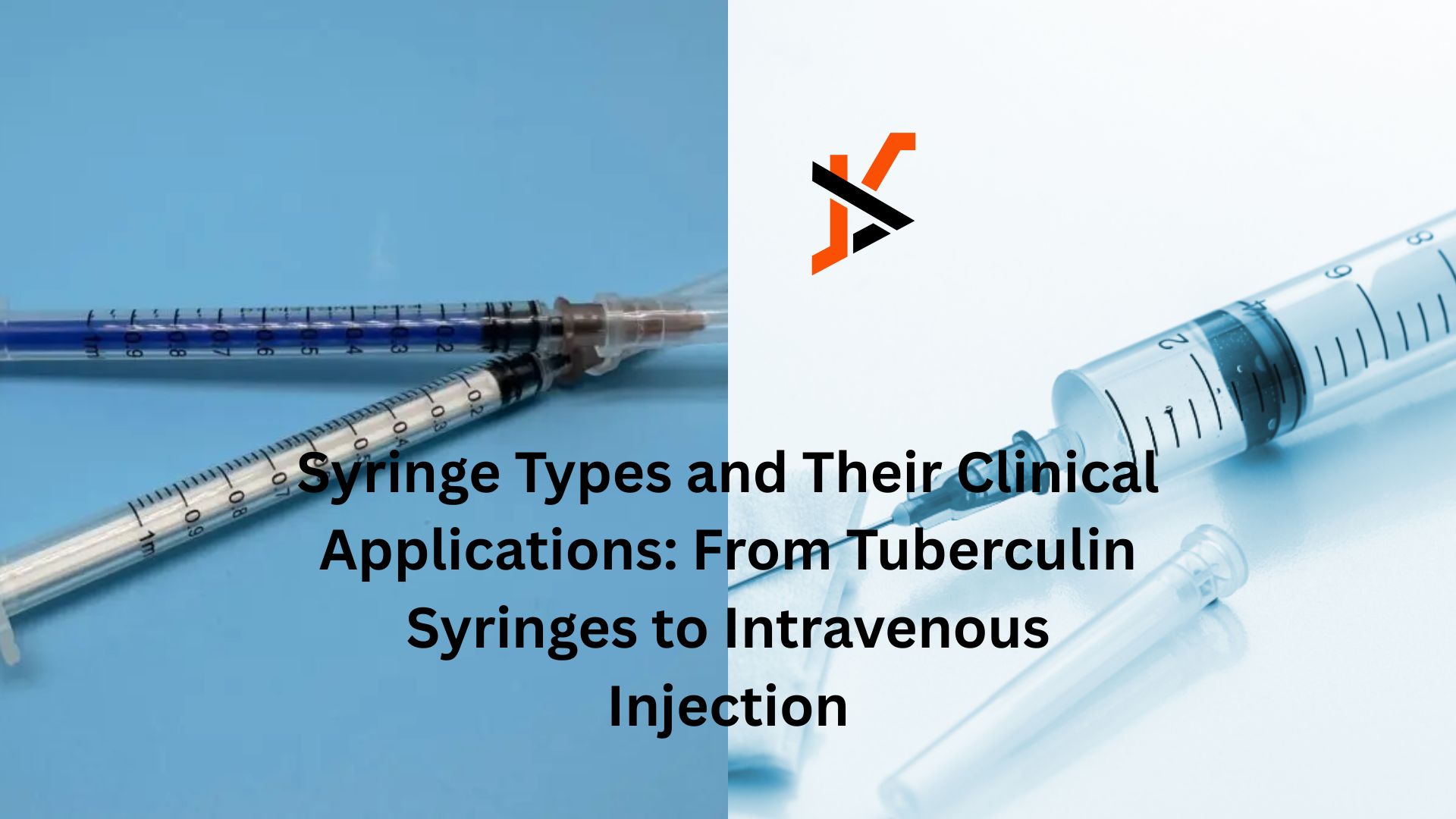
As one of the most basic and commonly used medical devices, syringes play a very import role in clinical treatment, vaccination, diagnostic testing, and chronic disease management. With the continuous refinement of medical needs, different types of syringes have been developed to meet the requirements of different drugs, routes of administration, and usage scenarios. This article will systematically introduce common syringe types, focusing on the analysis of tuberculin syringes, insulin syringes, syringe components, and their applications in intravenous injection, helping readers to fully understand the classification and usage logic of syringes.
I.Overview of Common Syringe Types
Based on capacity, scale accuracy, purpose, and method of administration, syringe types can be broadly divided into the following categories:
Ordinary Disposable Syringes
Common capacities include 1 mL, 2 mL, 3 mL, 5 mL, 10 mL, 20 mL and above, widely used for intramuscular injection, subcutaneous injection, and intravenous injection.
Tuberculin Syringes
Usually 1 mL capacity, with fine graduations, specifically used for tuberculin skin tests and other small-dose injections.
Insulin Syringes
Mainly used for insulin injection in diabetic patients, emphasizing unit markings rather than milliliter markings.
Safety Syringes
These syringes have added needle protection structures to reduce the risk of needle stick injuries.
Pre-filled Syringes
The drug solution is pre-filled by the manufacturer, reducing preparation steps and improving medication safety.
The design of different syringe types directly determines their applicable clinical scenarios and safety requirements.
II. Characteristics and Uses of Tuberculin Syringes
Tuberculin syringes are syringes specifically designed for small-dose, precise injections. Their typical characteristics include:
- Standard capacity of 1 mL
- Graduations are usually in 0.01 mL increments
- The barrel is slender, with clear markings
- Often equipped with a fine needle, suitable for intradermal injection
Clinically, tuberculin syringes are mainly used for tuberculin skin tests (PPD tests), which require extremely precise injection doses. Using ordinary syringes can easily lead to dosage errors due to insufficient precision of the graduations; therefore, tuberculin syringes are the preferred tool for this type of test. In addition, tuberculin syringes are also commonly used in research or special clinical settings that require micro-dosing.
III. Design Logic of Insulin Syringes
Insulin syringes are indispensable instruments in diabetes management, and their design differs significantly from ordinary syringes:
- The unit of measurement is IU (International Units).
- Common specifications include U-40 and U-100.
- The injection volume is usually small.
- The needle is thinner and shorter to reduce pain.
The core purpose of insulin syringes is to help patients accurately and independently complete multiple daily injections. Because insulin is a high-risk medication, dosage errors can lead to serious consequences. Therefore, insulin syringes require extremely high precision in calibration and ease of use.
In some markets, insulin syringes are gradually being replaced by insulin pens, but in resource-limited or cost-sensitive regions, traditional insulin syringes still hold an irreplaceable position.
IV. Analysis of Syringe Components and Their Functions
Regardless of the type of syringe, its basic components usually include the following core parts:
- Barrel (Cylinder): Used to hold the medication, usually made of transparent plastic with clear markings.
- Plunger (Piston): Used to draw and inject medication by pushing or pulling.
- Seal (Rubber Stopper): Located at the front of the plunger, ensuring airtightness and smooth injection.
- Needle Hub (Luer Connector): Used to connect the needle, commonly Luer Slip or Luer Lock.
- Needle Assembly: Includes the needle tube and needle hub, used to puncture the skin or blood vessels.
Each syringe component directly affects the safety, smoothness, and clinical experience of the product, which is especially crucial in high-risk applications.
V. Special Requirements for Syringes in Intravenous Bolus Administration
IV bolus is a method of drug administration that involves injecting medication directly into a vein. It offers the advantages of rapid onset and accurate dosage, but it also places higher demands on the quality of the syringe:
- The injection process requires stable and controllable force.
- The syringe must have good sealing and pressure resistance.
- There should be no leakage between the piston and the barrel.
- In some cases, safety syringes are required to prevent needle stick injuries.
Not all ordinary syringes are suitable for intravenous push administration, especially when injecting pressure-sensitive or highly irritating medications. It is essential to select models and specifications that meet clinical requirements.
VI. Conclusion
From the classification of different syringe types to the specialized design of tuberculin and insulin syringes, and the critical role of syringe components in intravenous push administration, it is clear that although syringes are small, they carry highly specialized medical requirements. Choosing the appropriate types of syringe is not only crucial for treatment effectiveness but also directly impacts the safety of healthcare professionals and patients.
In the modern healthcare system, syringes have evolved from “general consumables” to highly specialized professional products, and their design and application continue to evolve.
