

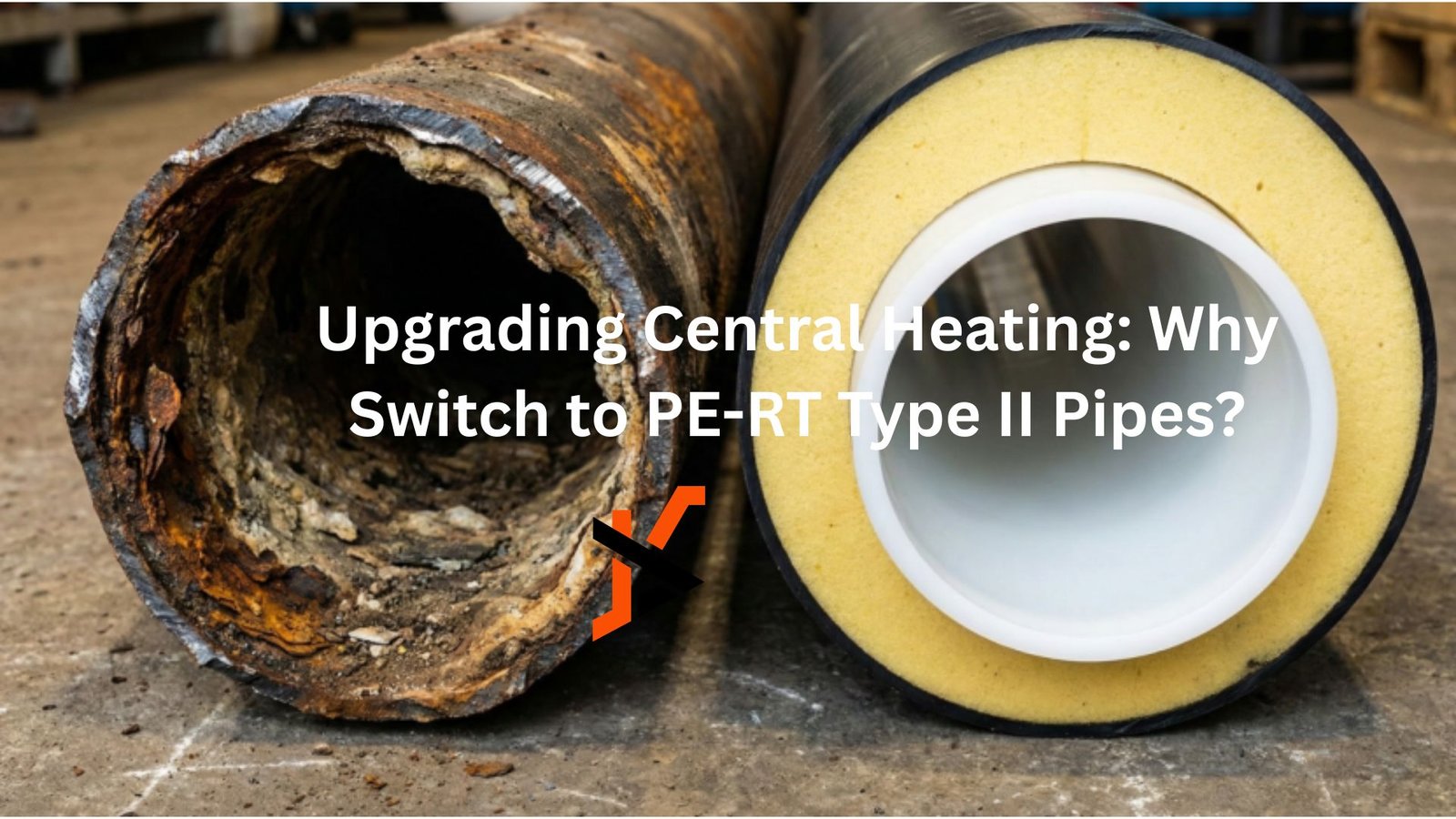
The secondary heating network serves as the critical lifeline connecting heat exchange stations to buildings, yet traditional steel infrastructures are increasingly failing due to inevitable electrochemical corrosion and significant energy loss. As a modern, high-performance successor, PE-RT Type II (Polyethylene of Raised Temperature Resistance) pipes have emerged to revolutionize this sector, offering a durable, corrosion-free solution that meets the rigorous demands of today’s central heating pipe replacement projects.
Solving the Corrosion Crisis
1. The Steel Problem: Inevitable Decay
The Achilles’ heel of traditional metal infrastructure is its chemical instability. In the context of district heating, steel pipes inevitably suffer from electrochemical corrosion. When metal interacts with water and dissolved oxygen over time, it rusts. This leads to two major problems: structural leaks and “secondary pollution,” where the water quality degrades due to rust contamination. The lifespan of a steel pipe in these conditions is often limited to approximately 15–20 years before extensive maintenance or replacement is required.
2. The PE-RT II Solution: Chemically Inert and Durable
PE-RT Type II pipes solve this crisis by changing the material paradigm. As a high-density polyethylene-based material, PE-RT II is chemically inert. It is completely immune to rust, electrochemical corrosion, and the acid-alkali reactions that plague metal pipes.
This immunity translates to a dramatic increase in longevity. LESSO’s PE-RT II pipes boast a design service life of 50 years—more than double that of traditional steel. For municipal engineers, this effectively eliminates the maintenance headaches associated with corrosion, ensuring a stable heating network that does not require constant repairs or premature replacement.

Maximizing Energy Efficiency (Hydraulic Performance)
1. Smoother Flow, Lower Friction
Efficiency in a secondary heating network is defined by how easily water moves through the pipes. Steel pipes often suffer from rough internal surfaces, which degrade further as scale and rust build up over time. In contrast, PE-RT Type II pipes feature a mirror-smooth inner wall that resists scaling. This smoothness is maintained throughout the pipe’s lifespan, ensuring consistent hydraulic performance.
2. Significant Cost Savings
The hydraulic superiority of PE-RT II leads to direct financial benefits. The lower friction coefficient means there is less resistance to water flow. Consequently, heating companies can significantly reduce the pumping power required to circulate hot water. This reduction in resistance leads to substantial electricity operational cost savings over the lifetime of the system, optimizing the network’s Total Cost of Ownership (TCO).
3. Superior Thermal Insulation
Modern PE-RT II piping systems are typically installed as pre-insulated composite structures. These consist of the inner PE-RT II carrier pipe, a middle layer of polyurethane (PU) foam, and an outer HDPE protective casing. This design is highly effective at minimizing heat loss. The PU foam insulation has a thermal conductivity coefficient of just
λ50 = 0.032 W/m·K
ensuring that the thermal energy generated at the source reaches the end-user with minimal dissipation.

Revolutionizing Installation and Safety
1. Leak-Free Joints with Heat Fusion
One of the most critical advantages of PE-RT II is the integrity of its connections. Traditional steel pipes rely on welding or threading, which can introduce weak points prone to leakage. PE-RT II pipes utilize advanced heat fusion technology (such as hot melt socket or electro-fusion).
This process melts the pipe and fitting materials together to form a permanent, monolithic bond. The result is a joint that is as strong as the pipe itself, eliminating the most common source of leaks in heating networks. This “leak-free” characteristic is vital for burying pipes under city streets where repairs are costly and disruptive.
2. Flexibility and Resilience
Unlike rigid steel, PE-RT II is inherently flexible. This characteristic is a game-changer for underground installation. The pipe can withstand geological shifts, ground settlement, and the vibrations caused by heavy traffic without cracking.
This flexibility also simplifies installation. PE-RT II pipes can be supplied in long coils (up to DN50) or bent to follow the curvature of a trench, significantly reducing the number of fittings and joints required. Fewer joints mean faster installation and fewer potential failure points, making central heating pipe replacement projects quicker and less labor-intensive.
Conclusion
The shift from steel to plastic in district heating is driven by undeniable economic and technical advantages. While raw material costs may fluctuate, the long-term value of PE-RT II is unmatched. Its zero-maintenance requirements, significant energy savings from reduced pumping costs, and extended 50-year lifespan make it the superior choice for Total Cost of Ownership.
LESSO PE-RT Type II pipes are positioned as the ideal upgrade for modern city infrastructure. They meet the rigorous demands of district heating pipes, offering a green, recyclable, and highly efficient solution that aligns with the future of sustainable urban development. By choosing PE-RT II, municipalities and developers are not just replacing pipes; they are investing in a half-century of reliability.
