

The digitalization of the healthcare industry clearly changed the way we see and approach healthcare. Since the introduction of healthcare software systems, and especially since the introduction of Electronic Health Records, practices have completely eliminated paper-based documentation.
This has indeed made healthcare much better; however, when this process of digitalization started, many practices adopted legacy EHR systems, which have a very rigid development process. Moreover, initially, almost every healthcare practice used a generic EHR software, without specific workflow alignment, etc.
While it worked perfectly at the start, as healthcare became more specific and technologies became more advanced, these standard EHRs struggled to support the unique needs of healthcare practices, speciality practices’ unique workflows, and the rapidly changing nature of healthcare and healthcare technology.
Upon investigating some of these systems, it became evident that the reason behind the rigidity of these systems has been the software architecture. You see, most of these systems had a monolithic architecture, where a single, unified codebase is used for the entire application.
This approach not only made customization more difficult, but also scaling that software meant replacing that software. Recognising this and the need for healthcare practices, our modern custom EHR development approaches rely on modular architecture. This way, you can easily scale your software at will, stay compliant with necessary compliance, and easily adapt to the changing nature of the healthcare industry.
But what exactly is a modular architecture, and why is it the need of the hour for healthcare practices looking for custom EHR software in 2026?
Well, let’s find that out in this blog below!
What does Modular Architecture mean in Simple Terms?
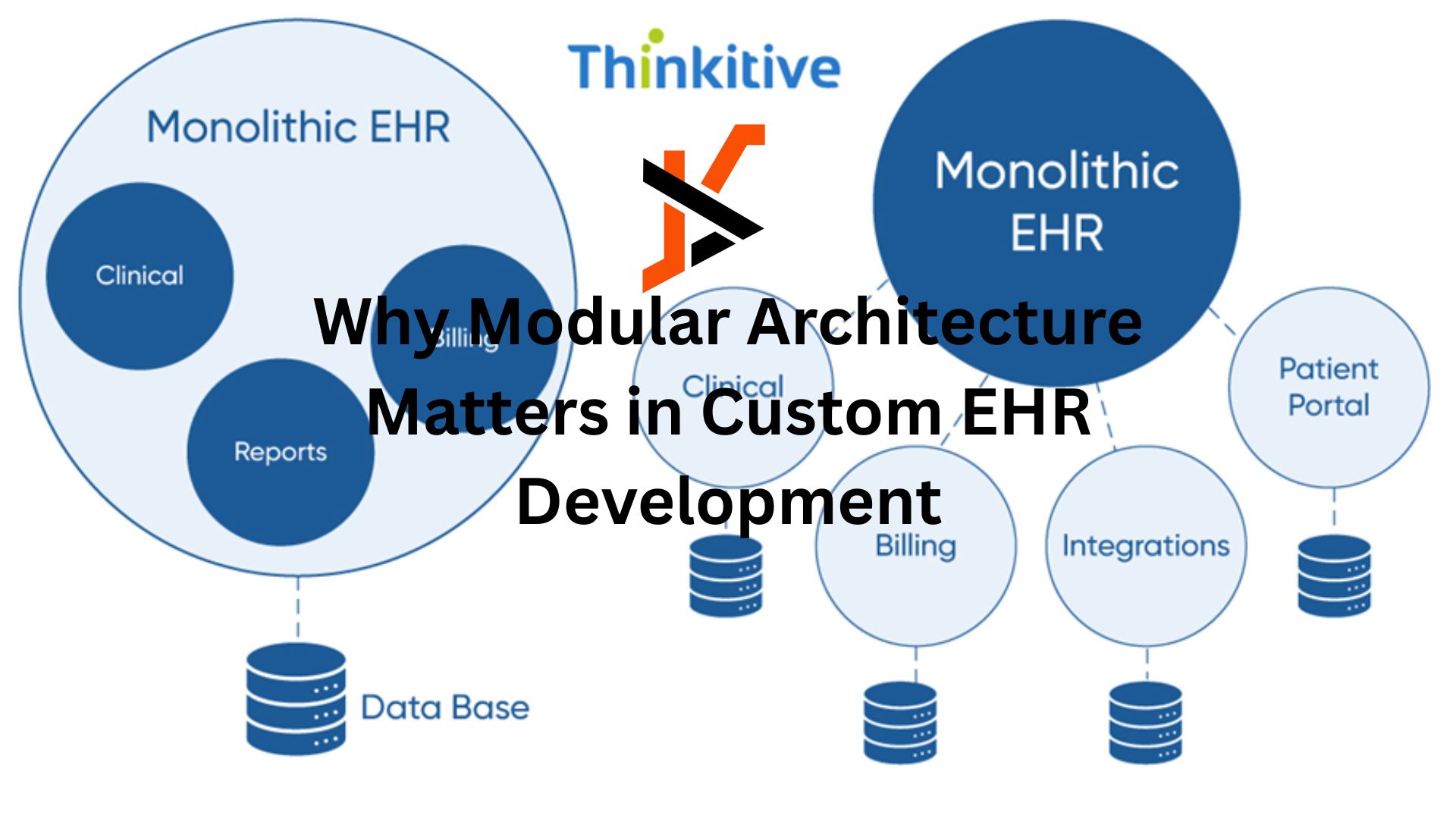
To understand modular EHR architecture, we first need to understand the differences between modular and monolithic architectures. Traditional EHRs were built on monolithic architecture. In this, the entire system is built as one large system where all the components are stacked together.
In this, making changes to the architecture becomes extremely difficult, as changing something will likely impact everything in the software. However, in a modular architecture, every single component of the software is developed independently and then compiled together to work as one.
To give you an example of some of the core components, the clinical records, billing, patient portals, reporting, ePrescriptions, etc., work separately as separate modules. And when all the components are developed, they are connected together to work as one system.
Now, the interesting part, you see, each module can be updated, scaled, and at times even changed without disrupting the entire system.
Why Modular Design is Essential for Custom EHR Development?
In 2026, modular EHR architecture is the preferred choice for custom EHR software development. While the reason might be clear to you, here are some reasons why modular EHR architecture is essential for yourcustom healthcare software development:
- Faster Updates: One of the core benefits of modular architecture is that you can update separate modules faster. Let that be making updates in the same way as adding new features; you can do that easily without having to disrupt the normal functioning of your entire system.
- Cost Control: Another benefit that you get with a modular EHR architecture is that you can control the cost of development extremely easily. For instance, most traditional EHRs come with predefined features and functionalities, out of which you hardly use half of them. Here, you can only build the components that you need.
- Future Readiness: With modular architecture, you make your software into a scalable healthcare software, given its flexible nature. This means you can easily follow the trends in the healthcare industry by easier adoption of new capabilities like telehealth, AI tools, and remote monitoring.
One of the major benefits of modular design is that it reduces long-term technical and operational risks, which usually come with monolithic architecture.
Interoperability, Security & Compliance Made Easier
Interoperability, security and compliance are the core things that you require in your custom EHR software. Now, as a software developer, if you’re sticking to the traditional ways with monolithic architecture, achieving interoperability, securing your system and adhering to compliance can be a little too difficult.
However, with a modular architecture, all the aspects mentioned above can be easily achieved. For instance, modular systems support standards-based data exchanges with labs and pharmacies. This way, you can easily achieve interoperability by adopting standard data exchange standards such as FHIR, HL7, etc.
Furthermore, with a modular EHR architecture, you can adhere to compliance with specific modules instead of the entire system. This can cut down your development time significantly and even contribute to the development of secure healthcare software with easy implementation of role-based access control and data encryption modules.
Interestingly, all this can be done on a module level, giving you a major advantage in development. And given the flexibility it brings to your system, it simplifies HIPAA compliance and ongoing regulatory changes, giving you a competitive edge.
Real Benefits for US Healthcare Providers
Here are some of the real benefits that US healthcare providers can get by adopting a modular EHR architecture.
- Specialty-Specific Workflows: The major advantage that providers can get with modular architecture with custom EHR software is that modules can be tailored for different care types. Meaning, if you are a specialty practice, then you can easily make your EHR software a specialty-specific EHR software.
- Reduced Clinician Burden: The reason why many healthcare practices are looking to make a switch to custom EHR software is to reduce the cognitive load of documentation. This can be easily reduced with modular software, as you can curate cleaner interfaces and eliminate features that are not required.
- Scalable Growth: If you are looking for an EHR software that can accommodate your growth aspects, then a modular EHR architecture is the way to go. Given the customization and flexibility factor, new locations, services or even users can be easily added to the system without major disruptions.
- Operational Efficiency: With the separation of modules and their independence to operate separately, the performance of those specific departments can be improved significantly. For instance, with dedicated billing and reporting modules, the performance of the billing system and reporting modules can be enhanced, giving you an edge in operational efficiency.
Conclusion: Build an EHR That Can Evolve
The current need of healthcare practices with respect to their systems is that of adaptability. One of the major reasons for this is the ever-evolving nature of the healthcare industry and the technological advancements that are advancing as you read this. This is the reason why many healthcare practices are turning to custom EHR software development for their systems.
And to meet all your needs, modular architecture holds the key. This architecture provides your flexibility, stability and long-term value to your software system. So rather than getting stuck with rigid systems, make strategic advancements with custom EHR development and choose modular architecture to avoid rebuilds and future bottlenecks.
So, what are you waiting for? Let’s get started by analyzing your system first. Click here to book your first free consultation.
FAQs
- What is the advantage of modular architecture over traditional monolithic EHRs?
Modular EHR architecture breaks the system into independent, loosely coupled components (clinical, billing, analytics, integrations). This makes the platform more flexible, easier to upgrade, and less risky—changes to one module don’t disrupt the entire EHR.
- How does custom EHR development improve clinician workflows and reduce documentation burnout?
Custom EHR software allows workflows, screens, and data capture to be designed around real clinical processes rather than generic templates. This reduces clicks, automates repetitive documentation, and enables role-based interfaces that align better with how clinicians actually work.
- How does a modular approach ensure compliance with 2026 HIPAA and ONC interoperability standards?
With modular EHR architecture, compliance-related capabilities—such as security, audit logging, consent management, and interoperability—can be isolated into dedicated modules. This makes it easier to adapt quickly to evolving HIPAA rules and Office of the National Coordinator for Health Information Technology interoperability requirements without reworking the entire system.
- Can a custom EHR built on modular architecture integrate seamlessly with existing legacy lab or pharmacy systems?
Yes. Modular healthcare software is typically API-driven, allowing individual integration modules to connect with legacy lab, pharmacy, imaging, or payer systems. This ensures smoother data exchange while preserving existing infrastructure investments.
- What impact does a modular design have on the long-term maintenance and scalability of a custom EHR?
A modular design significantly lowers long-term maintenance costs and improves scalability. New features, specialties, or locations can be added as separate modules, enabling the EHR to grow with the organization without performance degradation or major system rewrites.
