

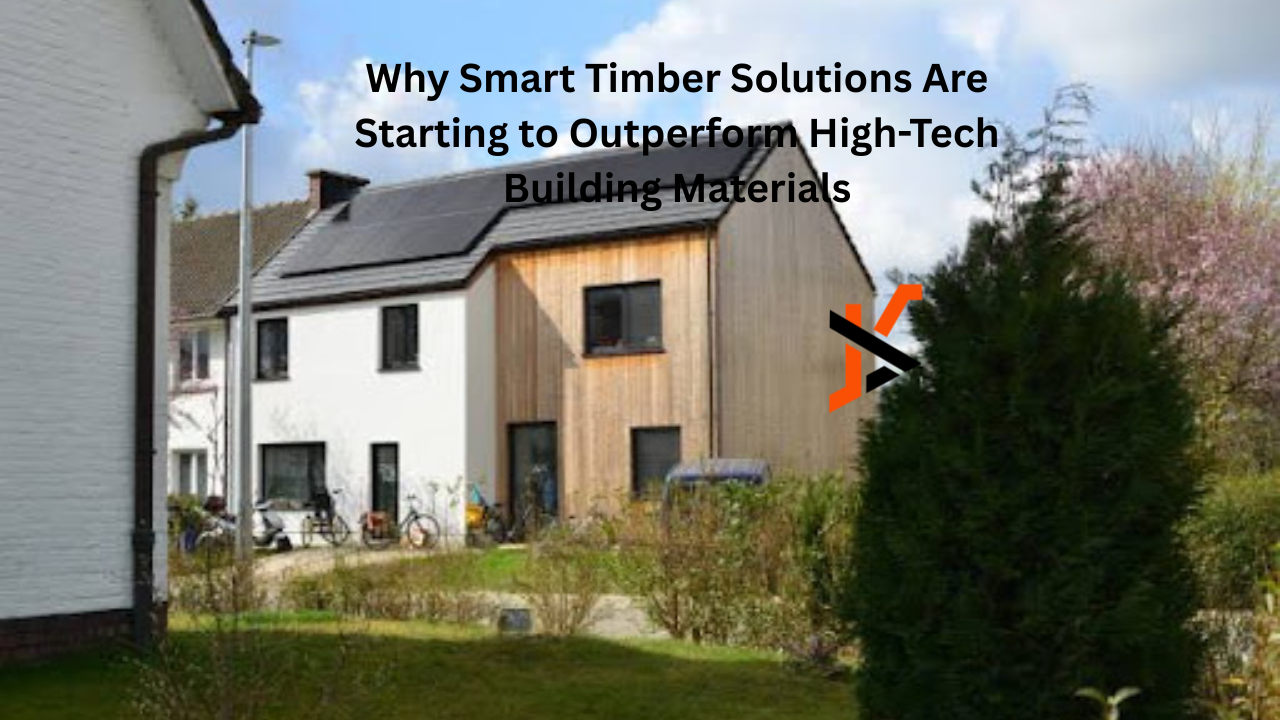
Over the past few years, building materials have shifted in a direction that almost no one expected. With all the talk about advanced composites, lightweight alloys, hybrid cement mixes, and futuristic façade systems, you’d think modern construction would lean more toward synthetics than natural materials. But what’s actually happening on the ground looks very different. Timber—one of the oldest building materials in history—is quietly outperforming many of the engineered alternatives.
This shift didn’t happen because people suddenly wanted rustic cabins or old-fashioned façades. It happened because timber itself evolved. What’s available today is a completely different category of material: engineered, stabilised, improved, and far more predictable. It sits somewhere between the softness of nature and the reliability of modern manufacturing, and that combination is proving unexpectedly powerful
Part of the appeal.
Part of the appeal is emotional, even if people don’t always say it directly. Modern buildings have become harder, shinier, and sometimes overwhelming. When every new structure looks like the last, something gets lost. Timber brings texture and warmth—two things that break monotony without feeling forced. Yet the real turning point isn’t about looks at all. It’s about performance.
One material that captures this perfectly is Shou Sugi Ban. Originally a traditional Japanese wood-charring technique, it’s gone through a modern reinvention. The charred surface isn’t just aesthetic; it provides natural resistance to weathering, insects, and moisture. It also has that deep, matte-black appearance that shifts subtly with light—something synthetic panels always try to imitate but never quite achieve.
Many designers now treat Shou Sugi Ban wood as a kind of “premium natural tech material,” because it does what people expect modern façades to do—resist the elements, age gracefully, and require minimal maintenance—while still looking incredibly distinctive. It doesn’t fade into the background like composite cladding. It doesn’t reflect harshly like metal sheets. It simply sits there with quiet confidence.
Shou Sugi Ban
But Shou Sugi Ban is only one part of the story. The broader movement toward high-performance timber has been shaped heavily by material science. Thermally modified wood, for example, has changed how architects think about natural materials. ThermoWood, which is softwood heated to the point where its internal structure changes, performs completely differently from untreated timber. It absorbs far less moisture, meaning it doesn’t swell, shrink, or twist as the seasons change. That solves one of the oldest problems of timber construction.
This stability is what brings ThermoWood into conversations normally dominated by synthetic materials. When a building relies on crisp lines and strong geometry, the cladding has to behave. It can’t warp. It can’t ripple. It can’t make the façade look like it’s breathing. ThermoWood gives architects that consistency while also maintaining the natural character that composite materials usually lack.
This is why many professionals now choose reliable suppliers that specialise in ThermoWood cladding. Not because it’s trendy, but because it solves both technical and aesthetic problems without compromise. The more predictable the material, the more designers can push the limits of their ideas without worrying about long-term maintenance issues.
Another factor supporting timber’s
Another factor supporting timber’s rise is sustainability—though not in the superficial marketing sense. Real sustainability is no longer just a nice tagline. It’s something planners and developers are required to justify in measurable terms. Embodied carbon, life-cycle impact, and long-term waste reduction all play into those decisions. Timber holds a natural advantage here. It stores carbon rather than producing it, and when it’s sourced responsibly, it becomes part of a long-term environmental solution rather than a short-term fix.
High-tech materials often come with hidden environmental costs. Their production can be energy-intensive, their disposal complicated, and their performance over time inconsistent. Timber, on the other hand, tends to age more gracefully. A well-designed timber façade can weather beautifully, picking up subtle shifts in tone that make the building feel more rooted in its environment. People respond to that without consciously realising why.
And then there’s maintenance. Interior designers and property owners often report that modern materials look flawless at first but begin to age unevenly. Sunlight fades them in patches. Micro-scratches accumulate. Surfaces become dull or brittle. High-performance timber doesn’t follow that pattern. Shou Sugi Ban, for example, ages in a way that actually enhances the material. ThermoWood tends to grey evenly, avoiding the blotchy weathering that standard softwood experiences.
Architects working
For architects working on residential projects, small commercial spaces, and garden rooms, this matters enormously. A building that still looks intentional after five or ten years carries far more value than one that requires constant refreshing. And in a world where clients expect both sustainability and longevity, timber offers a balance that’s hard to replicate.
What’s interesting about all of this is how quietly the transition has happened. There was no big announcement, no dramatic industry moment. Timber simply kept getting better. The technology matured. The treatments improved. Fire ratings became stronger. And designers slowly realised that the material they used to avoid had turned into one of the most dependable options available.
The future
The future likely won’t be a battle between timber and high-tech synthetics. It will be a mix—a layering of natural materials with modern engineering. Timber isn’t trying to replace other façades. It’s simply reclaiming its space in modern architecture, but this time with upgrades that make it competitive at every level.
If the current momentum continues, we’ll see even more hybrid buildings—structures that blend natural textures with contemporary lines, creating spaces that feel both sophisticated and human. And if that happens, it won’t be a return to the past. It’ll be a quiet evolution toward materials that perform better, age better, and feel better to live around.
