

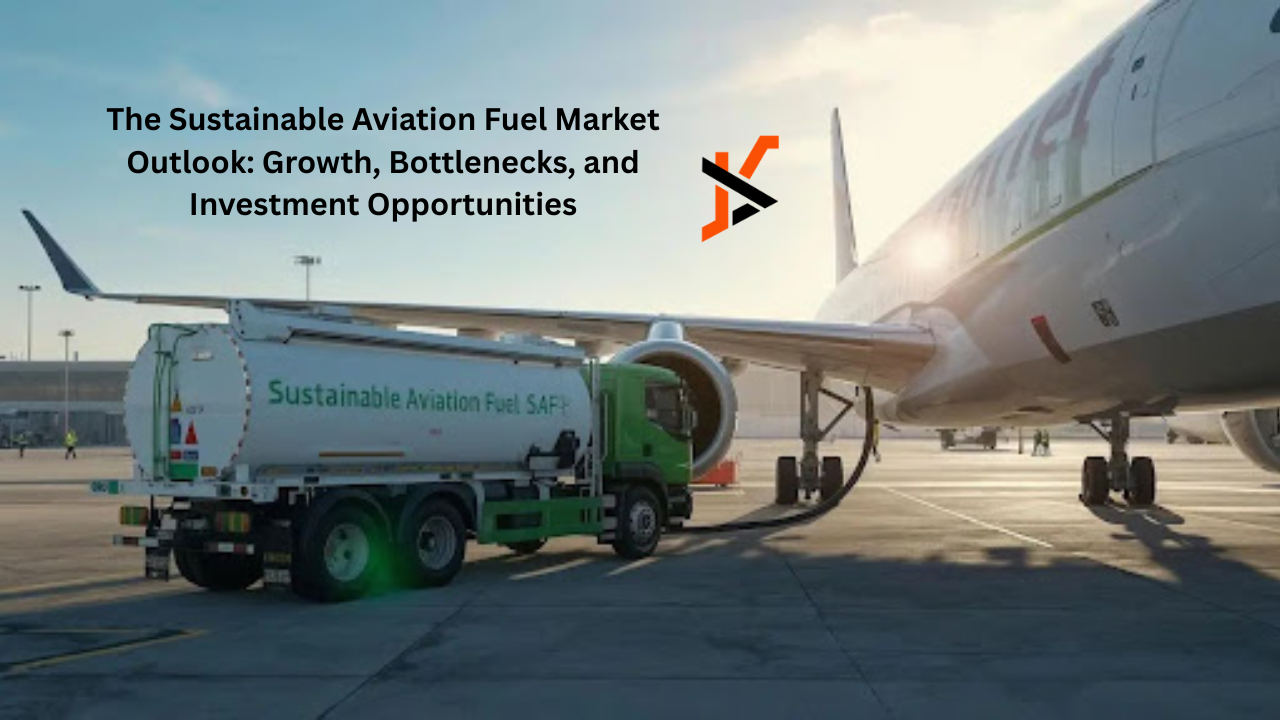
Flying is one of the hardest habits to decarbonise. I say that not to be discouraging, but because most coverage of Sustainable Aviation Fuel paints either a rosy picture or a catastrophist one, and neither helps you understand where the money is going or whether it’s moving fast enough.
Sustainable Aviation Fuel is jet fuel made from non-petroleum sources: waste cooking oils, agricultural residues, municipal solid waste, and captured CO2. It can cut lifecycle carbon emissions by up to 80% compared to conventional jet fuel, depending on feedstock and production pathway. That’s real. The catches are also real.
Where the Market Stands
In 2023, global SAF production hit roughly 600 million litres. That sounds significant until you learn it covers about 0.1% of total jet fuel demand. IATA wants SAF to supply 65% of aviation’s carbon mitigation by 2050. That gap, from 0.1% to something meaningful, is where all the tension lives.
Regulators are pushing hard. The EU’s ReFuelEU Aviation mandate requires 2% SAF blending at European airports by 2025, rising to 6% by 2030. The US Inflation Reduction Act established a tax incentive ranging from $1.25 to $1.75 per gallon for sustainable aviation fuel (SAF). The policy scaffolding is getting serious, fast.
The Bottlenecks Nobody Talks About Plainly
Coverage of Sustainable Aviation Fuel tends to celebrate announcements. A new offtake agreement. A record blending milestone. What it skips is the production capacity problem.
SAF currently costs three to five times more than conventional jet fuel. Most of that premium comes from feedstock costs and limited refinery capacity. HEFA, the dominant production pathway, uses existing refinery infrastructure and works well at current scales. But the sustainable feedstocks it needs, mainly waste fats and oils, are finite. You cannot scale HEFA to replace global jet fuel without running out of raw material.
Power-to-Liquid SAF, which uses CO₂, water, and renewable electricity, could theoretically scale without those constraints. But the capital costs are enormous, and commercial production is still years away. Airlines can’t absorb the full cost premium alone. Without corporate buyers and government procurement co-funding supply chains, the economics don’t work at volume.
Case Study 1: Virgin Atlantic Flight 100 (2023)
In November 2023, Virgin Atlantic flew a Boeing 787 Dreamliner from London Heathrow to JFK using 100% Sustainable Aviation Fuel, with no fossil jet fuel blended in. The flight carried 185 passengers and burnt around 200 tonnes of SAF, a mix of HEFA-based fuel and alcohol-to-jet blend sourced from World Energy and Virent. The UK Government’s Jet Zero Council co-funded the operation.
No engine modifications were needed. The aircraft performed identically to a conventional fuel flight.
What it proved, practically, is that ASTM D7566 certification for 100% SAF is achievable in real conditions. What it didn’t prove is that this is economically viable at scale. That’s the honest read.
Case Study 2: Delta Air Lines and Gevo
Delta signed a seven-year agreement with Gevo to purchase up to 75 million gallons of SAF per year, one of the largest offtake commitments in the industry. Gevo’s Net-Zero 1 facility in Lake Preston, South Dakota, targets first production in 2026, using agricultural residues and renewable electricity for alcohol-to-jet SAF.
The deal structure matters. Delta isn’t just buying fuel. It’s de-risking Gevo’s capital raise by providing committed demand. That’s how SAF investment functions right now: airlines provide offtake certainty, which unlocks project financing, which builds the supply capacity that eventually brings costs down. Slow. But structurally sound.
Where the Investment Opportunity Lives
SAF is a fixture at every major aviation event and Sustainable Aviation Fuel Conference because investors are still sorting out which part of the value chain to own. Right now, the clearest returns sit in feedstock processing and aggregation, where supply is fragmented; next-generation production technology at a pre-commercial stage; and SAF certificates under book-and-claim schemes, which let corporate buyers fund supply without requiring physical delivery.
The SAF space isn’t a sure bet. But the policy tailwinds from the EU, US, UK, and Japan are durable. That combination of regulatory mandate and genuine investor interest is what makes every Sustainable Aviation Fuel Conference worth watching.
Frequently Asked Questions
1. What is Sustainable Aviation Fuel made from?
SAF comes from used cooking oils and animal fats (HEFA pathway); agricultural waste and woody biomass (Fischer-Tropsch); municipal solid waste (gasification); and CO₂ with renewable electricity (Power-to-Liquid). Feedstock determines both the emissions reduction and the production cost.
2. How much does SAF actually reduce carbon emissions?
HEFA-based SAF from used cooking oil typically delivers 70-80% lifecycle carbon reduction versus fossil jet fuel. Power-to-Liquid SAF using green hydrogen and captured CO2 can approach near-zero or negative lifecycle emissions. Both figures account for feedstock processing and combustion.
3. Why does SAF cost so much more than conventional jet fuel?
Feedstock costs are high, particularly for waste-based inputs that compete with road transport biodiesel markets. Dedicated SAF refinery capacity is still limited, so producers can’t access the economies of scale conventional refineries rely on. Price parity before 2035 is unlikely under current projections.
4. What happens at a Sustainable Aviation Fuel Conference?
Sustainable aviation events focused on SAF, like the IATA SAF Summit and the SAF Conference, bring airlines, producers, investors, and policymakers into the same room. Offtake agreements, production deals, and policy positions often surface here before anywhere else. If you track the SAF market, these events carry real forward signal.
5. How can a corporation support SAF without operating flights?
Through book-and-claim programmes. Producers like Neste and Shell run certificate schemes where a corporate buyer funds SAF production and receives a certificate crediting that volume to their carbon footprint. The physical SAF enters the general fuel supply. It’s imperfect but currently the most scalable option for non-airline organisations.
