

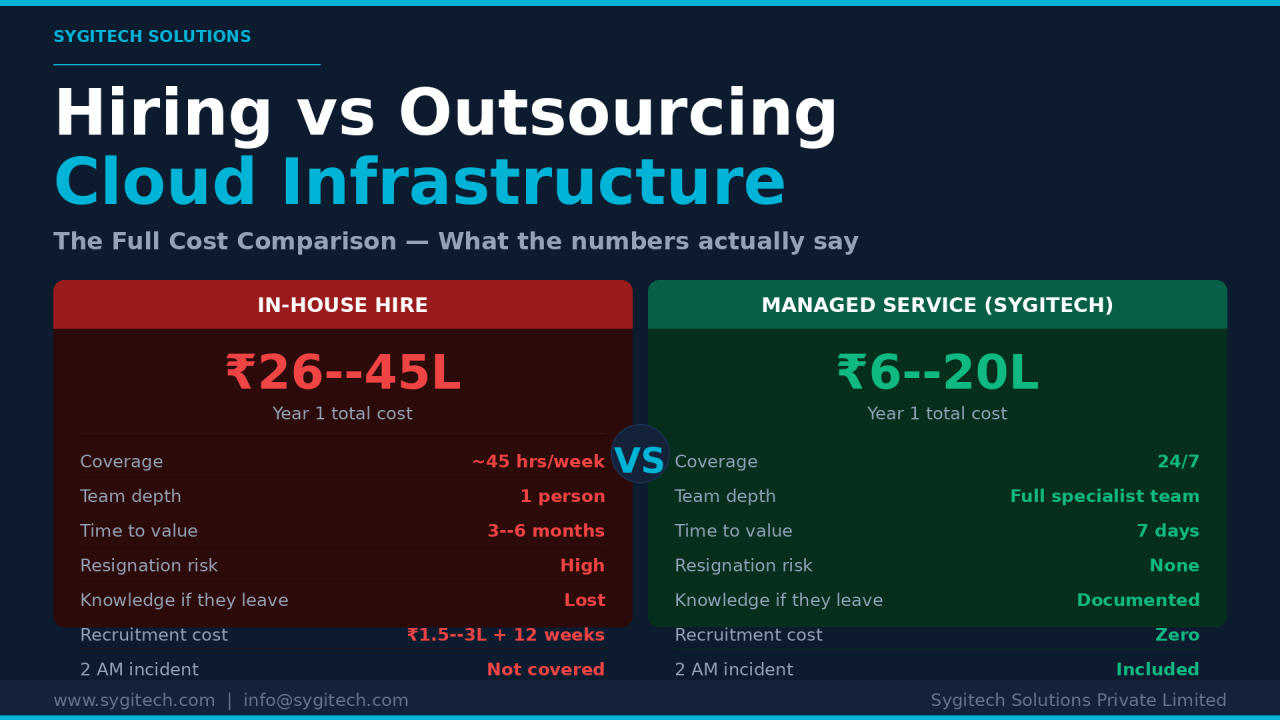
Most business owners reach a point where they have to make a decision about IT. The break-fix approach has run its course, the part-time consultant keeps missing things, and the cost of downtime is becoming impossible to ignore. The question becomes whether to hire an internal IT person or to bring in outsourced IT support to handle everything.
It is a decision that gets made the wrong way more often than not. Companies look at the salary of an internal hire, compare it to a monthly managed services fee, and pick the lower number. That comparison misses most of the actual cost. Over a three-year period, the gap between these two options is far wider than most businesses expect, and the reasons have very little to do with the base salary.
This is a breakdown of what both options actually cost over three years, based on what growing businesses encounter in the real world.
The Internal Hire: What You See on Paper
When a business decides to hire an internal IT person, the conversation usually starts with salary. A mid-level IT generalist in most markets runs somewhere between $65,000 and $85,000 per year. For a business with 25 to 50 employees, that feels like a reasonable investment. One person, one salary, one person who knows the environment.
That number is the floor, not the ceiling.
The first cost that gets missed is burden. A salaried employee is not just a salary. There are payroll taxes, benefits, paid time off, and often a retirement contribution. A reasonable estimate puts total burden at 25 to 30 percent on top of base salary. That $75,000 hire is closer to $95,000 in real cost.
Then there is the cost of finding them. Recruiting an IT professional takes time and money. A recruiter specializing in technology roles often charges 15 to 25 percent of first-year salary. Even posting the role and handling the search internally costs staff hours that could be spent on revenue-generating work. Add training time, the productivity dip while the new hire learns the environment, and the first six months are essentially a loss.
By the end of year one, a business has easily spent $110,000 to $130,000 on a single internal IT person. And that is before the costs that really add up.
The Internal Hire: What You Do Not See on Paper
The hidden costs of an internal hire are where the comparison falls apart.
The first is coverage. A single IT person works roughly 40 hours a week. They take vacations. They get sick. They go to training. They quit. Every hour your business operates outside of that person’s schedule is an hour where IT issues either wait or fall to someone unqualified to handle them. For a business that operates during standard hours, that might be acceptable. For any business with remote workers, early mornings, late nights, or weekend operations, it is a problem.
The second is expertise. A generalist can handle day-to-day issues, password resets, printer problems, and basic network troubleshooting. What they typically cannot handle is advanced cybersecurity, compliance audits, cloud architecture, and disaster recovery planning. When those needs arise, the business ends up hiring consultants anyway, paying a premium for project work that could have been included in a managed services agreement.
The third is turnover. IT professionals move. The average tenure for an in-house IT role at a small or mid-sized business is roughly two to three years. When that person leaves, the business pays to recruit, onboard, and train a replacement. During the gap, institutional knowledge walks out the door and the environment is managed by whoever can figure it out.
The fourth is tooling. A good IT person needs good tools. Remote monitoring and management software, ticketing systems, endpoint detection, backup solutions, and security platforms all carry licensing costs. A business either pays for these tools directly or expects the IT person to make do with less, which usually shows up later as a security incident or an outage.
Over three years, a single internal hire realistically costs a business between $330,000 and $400,000 when all of this is accounted for. And the business still has gaps in coverage, expertise, and continuity.
The Outsourced Model: What You Actually Pay For
Outsourced IT support is structured differently. Instead of paying for a person, the business pays for a team and a set of outcomes. Pricing is typically based on the number of users or devices, and it scales with the business.
A standard managed services agreement for a 25 to 50 person business runs somewhere between $150 and $250 per user per month, depending on the level of service and the included tools. For a 35-person company, that puts annual cost in the range of $63,000 to $105,000.
That number covers more than a single pair of hands. It includes a help desk with multiple technicians, after-hours coverage, cybersecurity tooling, monitoring, patching, backup management, and access to specialists who can handle projects that a generalist cannot. The licensing for the tools is usually included or bundled at a reduced rate.
The cost is predictable. It does not spike when someone goes on vacation. It does not double when a project comes up. It does not require a recruiter fee every two years.
Over three years, the same 35-person business is looking at roughly $190,000 to $315,000 in total IT cost. That is less than the fully loaded cost of a single internal hire, and the business gets a team, full coverage, and a stack of tools that would cost tens of thousands to license independently.
Where the Comparison Actually Tips
The cost difference is only part of the story. The real value of outsourcing shows up in the moments that break internal models.
When a server fails at 11 PM on a Sunday, an internal person either gets a call they did not want or the business waits until Monday. When a compliance audit is scheduled and the internal person has never run one, the business pays a consultant to step in. When ransomware hits and the internal person has never handled an incident, the business pays for emergency response at a premium.
Outsourced providers build for these moments. The monthly fee funds a team that is staffed for coverage, trained for incidents, and equipped with the tools to respond. The business is not paying a person to wait for something to go wrong. It is paying for a system that is already in place when something does.
There is also the question of accountability. An internal person can have a bad month, miss patches, and let security drift, and the business may not know until something fails. A managed services provider is contractually accountable for uptime, response times, and security posture. Reporting is part of the engagement. If something is slipping, it shows up on a monthly review, not in a breach notification.
When Internal Still Makes Sense
There are situations where hiring internal is the right call. Larger businesses with complex, proprietary environments often benefit from someone who is embedded full time and deeply familiar with the systems. Companies with specialized software that requires constant administration may need a dedicated role. And businesses that have already built a mature IT function with documented processes can sometimes extend that with a single hire.
But for most growing businesses in the 20 to 100 employee range, the math does not favor internal. The cost is higher, the coverage is thinner, and the expertise is narrower. The business ends up paying for a person and then paying again for the gaps that person cannot fill.
The Three-Year Question
The decision between internal and outsourced IT is rarely about year one. It is about what happens over time. In year one, both options look manageable. In year two, the internal hire is asking for a raise, the tools need renewing, and a project has come up that requires outside help. In year three, the internal person has moved on, the business is recruiting again, and the environment has drifted because no one was watching the strategic pieces.
Outsourced IT support does not have those cycles. The team stays. The coverage stays. The tools stay. The cost stays predictable. And the business is not rebuilding its IT function every time a single person decides to take a new job.
For most businesses weighing the decision, the right question is not whether they can afford to outsource. It is whether they can afford not to.
FAQ
Is outsourced IT support cheaper than hiring internal?
Over a three-year period, outsourced IT support is typically less expensive than a fully loaded internal hire when you account for salary, benefits, recruiting, tooling, and turnover. It also provides broader coverage and access to specialized expertise.
What size business benefits most from outsourced IT support?
Businesses in the 20 to 100 employee range generally see the clearest cost and coverage advantage. Smaller businesses often cannot justify a full-time internal hire, and larger businesses may need a hybrid model.
Does outsourced IT support replace the need for any internal IT staff?
Not always. Some businesses use a co-managed model where an internal person handles day-to-day needs and an external provider handles coverage, security, and specialized projects. The right structure depends on the environment and the business goals.
What is included in a typical managed services agreement?
Most agreements include help desk support, remote monitoring, patch management, endpoint security, backup management, and reporting. Cybersecurity, compliance, and cloud services are often included or available as add-ons.
How long does it take to transition to outsourced IT support?
A typical onboarding takes 30 to 60 days, depending on the complexity of the environment. A good provider will document systems, establish monitoring, and transition support without disrupting the business.
What happens if we outgrow outsourced IT support?
Most providers scale with the business. If the environment becomes complex enough to justify an internal hire, a co-managed model can bridge the gap without losing the coverage and tooling the provider brings.
