

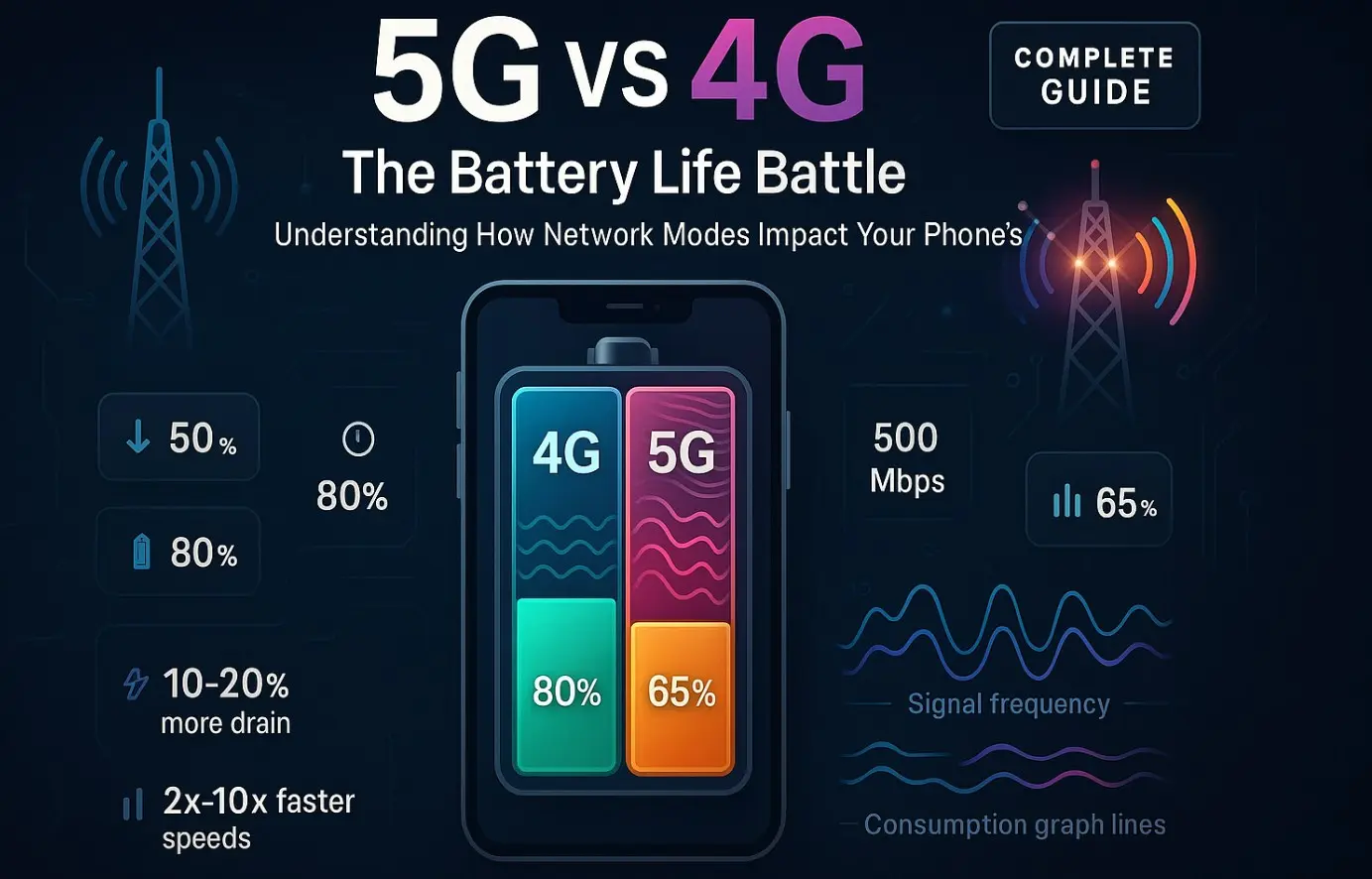
A 5G connection can consume more power under certain conditions, particularly when the signal is weak or the phone has to work harder to maintain connectivity. However, a strong 5G connection can also transfer large amounts of data quickly, potentially reducing the time the radio needs to remain active. Qualcomm testing has found that the relationship between 5G and battery life is more nuanced than simply saying 5G always drains batteries faster.
The lte vs 5g battery debate sounds simple: 5G is newer and faster, so it must use more power. That assumption is understandable, but it misses how modern smartphones manage wireless connections. Battery consumption depends on much more than whether the status bar says LTE or 5G.
Why People Think 5G Drains Batteries Faster
There is a logical reason behind the perception.
5G can deliver much higher data rates than older mobile technologies, and cellular connectivity requires energy from several components inside the phone. The modem, radio-frequency front end, antennas, processor, and display can all contribute to overall power consumption.
Early generations of 5G smartphones also had to deal with less mature hardware and network implementations. Some early devices used separate LTE and 5G modem components, creating additional power-management challenges. Qualcomm noted that later generations could improve efficiency through greater integration between modem, radio-frequency components, and other circuitry.
That history helped establish the idea that 5G automatically means shorter battery life.
Modern smartphones are more complicated than that.
Battery Drain Is a System-Wide Issue
Your phone does not have a separate battery meter for its cellular modem.
When you stream video over 5G, for example, the display, processor, speakers, storage, application, and network hardware may all consume power simultaneously.
That means blaming 5G alone can be misleading.
GSMA’s battery measurement methodology specifically treats power consumption as something that needs to be evaluated across defined usage scenarios rather than reduced to one universal figure.
A Strong 5G Signal Can Actually Be Efficient
Here is where the battery argument gets interesting.
A faster connection can complete a data transfer more quickly. If your phone needs to download a large file, a capable 5G connection may finish the task substantially sooner than a slower LTE connection.
Qualcomm’s testing found that although 5G could have higher current consumption during some periods, its greater data-transfer efficiency could offset that difference when handling large amounts of data under good radio conditions.
Think of it like driving.
A vehicle that travels faster does not necessarily consume more fuel over a fixed journey if it spends less time travelling. Smartphone power behaviour works differently from fuel consumption, but the basic idea is useful: power used per moment and total energy used for a task are not the same thing.
Speed Can Reduce the Time Spent Transmitting
Suppose you need to download a large file.
A slower connection may keep the cellular radio active for longer. A faster 5G connection may transfer the same data in less time.
That does not guarantee better battery life, because network conditions and device design vary. It does explain why “5G is faster” and “5G uses more power” do not automatically lead to “5G always gives you worse battery life.”
Weak 5G Can Be a Different Story
Signal conditions can change the equation.
When your phone has difficulty maintaining a reliable cellular connection, it may have to work harder to communicate with the network. Constantly switching between technologies or dealing with poor radio conditions can also affect power consumption.
This is one reason you might notice faster battery drain in locations where 5G coverage is inconsistent.
Coverage Matters More Than the 5G Icon
Seeing “5G” on your screen tells you that the phone is connected to a 5G network, but it does not tell you how efficiently that connection is operating.
A strong, stable 5G signal can be very different from a marginal connection at the edge of coverage.
If your phone repeatedly moves between 5G and LTE while you travel through areas with inconsistent coverage, the overall experience may also differ from staying on a stable LTE connection.
LTE Can Sometimes Be the Better Battery Choice
LTE is not an inefficient technology simply because 5G exists.
A stable LTE connection can use relatively little power for ordinary activities, particularly when you do not need high bandwidth.
If you are checking messages, reading articles, listening to music, or occasionally browsing social media, there may be little practical benefit from maintaining maximum cellular performance.
Everyday Tasks Rarely Need Maximum Speed
Most smartphone activities do not continuously demand hundreds of megabits per second.
Messaging applications transfer relatively small amounts of data. Email is lightweight. Navigation downloads map information incrementally. Audio streaming typically requires far less bandwidth than high-resolution video.
For these activities, the difference between a good LTE connection and a good 5G connection may be difficult to notice.
And if the 5G connection is weak, LTE may provide the more efficient experience.
Your Screen May Matter More Than Your Network
It is easy to focus on cellular connectivity when discussing battery life, but the display can be a major contributor to overall smartphone power consumption.
Brightness, refresh rate, screen-on time, gaming, camera use, and demanding applications can all have substantial effects on how long your battery lasts.
Qualcomm’s battery research emphasizes that smartphone-level power consumption includes the display, modem, CPU, GPU, sensors, and other components rather than the cellular connection alone.
This is why two people with identical 5G connections can experience very different battery life.
Usage Habits Can Overwhelm the Network Difference
Someone who spends four hours watching high-resolution video may consume much more battery than someone who spends the same amount of time reading text.
Likewise, a gamer running a graphics-intensive title can place heavy demands on the processor and display regardless of whether the phone uses LTE or 5G.
If your battery is disappearing unusually quickly, check the complete usage picture before blaming the network generation.
5G Battery Drain Can Depend on Your Phone
The smartphone itself plays an important role.
Different devices use different modems, processors, antenna designs, power-management systems, software configurations, and batteries.
Modern 5G modem systems have increasingly focused on power efficiency. For example, newer modem platforms incorporate power-saving technologies and tighter integration between the modem and radio-frequency system.
That means comparing “5G battery life” between two phones without considering their hardware can produce misleading conclusions.
Older 5G Phones May Behave Differently
If you own an early-generation 5G smartphone, its power efficiency may not represent what newer devices can achieve.
Advances in semiconductor manufacturing, modem design, antenna tuning, software optimization, and power-management technology have changed the efficiency equation.
Your phone’s age can therefore matter almost as much as your choice between LTE and 5G.
What Actually Affects Your Battery Most?
The battery impact of mobile connectivity is best understood as a combination of factors rather than a simple LTE-versus-5G switch.
The Biggest Factors to Watch
- Signal quality: Poor cellular conditions can increase the work required to maintain a connection.
- Data activity: Large downloads and uploads keep network hardware active for longer, although faster 5G can sometimes complete them sooner.
- Screen time: Display usage can be a major contributor to overall battery consumption.
- Device hardware: Modem generation, processor efficiency, antenna design, and battery capacity all matter.
- Network switching: Moving between LTE and 5G can affect power consumption depending on the device and network configuration.
- Background activity: Applications constantly syncing data can consume power regardless of whether the phone uses LTE or 5G.
This is why there is no universal percentage that tells you exactly how much more battery 5G will consume.
Should You Turn Off 5G to Save Battery?
For some users, switching to LTE can make sense if they are experiencing poor 5G coverage or simply do not need the additional performance.
But turning off 5G is not automatically the best battery-saving strategy.
If your 5G connection is strong and your phone has an efficient modern modem, the battery difference may be modest. If 5G coverage in your usual locations is weak or inconsistent, LTE may provide a more stable experience and potentially reduce unnecessary network activity.
The best setting depends on your device, carrier, location, and usage.
Where Giga Fits Into the Battery Question
For a Giga user, choosing between LTE and 5G should involve more than maximum download speed. If you regularly use mobile data for video streaming, large downloads, hotspot connections, or uploads, 5G can provide meaningful performance benefits. If your usage is lighter and your 5G coverage is inconsistent, reliable LTE may be perfectly practical.
The goal is not to avoid 5G because of battery concerns. It is to use the connection that provides the right balance of performance, coverage, and power consumption for your routine.
The Battery Verdict: 5G Is Not Automatically the Culprit
So, does 5G drain your battery faster?
Sometimes, but not universally.
A weak 5G connection, demanding data activity, frequent network changes, or inefficient hardware can contribute to higher battery consumption. At the same time, a strong 5G connection can transfer large amounts of data efficiently and finish tasks faster. Research from Qualcomm demonstrates why the relationship cannot be reduced to a simple rule that LTE always saves more battery than 5G.
If your phone loses battery unusually quickly, look beyond the 5G symbol. Check signal quality, screen usage, background applications, device age, network behaviour, and the type of activities consuming the battery.
The real lte vs 5g question is therefore not which technology uses more power in every situation. It is which connection gives your particular phone the best combination of coverage, performance, stability, and efficiency.
That is a much more useful way to judge whether keeping 5G enabled is worth it.
