

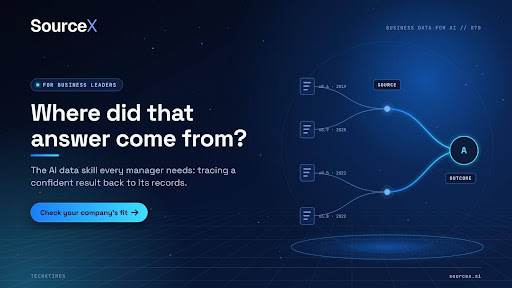
Before you trust a confident AI answer, trace it back to its source, its version, its permissions and its timing.
Sponsored content from SourceX
Before you trust a confident AI answer, trace it back to its source, its version, its permissions and its timing.
Imagine an AI assistant answering in four seconds. It cited an internal policy document, summarised it neatly and sounded entirely sure of itself. Around the meeting table, heads nodded.
Nobody asked the question that mattered: which version of the policy was that?
It was last year’s. The answer was beautifully written and wrong.
THE SHORT VERSION
- AI data literacy for managers means tracing an answer back to its records, not just reading the output.
- Provenance, timing, permission and outcome evidence decide whether a result deserves trust.
- You can challenge an AI result with four plain questions and no technical background.
What does AI data literacy mean for a manager?
AI data literacy includes understanding evidence, uncertainty and appropriate use. One practical habit for managers is following a result back to the records and decisions that produced it.
A citation tells you where an answer points. Provenance helps you judge its reliability.
Think of it as the difference between reading a headline and checking who reported the story, when, and on what evidence. Managers already do this instinctively with people. AI outputs deserve the same scrutiny.
Once you have that habit, you can interrogate any AI output in a meeting without inspecting a single line of model code.
Provenance: the history behind the answer
Data provenance describes where information came from and how it was produced or changed. Lineage usually focuses on its path through systems and transformations. Organisations use these terms differently, so agree local definitions with your data team.
The W3C PROV standard offers a formal way to express relationships between data, the activities that produced it and the people or systems responsible. You don’t need to learn the standard. You need to be able to ask whether your organisation can explain the history behind a result.
A source label is the beginning of that explanation, never the whole of it.
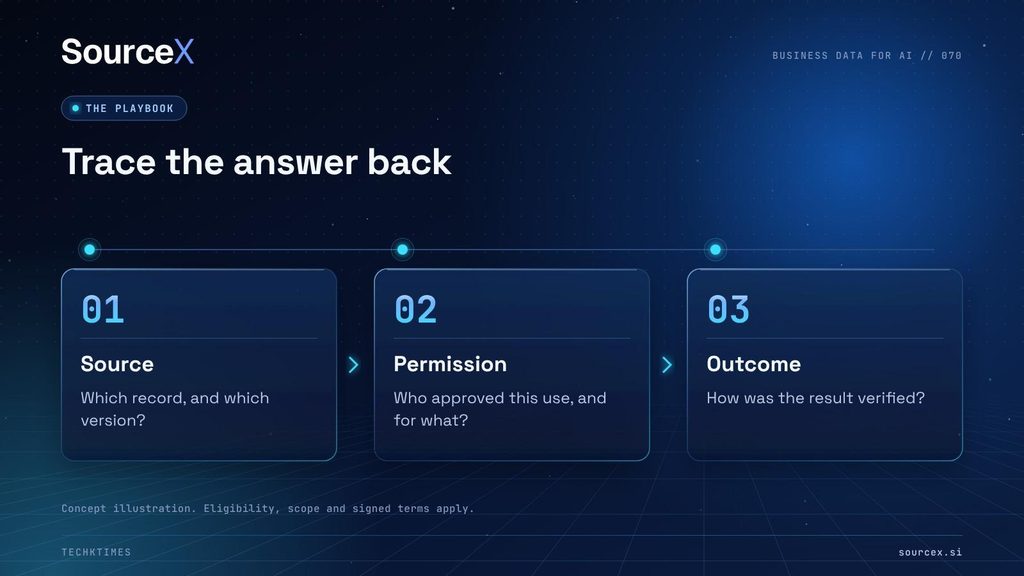
Trace the answer back: Source, Permission, Outcome. Concept illustration, not measured performance or a completed transaction.
Timing changes what the evidence means
A procedure updated yesterday may be right for today’s question and wrong for judging a decision made last year.
Here’s an illustrative trap. An AI system is being evaluated on historical customer service cases. Each case file includes a closing note that explains how things turned out. If the system sees that note before making its “decision”, the test no longer resembles the real task. It’s grading itself with the answer sheet open.
So ask: which information was the system allowed to use, and why? That question can expose a flaw worth investigating before anyone relies on the score.
Is “available” the same as “allowed”?
No, and this is where many organisations get caught out.
A document can be technically accessible while still restricted for a particular person or purpose. Company systems hold customer content, licensed material and confidential discussions side by side. Internal use and an external AI licence may need entirely different reviews.
The fact that a file turns up in a searchable repository doesn’t settle whether the company can grant anyone new rights over it. The authorised owner and the appropriate reviewers should draw that line.
Outcomes need interpretation
A closed ticket is not always a solved problem. A completed workflow can still contain an unauthorised step. An elegant response can leave the underlying system unchanged.
Picture an illustrative dashboard reporting that an AI agent “resolved” 90% of requests. Resolved could mean the customer’s problem was fixed. It could also mean the ticket was auto-closed after a week of silence. Same word, very different story.
When someone shows you a score or a label, ask how it was established. Is it a verified result, an administrative status, or someone’s interpretation after the fact? The answer decides what conclusions the output, or the dataset behind it, can support.
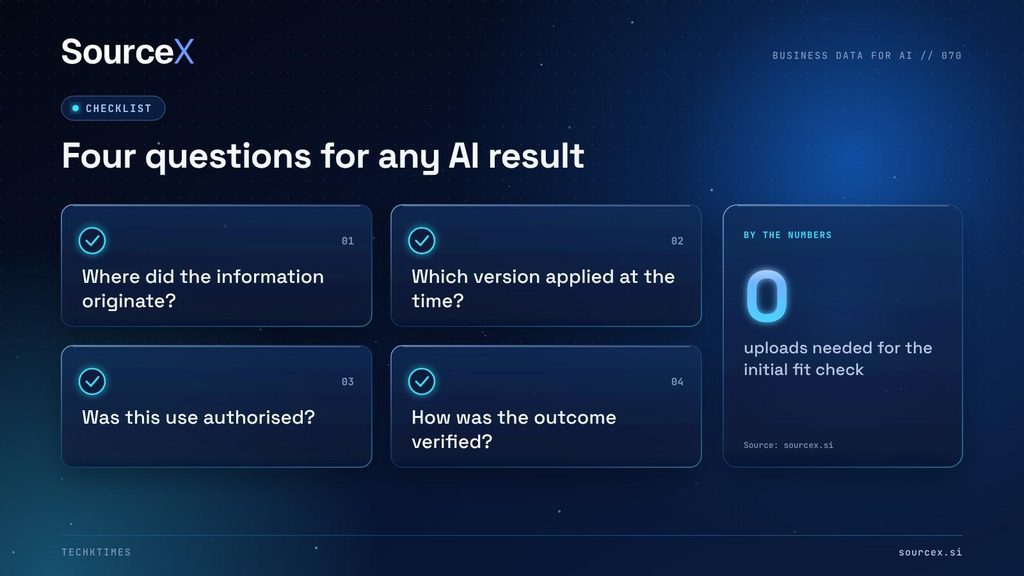
Four questions for any AI result. Four takeaways from the article; the text supplies the full context and conditions.
The same questions decide whether records can be licensed
These questions don’t only protect decisions. They also shape whether a company’s records could be licensed at all.
SourceX licenses approved business data directly from companies for AI training and evaluation. The organisation signs with SourceX, which manages the agreement, preparation and payout under signed terms. It advertises payouts of up to $4 million, a figure that marks the upper bound for the largest enterprise datasets and is not a typical or guaranteed payout; the specific records and transaction decide compensation.
The core fit is an organisation with 50+ full-time staff at peak and several years of operating history, and the initial fit check runs on company information, with no customer or employee records and no uploads.
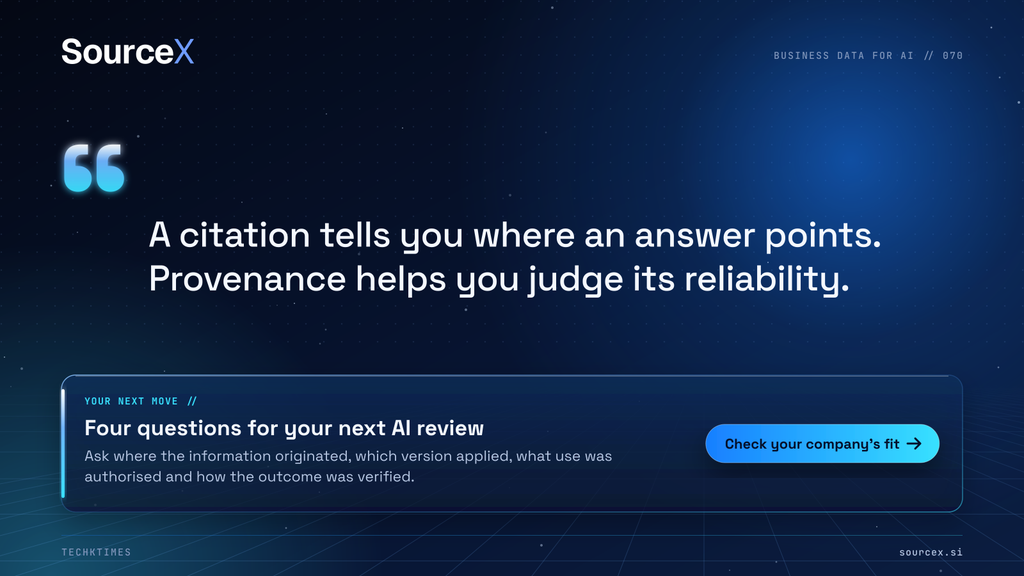
Four questions for your next AI review. Ask where the information originated, which version applied, what use was authorised and how the outcome was verified.
What should a manager ask in the next AI review?
Take four questions into the room:
- Where did this information originate?
- Which version applied at the relevant time?
- What use was authorised?
- How was the outcome verified?
None of them require a technical background, and any one of them can stop a confident mistake before it reaches a decision. Next time the assistant answers in four seconds, take four more to ask which version it read.
If those four questions reveal a company licensing opportunity, start with SourceX‘s fit check. Describe the business first and keep the underlying records in place.
About the founder
Noah Loul is a four-time founder and the founder and CEO of SourceX, which licenses business data directly from companies for AI training and evaluation. He previously founded B2B Rocket, acquired by Blackpearl Group. His work focuses on building permission-based data infrastructure for AI.
