

In the fast-paced ecosystem of software engineering, deep tech, and enterprise SaaS, product superiority is often treated as the ultimate competitive moat. Early-stage founders operate under the conviction that lower latency, cleaner APIs, and automated workflows will inherently win market share.
Yet, as tech companies mature beyond the initial traction phase and target seven-figure enterprise contracts, institutional capital, or international expansion, a recurring barrier appears. Sales cycles drag out, procurement committees stall evaluations, and lesser-featured legacy incumbents continue to win high-stakes tenders.
The underlying friction is rarely technological; it is perceptual. While software functions on logic, enterprise procurement operates on institutional risk mitigation. Without an authoritative, cohesive corporate brand system, even breakthrough technology platforms are evaluated as volatile startup risks rather than enduring enterprise partners.
The Shift from Product Utility to Institutional Trust
In the early lifecycle of a technology venture, branding is typically treated as a superficial layer: a vector logo, an open-source font pairing, and functional UI elements tailored for developer onboarding. This lightweight approach works well during the product-led growth (PLG) phase, where the primary objective is friction-free adoption by individual practitioners.
However, moving upmarket to enterprise buyers alters the decision-making criteria fundamentally:
- The Practitioner evaluates interface ergonomics, feature availability, and developer documentation.
- The Department Head analyzes productivity gains, implementation friction, and cross-team integration overhead.
- The Enterprise Buyer (CFO, CISO, CIO) evaluates governance, operational longevity, compliance, and organizational reputation.
When a global enterprise commits to an operational platform, switching costs run into millions of dollars. The executive decision-maker is not merely purchasing software; they are staking their professional reputation on the vendor’s long-term viability. A fractured visual presence and disjointed messaging signal internal turbulence, immediately triggering hesitation during enterprise security and financial audits.
The Three Symptoms of Technical Brand Debt
Just as software accumulates technical debt when short-term fixes supersede scalable architecture, growing tech organizations accumulate brand debt. This debt typically surfaces across three key areas:
- Portfolio Fragmentation After Product Expansion: As companies scale, they frequently launch secondary platforms, acquire smaller point solutions, or split into specialized industry verticals. Without a defined brand hierarchy, each product team creates isolated visual identities and marketing sub-domains. The result is market dilution, where existing customers remain unaware of the company’s broader ecosystem capabilities.
- The Generic Positioning Trap: In sectors such as artificial intelligence, cloud infrastructure, and fintech, visual identity has converged toward homogenous aesthetics: ubiquitous dark-mode dashboards, identical geometric sans-serif typefaces, and interchangeable abstract particle animations. When visual language is indistinguishable from hundreds of emerging competitors, pricing power evaporates, forcing the company to compete on margin-destroying discounts.
- Misalignment Between Enterprise Pricing and Startup Polish: Attempting to sell an annual enterprise contract valued at £250,000 using digital assets, pitch decks, and brand collateral designed during a seed-stage hackathon creates immediate cognitive dissonance. High-ticket B2B clients demand proof of maturity before signing multi-year agreements.
Structuring a Multi-Market Corporate Brand Architecture
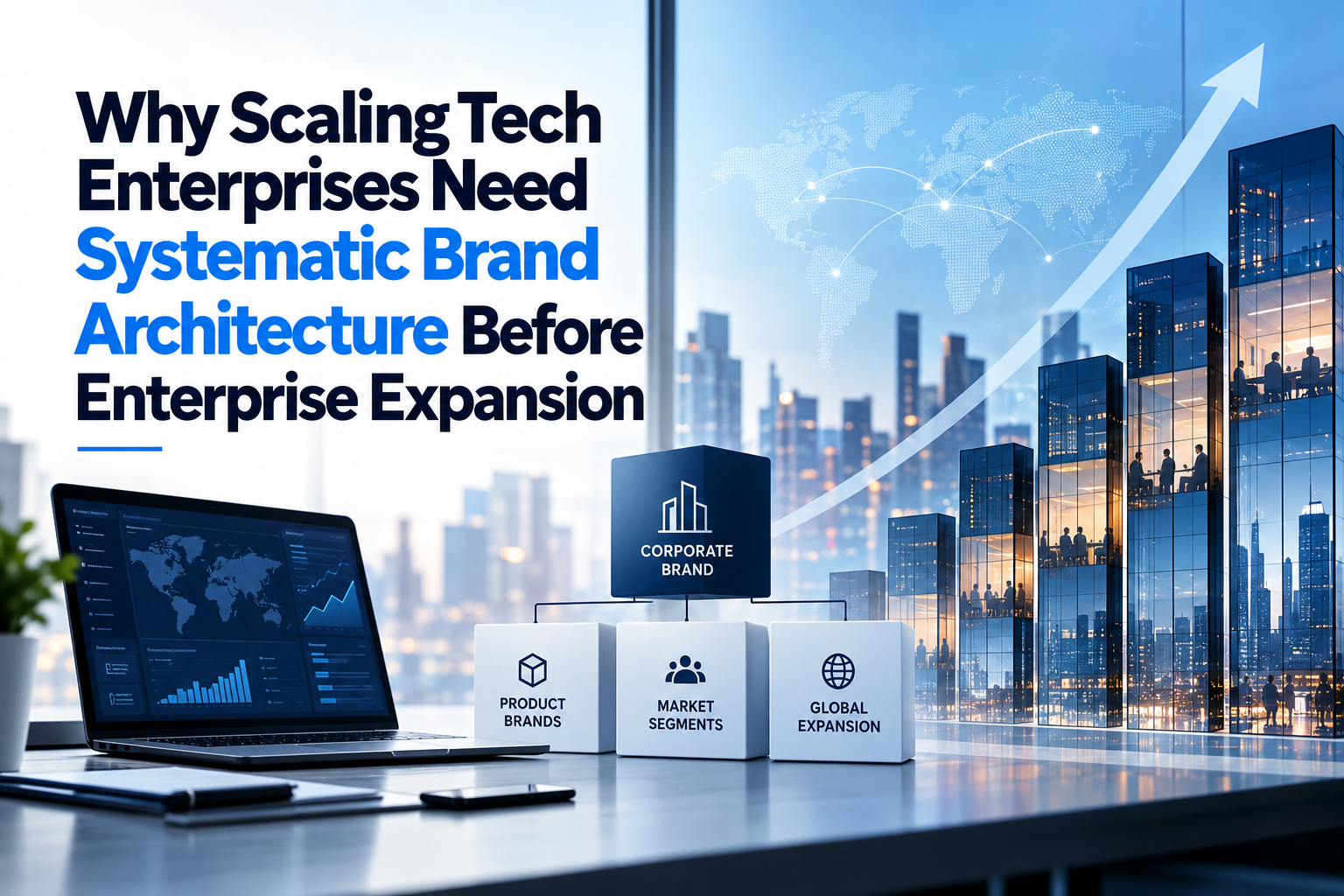
Resolving brand debt requires treating identity as a systematic engineering discipline rather than a subjective artistic exercise. For organizations expanding across borders—such as UK and European tech firms scaling into North America, the Middle East, or Asia-Pacific hubs—brand systems must balance global gravitas with regional market nuances.
This strategic inflection point is where forward-thinking technology leadership engages specialized corporate branding services to formulate comprehensive brand architectures. An experienced corporate branding partner audits existing equity, restructures product hierarchies, and builds multi-tier design systems that align parent-company governance with market-facing agility.
A scalable corporate brand infrastructure delivers three core pillars:
- Programmatic Design Systems: Tokenized design assets that synchronize directly between design repositories and production code, maintaining visual consistency across web, enterprise portals, and native software.
- Segmented Brand Messaging: A layered messaging matrix that addresses board-level risk mitigation, executive ROI, and operator workflows without contradictory claims.
- Global Cultural and Script Compatibility: Typography and layouts engineered to support multi-language localizations, including right-to-left (RTL) scripts such as Arabic and complex character sets, without breaking layout integrity.
Quantifying Brand Equity in Enterprise Tech
While consumer brand valuation relies heavily on emotional recall and affinity, B2B corporate brand impact manifests directly in core operational and financial metrics:
Customer Acquisition Cost (CAC) Efficiency: When corporate positioning establishes an organization as a category creator, inbound inquiry quality rises. Prospects enter sales funnels pre-sold on the platform’s methodology, shortening introductory qualification sequences and lowering aggregate blended acquisition costs.
Average Contract Value (ACV) Expansion: Market leaders command premium multiples. A mature brand profile provides the institutional justification for pricing structures that reflect true business impact rather than basic feature parity, unlocking larger upfront enterprise commitments.
Talent Attraction and Retention Moats: Top-tier engineering, product, and go-to-market executives assess prospective employers through public-facing brand authority. A compelling, mission-driven brand architecture signals market momentum, making it significantly easier to recruit high-performing talent in competitive markets.
The Defensibility Mandate in the Age of Automated Software
As artificial intelligence and automated development tools compress the time and capital required to build software, technical features will face rapid commoditization. Functionality that once took years to build can now be replicated in quarters.
In an environment where code is increasingly abundant, enterprise trust becomes the scarcest asset in the market. The technology companies that establish enduring market capitalization will not be those with isolated, incremental feature advantages, but those that establish authoritative, category-defining corporate brands. For tech enterprises navigating the chasm from rapid growth to permanent industry leadership, systematic brand architecture is the definitive foundation for sustained market valuation.
