

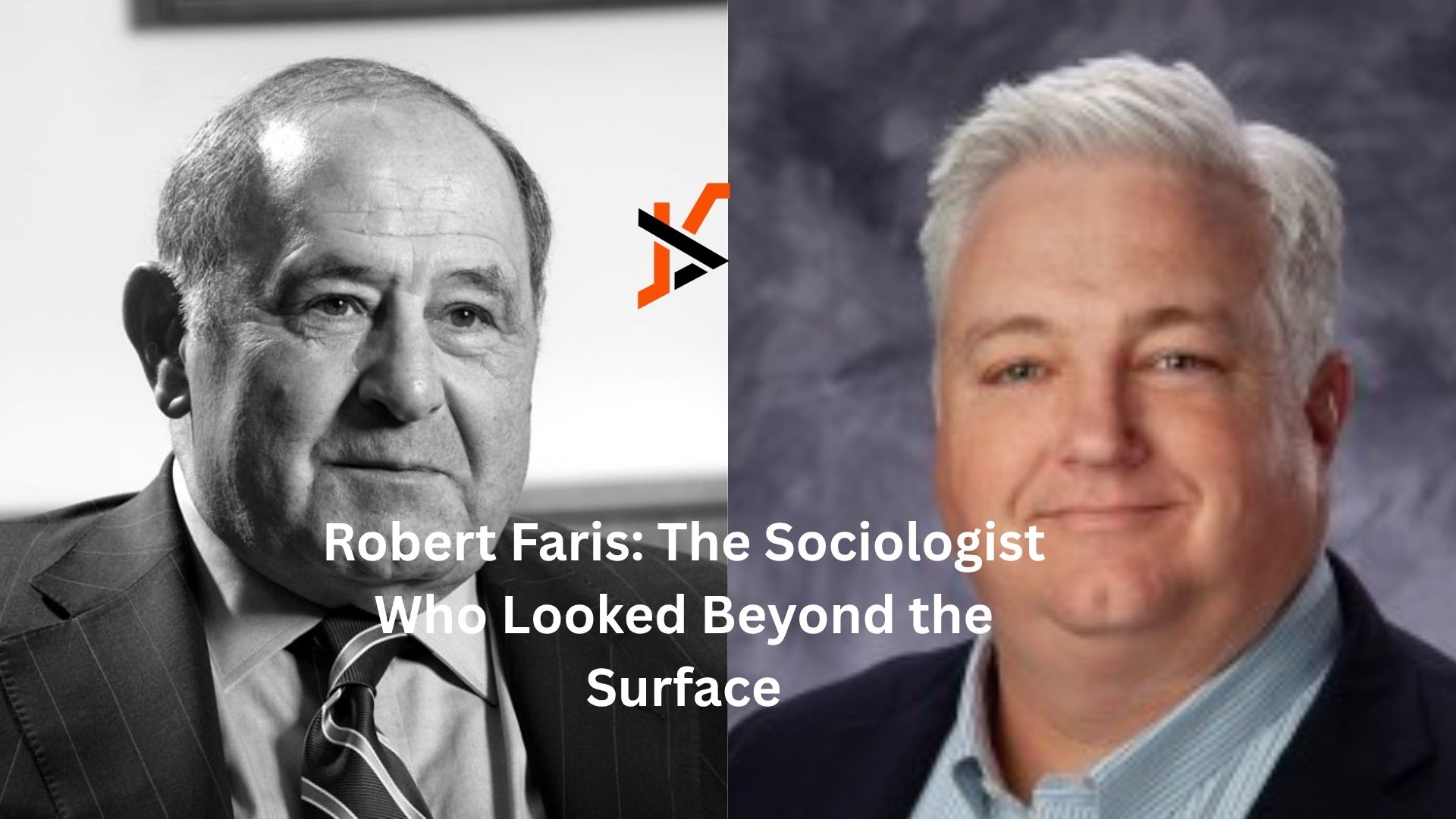
Most people don’t spend much time thinking about sociology. It’s one of those subjects that quietly sits in the background while louder fields grab attention. Economics talks money. Psychology talks emotions. Politics talks power. Sociology? It studies the patterns hiding underneath everyday life.
Robert Faris understood that better than most.
He wasn’t a celebrity academic. He didn’t build a public persona or become a household name. But his work shaped how people think about cities, social behavior, mental health, and human relationships. If you’ve ever heard someone say that environment influences behavior more than individual character alone, you’re already brushing against ideas Faris helped develop.
And honestly, his work still feels surprisingly modern.
The world he studied looked different on the surface — crowded early 20th-century cities, immigrant neighborhoods, changing industries — but many of the same social tensions exist today. Isolation. Group identity. Urban stress. Social pressure. Online communities replacing local ones. Different tools, same human struggles.
That’s what makes Robert Faris worth revisiting.
A Quiet Figure in American Sociology
Robert Ezra Park often gets the spotlight when people talk about early sociology in Chicago. Ernest Burgess too. Robert Faris tends to sit a little farther back in the conversation, even though his contributions were deeply influential.
Born in 1907, Robert E. L. Faris became part of the Chicago School of Sociology, one of the most important intellectual movements in American social science. The Chicago School wasn’t just interested in theories floating around in books. These researchers walked streets, studied neighborhoods, interviewed ordinary people, and treated cities almost like living organisms.
That practical approach mattered.
Instead of seeing social problems as isolated incidents, Faris and his colleagues looked for patterns. Why did crime cluster in certain areas? Why did mental illness appear more often in socially unstable neighborhoods? Why did some communities hold together while others fractured?
These questions sound obvious now, but at the time they pushed sociology into new territory.
Faris wasn’t interested in simple explanations. Human behavior rarely works that way.
The Famous Study That Changed Mental Health Research
One of Faris’s most important works came through his collaboration with Warren Dunham. Together, they published Mental Disorders in Urban Areas in 1939.
At first glance, the title sounds dry. Very academic. But the ideas inside were powerful.
Here’s the basic concept: they studied rates of mental illness across different neighborhoods in Chicago and found strong links between social conditions and psychiatric disorders.
That may not sound groundbreaking today because modern conversations constantly connect environment and mental health. But back then, many people viewed mental illness almost entirely through biological or moral lenses. If someone struggled psychologically, society often blamed personal weakness or heredity.
Faris and Dunham complicated that narrative.
They discovered that schizophrenia rates were significantly higher in areas marked by poverty, instability, overcrowding, and social disorganization. Wealthier neighborhoods showed different patterns.
Now, they weren’t claiming environment alone caused mental illness. That’s an important distinction. But they argued social conditions played a much larger role than many experts admitted.
It shifted the conversation.
Imagine living in a neighborhood where families move constantly, jobs disappear overnight, crime feels unavoidable, and trust between neighbors barely exists. Even today, most people recognize that kind of instability wears people down mentally. Faris saw those links decades before public discussion caught up.
Chicago Was Basically His Laboratory
The Chicago School loved cities because cities reveal human behavior in concentrated form.
And Chicago in the early 1900s was intense.
Immigration surged. Industry exploded. Neighborhoods transformed almost overnight. Ethnic communities formed tight enclaves while economic inequality widened. It was messy, chaotic, fascinating territory for sociologists.
Faris approached the city less like a statistician locked in an office and more like an observer trying to understand real life as it unfolded.
That perspective gave his work texture.
He wasn’t just analyzing numbers. He cared about how people adapted socially under pressure. What happened when traditional communities broke apart? What happened when people felt disconnected from institutions around them?
These questions still feel current.
You can see echoes of Faris’s concerns in conversations about social media isolation, suburban loneliness, rising anxiety, and fractured communities today. The setting changed, but the core issue remains: human beings are social creatures, and unstable social environments affect us deeply.
He Helped Expand How Sociology Thinks About Human Behavior
One thing that made Faris interesting was his refusal to reduce people to single causes.
That sounds simple, but it’s harder than it looks.
A lot of public debate even now falls into lazy binaries. Either behavior is individual responsibility or social conditioning. Either biology matters or environment matters. Either society shapes people or people shape society.
Faris pushed against that kind of oversimplification.
He understood social systems influence individuals while individuals also influence systems. Human behavior emerges from layers — family, neighborhood, economics, culture, opportunity, relationships, stress, identity.
Life is messy. His sociology reflected that.
And frankly, that’s part of why his work aged relatively well compared to some other early theorists whose ideas now feel rigid or dated.
The Human Side of Social Research
Here’s something people often forget about sociology: behind every data point is an actual person.
A struggling worker. A lonely teenager. A family under pressure. Someone trying to survive circumstances larger than themselves.
Faris seemed to understand that intuitively.
His work avoided some of the cold detachment that creeps into social science. Even when discussing broad patterns, there’s an underlying recognition that social conditions have emotional and psychological consequences.
That’s important because numbers alone rarely persuade people.
For example, if someone says, “Neighborhood instability correlates with mental health challenges,” that’s intellectually interesting. But when you imagine a child growing up in constant uncertainty — changing schools, unstable housing, strained family finances — the idea becomes emotionally real.
Faris connected social structures to lived experience.
That helped sociology become more than abstract theory.
Why His Ideas Still Matter
A lot of thinkers become trapped in their era. Their work only makes sense within old historical debates.
Robert Faris isn’t entirely like that.
The specifics of his research belong to another time, sure. But the broader ideas remain incredibly relevant.
Take modern cities.
Today, urban life comes with new forms of stress: rising housing costs, digital isolation, gig economy instability, fragmented communities. People can live surrounded by millions and still feel socially disconnected.
Faris would’ve found that fascinating.
He consistently emphasized that social organization matters. When communities weaken, when people lose stable social bonds, consequences follow. Sometimes psychological. Sometimes behavioral. Sometimes political.
You can see versions of this everywhere now.
People searching for belonging online because local communities feel thin. Rising anxiety among young adults. Distrust between institutions and ordinary citizens. Even the way neighborhoods change through rapid gentrification reflects themes Faris explored decades ago.
His work reminds us that society isn’t just a backdrop. It actively shapes how people experience life.
Not Every Idea Was Perfect
To be fair, some aspects of early sociology haven’t aged perfectly.
Certain Chicago School theories sometimes leaned too heavily on environmental explanations while underestimating biology or individual agency. Some terminology also reflects outdated assumptions common in that era.
That’s normal for intellectual history.
No serious thinker gets everything right forever.
But dismissing Faris because parts of the framework evolved would miss the bigger picture. His core insight — that social conditions deeply affect human behavior and mental well-being — remains widely accepted.
Modern public health research, urban studies, psychology, and sociology all build on variations of that idea.
Sometimes foundational thinkers don’t look revolutionary in hindsight because their ideas became normal.
That’s actually a sign of influence.
The Difference Between Observation and Judgment
One subtle thing Faris did well was observe without immediately moralizing.
That’s harder than it sounds.
Society loves simple judgments. Good neighborhoods. Bad neighborhoods. Responsible people. Irresponsible people. Strong communities. Broken communities.
Faris tried to understand systems instead of jumping straight into blame.
If crime increased somewhere, he wanted to know what social structures weakened. If mental illness clustered in specific areas, he examined environmental pressures rather than assuming personal failure.
That approach feels useful right now because modern conversations often become emotionally charged very quickly. People rush toward outrage before curiosity.
Faris leaned toward curiosity.
And curiosity usually leads to better understanding.
Sociology Became More Human Because of Researchers Like Him
There’s a tendency to think social science is all charts and surveys. But researchers like Robert Faris helped make sociology more grounded in actual human experience.
They treated cities as ecosystems shaped by relationships, institutions, migration, stress, economics, and culture all interacting at once.
That complexity matters.
Real life rarely has single explanations.
For instance, imagine two teenagers growing up in different environments. One has stable schools, trusted adults, safe streets, and predictable routines. The other grows up amid instability, violence, and economic uncertainty.
Even with similar intelligence or personality, their outcomes may diverge dramatically.
That doesn’t erase personal responsibility. But it highlights how environment influences possibility.
Faris spent much of his career exploring those dynamics.
His Legacy Isn’t Loud — But It’s Everywhere
Robert Faris isn’t the kind of historical figure who gets movies made about him. You probably won’t see inspirational quotes from him all over social media either.
His influence works differently.
It exists inside modern assumptions about social health, urban stress, mental illness, and community structure. It lives in public policy debates about housing, neighborhood investment, and social services. It shows up whenever researchers study how environments shape behavior.
That’s a substantial legacy, even if it’s quiet.
And maybe there’s something fitting about that.
Sociology itself often operates quietly. It notices patterns other people overlook. It asks uncomfortable questions about systems most people take for granted. It forces society to examine conditions beneath the surface instead of focusing only on individual stories.
Faris helped push that perspective forward.
Final Thoughts on Robert Faris
Robert Faris belonged to a generation of thinkers trying to understand rapid social change in modern America. Instead of reducing people to moral judgments or isolated biology, he explored the powerful influence of social environments on human behavior and mental health.
That idea still resonates because it reflects everyday reality.
People are shaped by where they live, who surrounds them, what pressures they face, and whether they feel connected to a stable community. We know this instinctively even before reading a single sociology book.
Faris simply studied it carefully and gave language to patterns many people sensed but couldn’t fully explain.
And honestly, his work feels more relevant now than it has in years.
Modern life is increasingly connected digitally while becoming fragmented socially. Communities shift faster. Institutions feel weaker to many people. Mental health conversations are everywhere. Questions about belonging, stress, and social stability dominate public discussion.
Robert Faris spent his career looking directly at those kinds of issues long before they became mainstream topics.
That’s why his name still matters. Not because he chased attention, but because he paid attention to how people actually live.

