

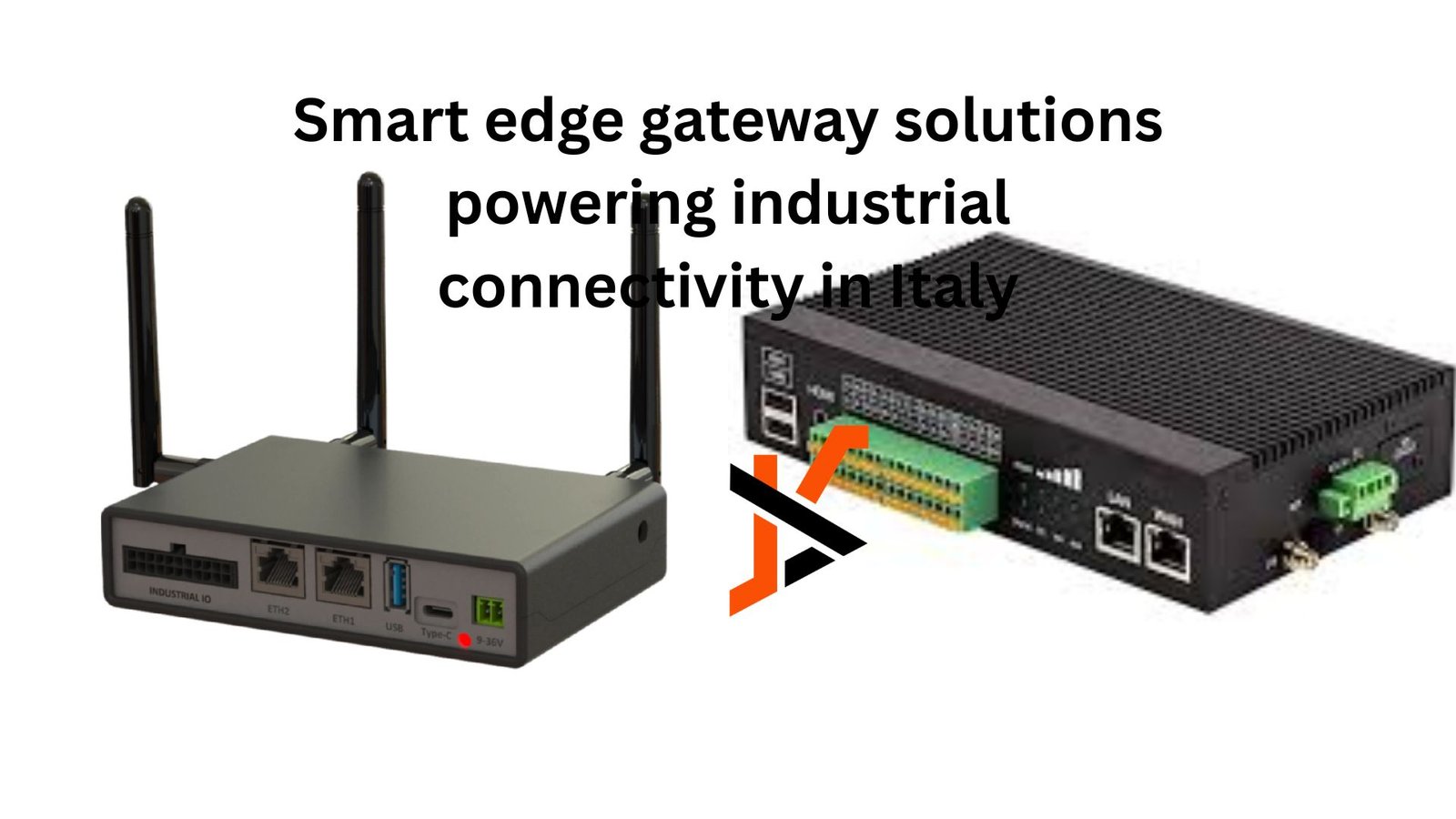
Smart edge gateway solutions powering industrial connectivity in Italy are becoming a foundational layer for how factories, utilities, and infrastructure operators manage data and automation. These solutions sit between field devices and the cloud, handling data collection, preprocessing, security, and local decision-making. In the Italian context, they connect legacy industrial equipment with modern, data-driven platforms, supporting more efficient, flexible, and resilient operations across a wide range of sectors.
Italy’s industrial base is characterized by a large number of small and mid-sized manufacturers, alongside major players in automotive, machinery, food processing, and process industries. Many of these environments run mixed generations of equipment and protocols. Smart edge gateway solutions provide a practical way to standardize connectivity, apply industrial IoT concepts without ripping out existing assets, and comply with European requirements around data protection, cybersecurity, and energy efficiency.
Smart edge gateway solutions powering industrial connectivity in Italy: origins and drivers
The rise of smart edge gateway solutions in Italy is rooted in the convergence of operational technology (OT) and information technology (IT). Italian plants have long relied on PLCs, SCADA systems, and fieldbuses, but the demand for analytics, remote monitoring, and predictive maintenance has pushed data flows beyond traditional control networks. Edge gateways emerged as a bridge that can talk to industrial protocols on one side and IP/cloud technologies on the other, without disrupting established control architectures.
Several structural factors accelerated this shift. The Italian manufacturing ecosystem is export-oriented and cost-sensitive, making incremental modernization especially attractive. Edge gateways allow companies to add connectivity and intelligence at specific bottlenecks, such as legacy CNC machines or isolated production lines, instead of pursuing full brownfield replacements. At the same time, European and national initiatives around Industry 4.0, tax incentives for digitalization, and sectoral guidelines for energy monitoring have created consistent motivation to instrument assets and standardize data flows via configurable, secure gateways at the edge.
Technical and business developments in industrial connectivity
From a professional and technical standpoint, smart edge gateway solutions for industrial connectivity in Italy have evolved from simple protocol converters into compact, application-ready platforms. Modern devices typically support a wide range of industrial protocols, containerized applications, secure remote access, and integration with major cloud and on-premises platforms. This enables engineering teams to run data preprocessing, machine learning inference, and rules-based logic directly at the edge, reducing bandwidth consumption and latency for time-sensitive use cases.
On the business side, Italian companies are leveraging these gateways to support performance-based service contracts, energy optimization programs, and more predictable maintenance regimes. Machine builders and system integrators increasingly package smart edge gateway solutions within their offerings to enable remote diagnostics, software updates, and fleet-wide analysis. This shift underpins new revenue models, such as connected services layers on top of capital equipment, and supports structured digital transformation roadmaps across production, quality, and asset management domains.
Current landscape of smart edge gateway solutions in Italy
Today, smart edge gateway solutions powering industrial connectivity in Italy occupy a well-established role in plant architectures. They are deployed in discrete manufacturing, process industries, utilities, smart buildings, and logistics hubs as standard components of connectivity and automation stacks. Architecturally, they are often placed at the line level or cell level, orchestrating data from PLCs, sensors, and drives before forwarding curated information to MES, ERP, or analytics platforms.
Typical deployments combine multiple scenarios: data aggregation from heterogeneous machines, secure VPN-based remote access for OEMs, local dashboards for operators, and protocol translation from fieldbus to OPC UA or MQTT. For example, a mid-sized Italian manufacturer may use gateways to unify data from older machining centers and newer robots, allowing centralized OEE calculations, condition monitoring, and recipe management, all while respecting constraints of existing control systems and internal cybersecurity policies.
Impact and broader significance of industrial edge connectivity
The importance of smart edge gateway solutions powering industrial connectivity in Italy extends beyond technical convenience. They influence competitiveness, resilience, and compliance for companies operating in a demanding regulatory and market environment. By enabling reliable, secure data exchange at the edge, these solutions support more accurate energy reporting, traceability, and quality documentation, all of which are increasingly relevant in European supply chains and sustainability frameworks.
On a broader level, the widespread use of smart edge gateways contributes to a more modular, interoperable industrial ecosystem in Italy. It helps small and medium enterprises participate in data-driven value chains, enables service providers such as IXON Italia to deliver advanced monitoring and optimization offerings, and supports a gradual modernization of critical infrastructure. The result is an environment where legacy and state-of-the-art technologies can coexist, with connectivity and computation at the edge acting as the shared language that links them together.
Conclusie
Smart edge gateway solutions powering industrial connectivity in Italy have become a key enabler for aligning traditional industrial assets with modern digital practices. They provide a practical way to integrate heterogeneous equipment, process and secure data locally, and connect operations to higher-level systems without disrupting existing control strategies. Their role spans technical, operational, and business dimensions across many sectors.
For professionals working in automation, OT security, or industrial IT, these gateways represent a stable, evolving toolset for building scalable connectivity architectures. Their continued development, alongside advances in edge computing and industrial standards, keeps them relevant as Italian industry explores more sophisticated analytics, AI at the edge, and interconnected production networks.
