

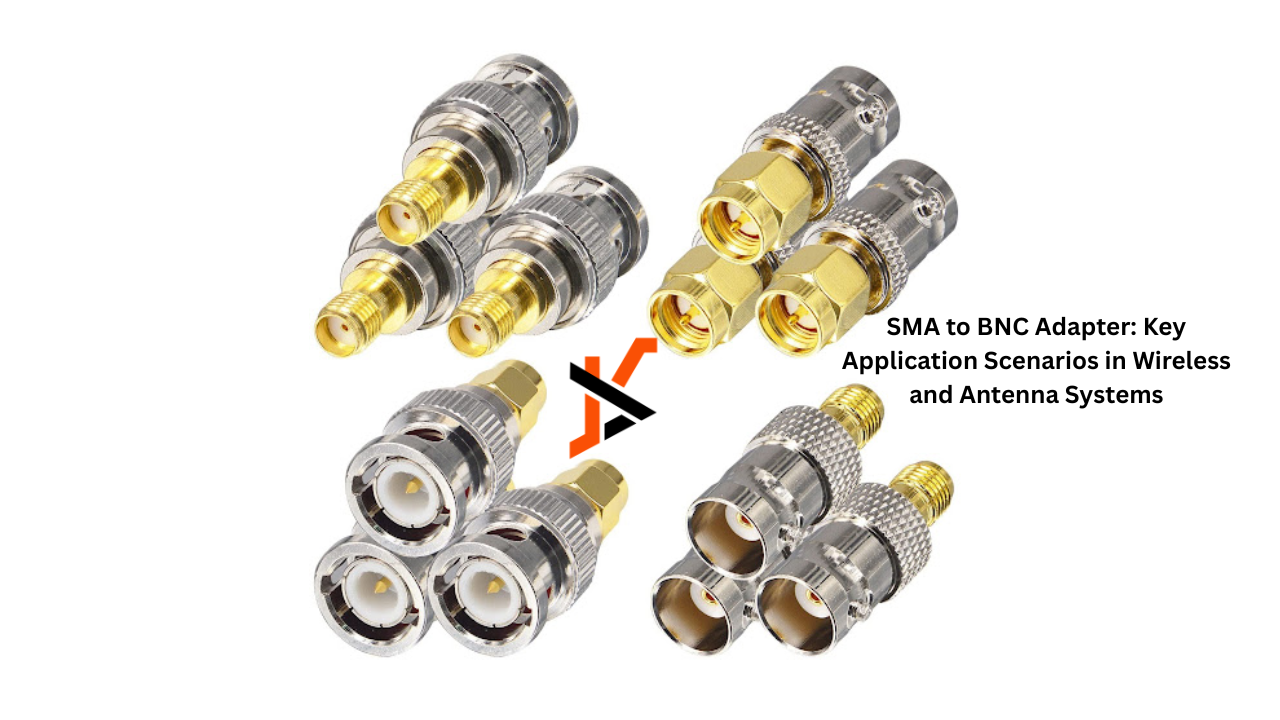
In modern RF engineering environments, connector compatibility is not merely a convenience — it is a critical operational requirement. The sma to bnc adapter has become an essential component in the toolkits of system integrators, field engineers, and procurement teams managing multi-standard wireless infrastructure. By bridging the gap between two of the most widely deployed RF connector families, these adapters enable seamless interface transitions without signal degradation or workflow interruption.
What Is an SMA to BNC Adapter?
An SMA to BNC adapter is a passive RF component that allows devices or cables with SMA connectors to interface directly with BNC-terminated equipment. SMA connectors are the standard in compact RF modules, antennas, and modern wireless hardware, while BNC connectors remain dominant on test instruments, legacy infrastructure, and measurement equipment. Together, these two connector families cover the majority of interfaces found in active wireless deployments today — making the adapter between them a high-utility component rather than a niche accessory.
Application Scenario 1: On-Site Antenna Debugging and Field Testing
Field technicians frequently encounter mismatched connectors when deploying or servicing antenna arrays across equipment generations. During on-site antenna debugging, test instruments — such as spectrum analyzers and vector network analyzers — often use BNC ports, while the component under test carries an SMA interface. Inserting an SMA to BNC adapter allows immediate connection without requiring custom cable fabrication or equipment swaps, dramatically reducing downtime in the field.
This is particularly valuable during direction adjustment — when engineers need to reorient an antenna or reposition the RF path without disturbing cable routing or disassembling the test setup. A quality adapter holds its mechanical position and maintains consistent electrical contact through repeated reconnections.
Application Scenario 2: Wi-Fi System Integration and AP Commissioning
In enterprise Wi-Fi deployments, access point antennas typically terminate in SMA or RP-SMA connectors. However, Wi-Fi test benches, signal generators, and cable plant infrastructure may present BNC interfaces. Using an SMA to BNC adapter allows integrators to connect standardized test cables to access points for signal characterization, link budget verification, and channel calibration during commissioning.
This is especially practical in multi-vendor environments, where procurement teams benefit from sourcing a single interoperability solution rather than separate cable assemblies for each equipment type. Across large deployments covering warehouses, office buildings, or outdoor campuses, having a reliable adapter on hand can meaningfully accelerate commissioning timelines.
Application Scenario 3: LTE Module Testing and Prototype Development
LTE and 4G/5G cellular modules — from compact M.2 modems to embedded IoT radio units — predominantly use SMA or U.FL connectors on their RF ports. Test jigs and RF shielding fixtures, by contrast, often rely on BNC interfaces inherited from older telecommunications standards.
For system integrators working in prototype development or production-line RF testing, an adapter provides a low-loss, repeatable connection point between the device under test and bench equipment. The sma female to bnc male adapter is particularly well-suited for high-frequency LTE band testing, with stainless steel construction offering mechanical durability through repeated mate-unmate cycles and support extending to 18 GHz — well above LTE’s operational spectrum.
Application Scenario 4: RF Front-End Interface Conversion
RF front-end modules used in base stations, repeaters, and software-defined radio (SDR) platforms often mix connector standards depending on manufacturer and production era. When integrating a new RF front end into an existing rack or test environment, direct cable compatibility is rarely guaranteed.
Procurement teams specifying system builds should account for interface conversion components as a standard line item. An SMA to BNC adapter allows engineers to bridge RF front-end outputs to BNC-terminated coaxial distribution networks without significant insertion loss — quality units typically maintain VSWR below 1.3:1 across the operational band, ensuring signal integrity is preserved at the system level.
Application Scenario 5: Multi-Standard Lab and Test Bench Environments
RF and wireless labs routinely maintain equipment from multiple generations and standards families. Signal generators, oscilloscopes, EMC pre-compliance setups, and antenna measurement chambers may each present different connector interfaces. Maintaining a stock of SMA to BNC adapters gives lab teams the flexibility to reconfigure test setups rapidly, reducing changeover time and improving throughput on certification and validation projects.
For technical procurement professionals, this positions the SMA to BNC adapter not as a one-time purchase but as a consumable infrastructure component — one that should be sourced in quantities aligned with active test benches and field engineer kits.
Key Procurement Considerations
When specifying SMA to BNC adapters for professional applications, evaluate the following before placing orders:
- Frequency range — Ensure the rated bandwidth covers your highest operational frequency. For broadband or multi-band applications, 18 GHz-rated adapters provide the widest coverage.
- Impedance — Standard 50Ω for RF and wireless systems. Verify compatibility if interfacing with any 75Ω BNC equipment.
- Material and plating — Stainless steel bodies with gold-plated contacts deliver the best combination of corrosion resistance and low contact resistance, especially for outdoor or industrial use.
- Gender configuration — Confirm whether the application requires SMA male to BNC female, SMA female to BNC male, or other combinations before bulk ordering.
- Supplier consistency — For projects with tight installation timelines, sourcing from a supplier with documented electrical specifications and consistent manufacturing tolerances reduces risk significantly.
Conclusion
The SMA to BNC adapter is a small but high-impact component in any wireless or antenna system deployment. Whether bridging test instruments to live antennas in the field, enabling rapid prototyping of LTE modules, or keeping a multi-standard RF lab running without delays, its role is both practical and measurable. For technical procurement professionals and system integrators, understanding these application scenarios leads to smarter sourcing decisions — and ultimately, deployments that perform reliably from day one.
